


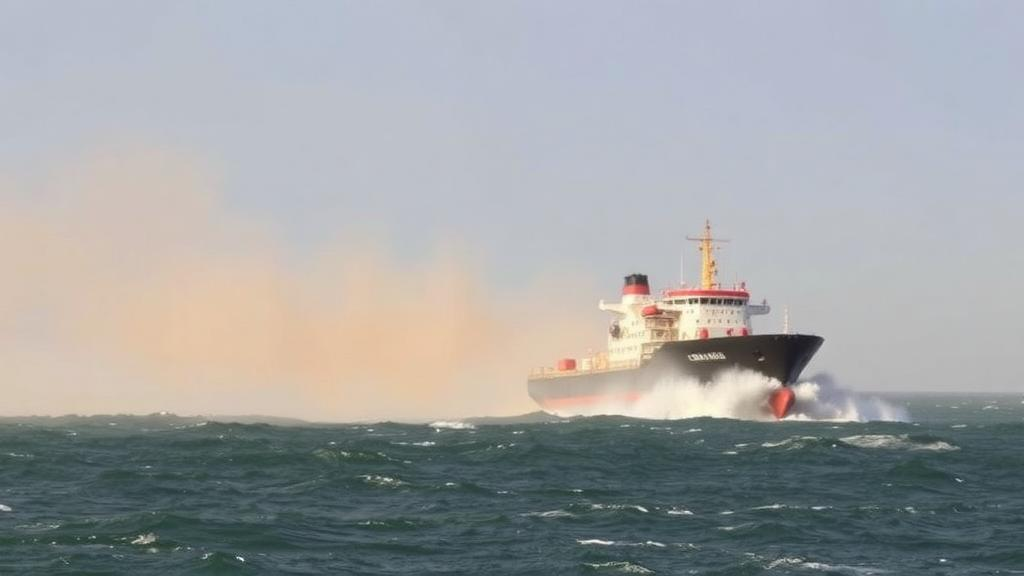
In the shallow waters of southern Iraq, where the Khor Abdullah channel links the port city of Basra to the northern Arabian Gulf, the weather is not a background detail but a gatekeeper of global trade. A new study published in Theoretical and Applied Climatology has dissected, with unusual statistical and synoptic precision, exactly why ships are forced to stop moving through this strategically vital waterway. The researchers, led by Ali Raheem Al-Nassar of Mustansiriyah University in Baghdad, analyzed nineteen documented episodes of Maritime Navigation Suspension, or MNS, recorded during 2019, combining operational meteorological thresholds with detailed case studies of the large-scale atmospheric patterns responsible.
The findings paint a picture of a marine corridor whose traffic is hostage to a narrow band of critical weather conditions. Wind speeds alone rarely told the whole story: maximum wind speeds during suspension events clustered between 8.9 and 10.4 meters per second, accounting for 47 percent of the cases, while the most frequently observed minimum speeds fell between 7.7 and 9.9 meters per second in 45 percent of events. These are not hurricane-force winds by any standard. Instead, they are the kind of moderate breezes that, in a dust-rich desert environment, can loft enough particulate matter to collapse visibility without generating dramatically powerful gusts.
Visibility emerged as one of the decisive variables. Although the study found that maximum visibility between 6.0 and 6.2 miles remained comparatively high during the analyzed periods, reductions in minimum visibility to between 1.2 and 2.2 miles were the key factor in 47 percent of the suspension episodes. The pattern held most consistently when visibility dropped below 2.2 miles, a level at which pilots navigating crowded, sediment-laden channels lose the visual references needed for safe passage. In a waterway that serves as the primary maritime artery for Iraqi oil exports and commercial imports, a single afternoon of obscured horizons can ripple through supply chains far beyond the Gulf.
Perhaps the most striking quantitative result concerns waves. Wave heights between 0.2 and 0.6 meters played a significant role, but the maximum wave heights reached 0.8 to 1.3 meters in 69 percent of all cases, and the analysis identified a threshold of roughly 0.8 meters as the main trigger of Maritime Navigation Suspension. For observers accustomed to ocean shipping standards, where vessels routinely endure swells of several meters, such a low trigger may seem surprising. The explanation lies in the geography: Khor Abdullah is a shallow, constricted estuarine channel where modest wave heights translate into steep, short-period seas that are hazardous for maneuvering large vessels near berths and dredged fairways.
Beyond the statistics, the study’s synoptic analysis linked each suspension to distinct seasonal atmospheric machinery. During summer, the notorious Shamal winds, the northwesterly winds that sweep across Iraq from the desert interior, combined with monsoon influences to produce dust episodes and enhanced wave heights, affecting navigation directly. The Shamal is a familiar hazard in Mesopotamian meteorology, capable of reducing visibility to near zero within hours as it drags loose sediment from the floodplains of the Tigris and Euphrates out over the Gulf, blanketing shipping lanes in airborne dust.
Autumn brought a different culprit. Mid-latitude shallow depressions and baroclinic instability, the process by which temperature contrasts in the atmosphere amplify into growing weather systems, increased the variability of marine weather during the transition season. Baroclinic instability is the engine of most mid-latitude storminess, and the study shows that even its weaker, shallower manifestations over the northern Gulf are sufficient to destabilize conditions in a channel already operating close to its meteorological limits. In winter, the dominant systems were frontal systems and deep mid-latitude depressions, occasionally reinforced by outbreaks of continental polar air masses pushing cold, dense air southward over the relatively warm Gulf waters.
This seasonal decomposition carries practical consequences. It means that port authorities cannot treat the navigation threat as a single phenomenon requiring a single forecasting solution. Summer suspensions demand dust prediction and wind forecasting tied to desert source regions hundreds of kilometers upwind, while autumn and winter events require tracking traveling cyclones and fronts across the Mediterranean and the Middle East. The authors emphasize that both synoptic-scale and mesoscale atmospheric processes play significant roles in driving severe marine conditions, and that improved forecasting is essential to support safer navigation in Khor Abdullah.
The methodology itself offers a template for other vulnerable waterways. The researchers drew on operational weather thresholds, the same criteria that trigger actual suspension decisions by port authorities, and combined them with reanalysis data from the ERA5 dataset of the European Centre for Medium-Range Weather Forecasts, alongside observational records. By anchoring the analysis to real suspensions rather than arbitrary meteorological events, the study avoids the common pitfall of relating ship traffic disruptions to weather conditions that are dramatic on paper but irrelevant to operational decision-making. The authors also acknowledged the State Company for Iraqi Ports, whose records made the event catalog possible.
The broader context is sobering. Iraq’s maritime infrastructure faces mounting pressure from climate change, sea-level rise, and increased shipping traffic, and prior research cited in the study has documented how altered tidal dynamics and sedimentation are already reshaping the Khor Abdullah and neighboring Khor Al-Zubair. As global trade routes concentrate more tonnage through a handful of chokepoints, understanding the precise meteorological triggers of disruptions becomes a matter of economic resilience, not merely academic interest. Studies across other regions, from the Atlantic coast of Canada to the ports of China and Tanzania, have repeatedly shown that wind strength and wave height measurably raise the probability of maritime casualties.
What makes this study resonate is its concreteness. A wave height of 0.8 meters, a visibility of 2.2 miles, a wind of 10 meters per second: these are numbers that port operators, ship masters, and forecasters in the northern Gulf can act on immediately. By translating the chaotic interplay of Shamal winds, monsoon influences, baroclinic depressions, and polar air outbreaks into statistical thresholds tied to real suspension events, the Baghdad-based team has converted years of operational experience into a quantified early-warning framework. For a channel that carries the lifeblood of Iraq’s economy, that translation may prove as valuable as any dredger or new berth.
Subject of Research: Meteorological and synoptic triggers of maritime navigation suspensions in the Khor Abdullah channel, southern Iraq
Article Title: Navigational challenges in Khor Abd Allah: statistical and synoptic analysis
Article References: Al-Nassar, A. R., Mutar, A. G., & Al-Dabbagh, S. K. (2026). Navigational challenges in Khor Abd Allah: statistical and synoptic analysis. Theoretical and Applied Climatology, 157(11), Article 690. https://doi.org/10.1007/s00704-026-06626-9
Image Credits: AI Generated
DOI: 10.1007/s00704-026-06626-9
Keywords: Maritime Navigation Suspension, Khor Abdullah, Iraq, Shamal winds, dust storms, wave height, visibility, baroclinic instability, synoptic analysis, ERA5 reanalysis, port operations, Theoretical and Applied Climatology
Cite Scienmag News
Violet Maxwell. (October 10, 2026). Dust, Waves and Shamal Winds: What Halts Shipping in Iraq’s Khor Abdullah. Scienmag. https://scienmag.com/dust-waves-and-shamal-winds-what-halts-shipping-in-iraqs-khor-abdullah/
Violet Maxwell. "Dust, Waves and Shamal Winds: What Halts Shipping in Iraq’s Khor Abdullah." Scienmag, 10 October 2026, https://scienmag.com/dust-waves-and-shamal-winds-what-halts-shipping-in-iraqs-khor-abdullah/. Accessed 10 October 2026.
Violet Maxwell. "Dust, Waves and Shamal Winds: What Halts Shipping in Iraq’s Khor Abdullah." Scienmag. October 10, 2026. https://scienmag.com/dust-waves-and-shamal-winds-what-halts-shipping-in-iraqs-khor-abdullah/


