


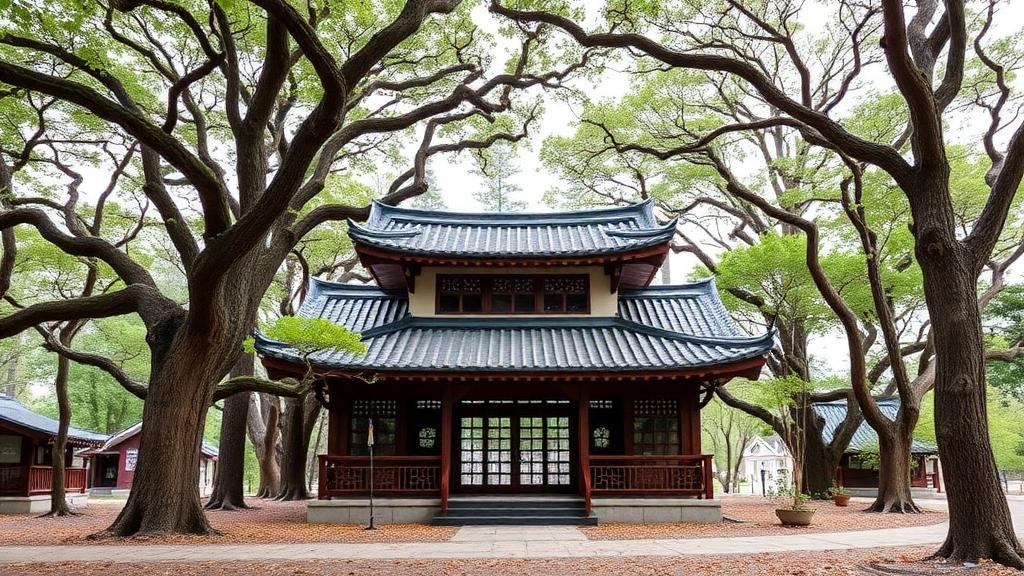
Interior canopies—the elaborately carved wooden ceilings that crown the grandest halls and gardens of Qing dynasty China—have long been read by architectural historians as fingerprints of regional craft traditions. Northern official workshops built with strict, symmetrical restraint, while southern garden artisans favored openwork lattice, flowing curves, and dense ornamental layering. A new study published in npj Heritage Science asks a deceptively simple question with a decidedly modern method: what happens when these two traditions meet, and can an artificial intelligence model be tuned precisely enough to explore that meeting point? The answer, according to a team led by Changqing Wei of the Henan Academy of Sciences and Zhengzhou University, is that carefully controlled image generation can act as a laboratory for testing how regional timbercraft styles blend—without ever claiming that its outputs are historical artifacts.
The research focuses on canopies from the Qianlong and Jiaqing reigns of the Qing dynasty, spanning 1736 to 1820, an era when imperial patronage and the movement of craftsmen brought northern and southern woodworking traditions into unusually close contact. Rather than treating style as a binary choice between courtly formality and garden exuberance, the team hypothesized that surviving works occupy a continuum between the two poles. To explore that continuum, they needed a way to generate hypothetical intermediate designs—objects that never existed but whose stylistic coordinates could be measured and compared against real historical samples from Yangzhou, a city famed for its refined southern craftsmanship.
The technical core of the study rests on a family of techniques known as parameter-efficient fine-tuning. The researchers started with Stable Diffusion v1.5, a widely used text-to-image diffusion model, and trained two separate Low-Rank Adaptation modules, or LoRAs, on top of it. LoRA training works by freezing the original model’s weights and learning only small, low-rank update matrices, which makes it possible to teach a large generative model a specialized visual vocabulary—in this case, the vocabulary of Qing interior canopies—without enormous datasets or computing budgets. Crucially, the team trained one LoRA module on a semantic lexicon of northern official canopy features and a second on a lexicon of southern garden canopy features, giving the model two distinct stylistic anchors.
The real innovation lies in how those anchors were combined. Using an alpha-based weighting scheme, the researchers could dial the influence of each LoRA module up or down during generation. At one extreme, the model produced canopies dominated by northern official characteristics; at the other, southern garden traits prevailed. In between, a continuous spectrum of hybrid designs emerged. Because the weighting parameter is explicit and adjustable, the process is described as controllable generation: the researchers knew exactly how much southern influence each batch of images was designed to carry, which turned the generative model from an unpredictable art engine into a calibrated instrument for exploring a stylistic space.
Generating images, however, was only half the work. To say anything meaningful about craft traditions, the team needed objective measurements. They extracted a suite of structural, ornamental, and semantic indicators from each generated canopy sample, including the aspect ratio of the canopy form, the proportion of openwork carving, the complexity of curved profiles, the density of decorative patterns, the degree of ornamental layering, and a composite southern tendency score. The results traced a clear gradient: as the southern weighting increased, generated canopies became squatter in proportion, more perforated, more richly curved, and more densely ornamented, with layering and semantic scores rising in step. The model, in other words, had internalized the stylistic grammar of both regions well enough that a single scalar knob moved its outputs along a coherent north-to-south axis.
The decisive test came from comparison with reality. The team analyzed historical canopy samples from Yangzhou and projected both the real specimens and the generated samples into a shared feature space, using principal component analysis to reduce the multidimensional indicator set to its dominant axes of variation. They also performed region-of-interest comparisons to examine specific zones of the canopies in detail. The finding is striking: the Yangzhou samples did not cluster near either endpoint of the generated spectrum. Instead, they aligned most closely with the mid-range of the model space, particularly the groups generated with alpha weightings between 0.50 and 0.75. In stylistic terms, the historical Yangzhou canopies appear to embody a genuine blend of northern and southern characteristics rather than a pure expression of either tradition.
This result speaks directly to a long-running conversation in Chinese architectural history about the Qianlong-era appetite for southern design. The emperor’s famous garden-retreat projects brought Jiangnan aesthetics into imperial interiors, and craftsmen traveled between regions, carrying techniques and motifs with them. The study’s mid-range compatibility finding offers quantitative support for the idea that Yangzhou’s canopy workshops occupied an intermediate position in this exchange—close enough to southern garden practice to master its openwork virtuosity, yet permeated by northern official conventions of structure and proportion. The AI model did not discover this convergence on its own; it provided a controlled continuum against which the historical evidence could be measured.
Just as important as the findings is what the authors insist the method does not claim. The paper is explicit that AI-generated outputs are not treated as historical evidence. A diffusion model can hallucinate plausible details, and no generated image can substitute for archival documentation, surviving structures, or workshop records. Instead, the team proposes controllable generation as a modeling and compatibility-assessment tool: a way to construct explicit, adjustable hypotheses about stylistic space and then test where real artifacts fall within it. This framing positions generative AI alongside photogrammetry, 3D scanning, and statistical shape analysis as one more instrument in the digital heritage toolkit—powerful precisely because its parameters are transparent and its outputs are never mistaken for the past.
The study also models a new standard of transparency in how AI participates in research. In its disclosure, the team reports that all AI-generated image elements were produced with Stable Diffusion v1.5 and author-trained LoRA modules built with the kohya_ss framework, with the researchers defining prompts and settings, screening outputs, and verifying architectural content and composition. OpenAI Codex assisted in drafting Python plotting code for the quantitative figures, while the authors supplied the data, executed the scripts, and verified every numerical value and label. The remaining figures and all photographs were prepared without AI assistance. This division of labor—machine assistance under continuous human verification—reflects a maturing attitude toward generative tools in scholarship, where the provenance of every image and every number is documented rather than obscured.
The broader implications reach beyond Qing canopies. Regional convergence in craft traditions is a notoriously slippery phenomenon: historians can often name the routes of exchange and the patrons who encouraged them, but quantifying how much of one tradition actually entered another has depended on qualitative judgment. The approach demonstrated here—dual specialized adapters, controlled blending, measurable style indicators, and comparison against real artifacts—could in principle be adapted to ceramics, textiles, lacquerware, or any craft domain with enough visual documentation to train on. It also offers heritage institutions a way to visualize hypothetical or lost design states, such as intermediate forms that may once have existed but left no surviving examples. For a field built on fragments, a controllable model of the spaces between the fragments is a genuinely new kind of evidence—so long as everyone remembers it is a model, and the wood, the chisels, and the hands that guided them remain the ultimate source of truth.
Subject of Research: Controllable AI modeling of northern–southern timbercraft convergence in Qing dynasty interior canopies
Article Title: Controllable AI modeling of northern and southern timbercraft convergence in Qing interior canopies
Article References: Wei, C., Liu, J., Jia, J., Kong, D., Yuan, M., & Yan, S. (2026). Controllable AI modeling of northern and southern timbercraft convergence in Qing interior canopies. npj Heritage Science. https://doi.org/10.1038/s40494-026-03031-3
Image Credits: AI Generated
DOI: 10.1038/s40494-026-03031-3
Keywords: Qing dynasty, interior canopies, timbercraft, Stable Diffusion, LoRA, controllable AI generation, digital heritage, Yangzhou, architectural history, principal component analysis, craft convergence, npj Heritage Science
Cite Scienmag News
Courtney Benton. (October 10, 2026). AI Blends Northern and Southern Woodcraft to Trace How Qing Canopy Styles Converged. Scienmag. https://scienmag.com/ai-blends-northern-and-southern-woodcraft-to-trace-how-qing-canopy-styles-converged/
Courtney Benton. "AI Blends Northern and Southern Woodcraft to Trace How Qing Canopy Styles Converged." Scienmag, 10 October 2026, https://scienmag.com/ai-blends-northern-and-southern-woodcraft-to-trace-how-qing-canopy-styles-converged/. Accessed 10 October 2026.
Courtney Benton. "AI Blends Northern and Southern Woodcraft to Trace How Qing Canopy Styles Converged." Scienmag. October 10, 2026. https://scienmag.com/ai-blends-northern-and-southern-woodcraft-to-trace-how-qing-canopy-styles-converged/


