


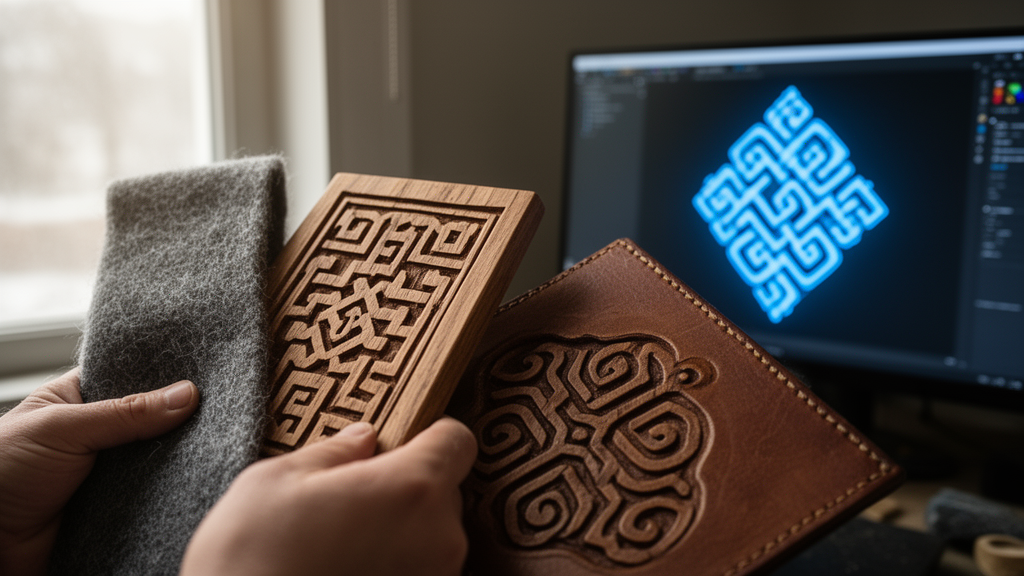
Mongolian decorative patterns have long been admired for their geometric vigour, but for researchers trying to preserve them digitally they pose a stubborn problem. When a motif moves from an embroidered robe to a carved saddle, a painted chest or a metal ornament, its colours, textures and proportions change, yet something recognisably the same survives. A new study published in npj Heritage Science argues that this elusive something is structure, and that it can be captured, measured and even tested on human perception rather than left to intuition.
The research, conducted by Jiatong Liu and Yue Huang of Beijing University of Posts and Telecommunications, introduces a framework that parameterises the internal architecture of Mongolian patterns so that examples drawn from completely different material carriers can be compared on common ground. Instead of treating each pattern as a flat image to be matched pixel by pixel, the authors decompose it into explicit structural relations: the directions of its constituent lines, the boundaries that separate individual elements, and the hierarchical way those elements are composed into a whole. These three layers together form a structural description that is, in principle, independent of the medium on which the pattern happens to appear.
The motivation is practical as much as theoretical. Museums and heritage teams routinely digitise ornaments as photographs, but a photograph of a felt appliqué and a photograph of an engraved bronze fitting share almost no low-level visual features, so automated comparison fails precisely where cultural continuity is most interesting. By extracting line direction fields, element boundary maps and compositional hierarchy from 566 field-documented images spanning six carrier types, the researchers built representations that could be aligned across carriers. The corpus was assembled from field documentation, giving the analysis a grounding in real surviving objects rather than idealised textbook motifs.
The technical core of the framework is a layered parameterisation. The direction field records the dominant orientation of strokes at each location, capturing the flow of the design. The element layer identifies where one motif ends and another begins, which matters because Mongolian ornament often packs multiple interlocking units into a single composition. The hierarchy layer encodes how small units aggregate into larger compositional blocks, a relation that survives translation between media even when surface detail does not. Alignment between two patterns is then scored by how well these structural relations correspond, rather than by superficial similarity.
To find out whether these abstract structural descriptions actually correspond to what people perceive, the team turned to immersive validation. Twenty-one non-specialist participants took part in a within-subject experiment in which they experienced patterns that had been remapped into immersive, virtual settings. The key measure was the alignment-event rate: how often a participant’s orientation or attentional response coincided with the structural relations extracted by the model. If the parameterisation captures something real about how humans read ornament, viewers navigating a virtual reconstruction should orient themselves in ways that track the extracted structure.
The results were striking. Using the full model, alignment-event rates reached 70.5 percent. When the direction field was removed, the rate collapsed to 29.1 percent, and when the element layer was removed it fell to 43.2 percent. These ablation experiments do more than validate the model; they quantify the distinct contribution of each structural layer. Line direction turns out to be the single most important cue for cross-carrier correspondence, while element boundaries provide a substantial additional share, and the compositional hierarchy ties the two together into a description robust enough to survive radical changes of material and scale.
Statistical rigour was built in from the start. The researchers prespecified four participant-level comparisons before running the immersive experiment, and all four remained significant after correction for the false discovery rate, a procedure that guards against the false positives that plague small behavioural studies. The within-subject design, in which every participant experienced every condition, further strengthens the comparison by controlling for individual differences in spatial ability and familiarity with Mongolian ornament. The authors are careful about interpretation: behavioural alignment is described as an association between participant orientation and extracted structural relations, not as proof that viewers consciously perceive the model’s features.
One of the more intriguing findings concerns which patterns transfer best across carriers. Patterns whose dominant structural logic can be recovered, meaning their underlying geometric rules remain legible despite surface variation, showed stronger cross-carrier consistency than patterns whose structure is more ambiguous. This suggests that the framework could serve as a diagnostic tool: curators and conservators could use it to flag which ornaments in a collection carry a clear, transmissible structural identity and which are more fragile under remapping. In digital restoration, virtual exhibitions and educational applications, that distinction could guide decisions about which patterns can safely be re-rendered in new media without losing their character.
The implications extend beyond Mongolian heritage. Ornament traditions worldwide face the same digitisation dilemma, where photographic archives preserve appearance but not the generative logic that makes a pattern recognisable across a yurt felt, a temple door and a festival costume. A parameterised, testable structural representation offers a way to document that logic explicitly, compare it across carriers, and verify through behavioural experiments that digital descendants still read as the same design. The immersive validation step is particularly notable because it closes the loop between computational description and human perception, something most pattern-analysis pipelines never attempt.
The authors are candid about scope. The conclusions hold within the tested corpus and architecture, and the behavioural result is an association rather than a causal claim about perception. The participant pool consisted of non-specialists, so it remains open how expert viewers, such as traditional craftspeople, would align with the extracted structures. Nevertheless, the study provides an operational approach to assessing structural continuity across carriers and after immersive remapping, turning a question that has usually been settled by expert judgement into one that can be measured. For a field racing to digitise intangible heritage before its carriers decay, that shift from intuition to quantification may prove the study’s most lasting contribution.
Subject of Research: Structural parameterisation and immersive behavioural validation of Mongolian decorative patterns for cross-carrier digital heritage comparison
Article Title: Structural parameterisation and immersive validation for cross carrier representation of Mongolian patterns
Article References: Liu, J., & Huang, Y. (2026). Structural parameterisation and immersive validation for cross carrier representation of Mongolian patterns. npj Heritage Science. https://doi.org/10.1038/s40494-026-03019-z
Image Credits: AI Generated
DOI: 10.1038/s40494-026-03019-z
Keywords: Mongolian patterns, digital heritage, structural parameterisation, cross-carrier comparison, immersive validation, virtual reality, pattern analysis, heritage science, line direction field, compositional hierarchy, behavioural experiment, cultural preservation
Cite Scienmag News
Courtney Benton. (October 9, 2026). Decoding Mongolian Patterns: New Framework Tracks Ornament Structure Across Materials and Into Virtual Reality. Scienmag. https://scienmag.com/decoding-mongolian-patterns-new-framework-tracks-ornament-structure-across-materials-and-into-virtual-reality/
Courtney Benton. "Decoding Mongolian Patterns: New Framework Tracks Ornament Structure Across Materials and Into Virtual Reality." Scienmag, 9 October 2026, https://scienmag.com/decoding-mongolian-patterns-new-framework-tracks-ornament-structure-across-materials-and-into-virtual-reality/. Accessed 9 October 2026.
Courtney Benton. "Decoding Mongolian Patterns: New Framework Tracks Ornament Structure Across Materials and Into Virtual Reality." Scienmag. October 9, 2026. https://scienmag.com/decoding-mongolian-patterns-new-framework-tracks-ornament-structure-across-materials-and-into-virtual-reality/


