


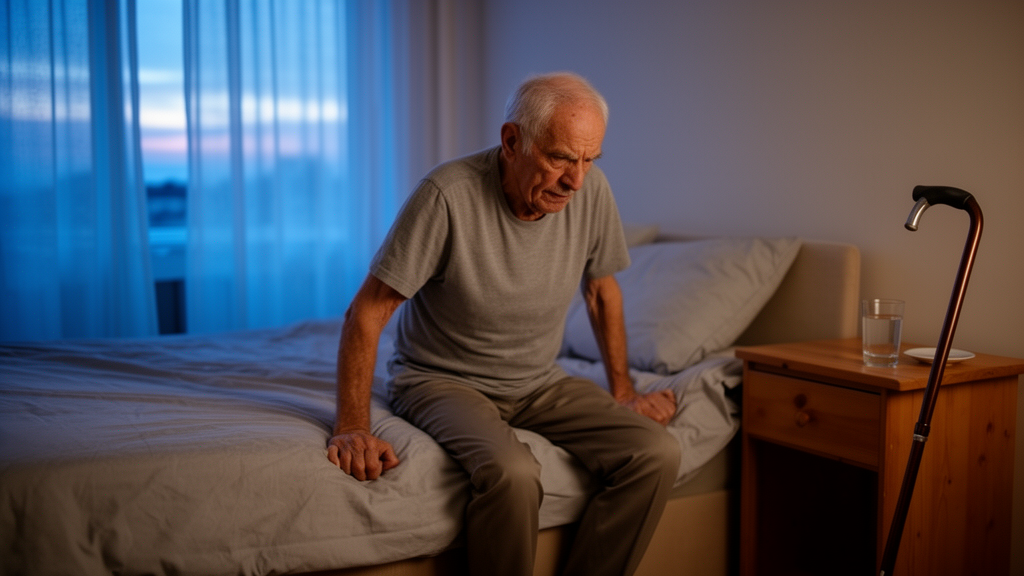
For millions of people living with Parkinson’s disease, the hours after dark can be the most treacherous of the day. A symptom known as nocturnal hypokinesia, in which movements become markedly slower and smaller during the night, makes simple acts such as turning over in bed, sitting up, or getting to the bathroom feel like navigating a frozen landscape. The condition has long been recognized by patients and caregivers as one of the most disruptive features of the disease, yet it has remained stubbornly understudied, largely because it unfolds in the bedroom, out of sight of clinicians and motion-analysis laboratories. A new study published in npj Parkinson’s Disease now suggests that what happens at night may not stay at night: researchers report that people with Parkinson’s disease who experience nocturnal hypokinesia also show measurable impairments in their daytime mobility, both when they are watched in a clinic and when they go about their ordinary lives at home.
The research, led by Edoardo Bianchini of Sapienza University of Rome and the University Grenoble Alpes, together with colleagues in Italy, France, and Germany, tackled a methodological problem that has hampered earlier work in this field. People with Parkinson’s disease vary enormously in age, disease duration, symptom severity, and medication profiles, so any observed difference between those with and without nocturnal hypokinesia could simply reflect underlying differences in how advanced their disease is rather than any specific effect of the nighttime symptom itself. To address this, the team used propensity score matching, a statistical technique borrowed from epidemiology that pairs individuals so that the groups are balanced across key clinical and demographic variables. From their cohort, they assembled eighty-eight participants with mild-to-moderate Parkinson’s disease, divided evenly into forty-four people with nocturnal hypokinesia and forty-four without, matched to be as comparable as possible on the characteristics that would otherwise confound the comparison.
Once the groups were constructed, the researchers subjected participants to a battery of supervised mobility tests performed under controlled laboratory conditions. These included a twenty-metre forward walking test, an instrumented version of the Timed-Up-and-Go test in which sensors capture the fine details of how a person rises from a chair, walks, turns, and sits back down, and a three-metre backward walking test, a demanding challenge for balance and motor control that is particularly sensitive to Parkinsonian motor dysfunction. The instrumented Timed-Up-and-Go is especially informative because turning is one of the movements most affected by the disease, and the embedded sensors allowed the team to quantify turning velocity with a precision that stopwatch-based clinical ratings cannot achieve. Backward walking, meanwhile, requires the brain to generate a motor pattern that is rarely rehearsed in daily life, making it a sensitive probe of the basal ganglia circuits that Parkinson’s disease progressively damages.
The results painted a consistent picture. Compared with their matched counterparts, people with nocturnal hypokinesia performed worse across most of the supervised mobility measures. They walked more slowly in the forward and backward directions, turned with reduced velocity during the instrumented Timed-Up-and-Go, and showed poorer overall functional mobility. The backward walking test proved particularly discriminating, with the nocturnal hypokinesia group moving noticeably slower when asked to walk in reverse. These differences emerged even though the two groups had been carefully balanced on the clinical variables that usually drive mobility performance, which strengthens the argument that the nighttime symptom itself is linked to a broader disturbance of movement regulation that persists into waking hours.
Crucially, the study did not stop at the laboratory door. Each participant wore a commercial activity tracker, the Garmin Vivosmart 4, for five consecutive days, allowing the researchers to capture average daily steps as a measure of unsupervised, real-world mobility. This distinction between supervised and unsupervised measurement matters enormously in movement disorders research. Clinic tests capture what a person can do when prompted and observed by an examiner, while free-living monitoring captures what a person actually does when no one is watching, a quantity shaped not only by motor capacity but also by motivation, habit, environment, and psychological state. The activity-tracker data revealed that the nocturnal hypokinesia group accumulated fewer average daily steps than the matched control group, indicating that the mobility deficit extended beyond the clinic and into the texture of everyday life.
The researchers then examined how the severity of nocturnal hypokinesia related to these outcomes. Across the cohort, worse nighttime hypokinesia correlated negatively with most of the supervised mobility measures and with daily step counts, meaning that the more severely a person’s movements were restricted at night, the worse their daytime performance tended to be. This dose-response pattern is an important feature of the findings, because a simple presence-or-absence difference could arise from chance or from an unmeasured confounder, whereas a graded relationship between symptom severity and mobility impairment is more suggestive of a genuine underlying link between nocturnal and diurnal motor function.
Yet the authors were careful to flag the preliminary nature of part of their evidence. In sensitivity analyses, they repeated the group comparisons while statistically controlling for fear of falling, a psychological factor that is common in Parkinson’s disease and known to constrain movement. When fear of falling was accounted for, the differences between the groups in supervised mobility shrank to statistical non-significance. This does not erase the observed pattern, but it raises the possibility that at least some of the clinic-based differences could be mediated by anxiety about falling rather than by a direct motor consequence of nocturnal hypokinesia. Fear of falling is itself a clinically meaningful target, and its role as a potential bridge between nighttime movement difficulties and daytime hesitancy is a question the study opens rather than closes.
Notably, the association between nocturnal hypokinesia severity and daily step count showed greater robustness in these sensitivity analyses than the supervised measures did. In other words, the link between how badly someone moves at night and how much they actually move during the day withstood the statistical adjustment for fear of falling better than the laboratory-based differences did. This asymmetry is intriguing. It suggests that free-living physical activity, measured continuously by a wrist-worn device, may capture a dimension of the nocturnal-daytime relationship that brief clinic tests miss, and it underscores the growing value of consumer wearable technology as a research instrument in neurology. A five-day monitoring window with an off-the-shelf tracker is far cheaper and more scalable than instrumented gait laboratories, and the findings hint that such devices could play a role in identifying patients whose nighttime symptoms are quietly eroding their daily activity.
The mechanistic story behind these associations remains to be worked out. Nocturnal hypokinesia is thought to reflect the interplay of declining dopaminergic medication coverage overnight, disrupted sleep architecture, and rigidity that worsens during periods of immobility. If the same circuits that fail to liberate movement at night are also operating at reduced efficiency during the day, the symptom could serve as a window onto a broader circadian dimension of Parkinsonian motor control that current clinical assessments, almost all conducted in daytime clinic hours, systematically overlook. Alternatively, poor nights could produce tired and stiff mornings, reducing daytime activity through fatigue and discomfort. The present study, being cross-sectional, cannot distinguish between these possibilities, and the authors themselves emphasize that their findings suggest an association rather than prove causation.
Even with those caveats, the practical implications are clear. Nocturnal hypokinesia is frequently underrecognized in routine care, partly because patients may not spontaneously report difficulties that occur while they are alone in bed, and partly because clinical rating scales focus overwhelmingly on daytime function. The study argues that nighttime movement should be actively screened for, and that when it is found, interventions should target both the nocturnal and the diurnal sides of the problem. Adjusting evening medication timing, optimizing nighttime sleep conditions, and designing physical-activity programs that account for fear of falling are all plausible avenues. For a disease in which mobility loss is the single most feared trajectory, the message from this research is that the night is not a pause in Parkinson’s disease but a continuation of it, and that protecting a patient’s ability to move may require paying attention to the hours when no one, until now, has been measuring.
Subject of Research: The association between nocturnal hypokinesia and supervised and unsupervised daytime mobility in mild-to-moderate Parkinson's disease
Article Title: The impact of nocturnal hypokinesia on supervised and unsupervised mobility in people with Parkinson’s disease
Article References: Bianchini, E., Lombardo, P., Milane, T., Rinaldi, D., De Carolis, L., Alborghetti, M., Suppa, A., Salvetti, M., Hansen, C., & Vuillerme, N. (2026). The impact of nocturnal hypokinesia on supervised and unsupervised mobility in people with Parkinson’s disease. npj Parkinson's Disease. https://doi.org/10.1038/s41531-026-01587-2
Image Credits: AI Generated
DOI: 10.1038/s41531-026-01587-2
Keywords: Parkinson's disease, nocturnal hypokinesia, mobility, gait analysis, wearable activity tracker, Timed-Up-and-Go, backward walking, fear of falling, daily steps, propensity score matching, sleep, digital biomarkers
Cite Scienmag News
Diana Fleming. (October 10, 2026). Nighttime Stiffness May Quietly Steal Daytime Mobility in Parkinson’s Disease. Scienmag. https://scienmag.com/nighttime-stiffness-may-quietly-steal-daytime-mobility-in-parkinsons-disease/
Diana Fleming. "Nighttime Stiffness May Quietly Steal Daytime Mobility in Parkinson’s Disease." Scienmag, 10 October 2026, https://scienmag.com/nighttime-stiffness-may-quietly-steal-daytime-mobility-in-parkinsons-disease/. Accessed 10 October 2026.
Diana Fleming. "Nighttime Stiffness May Quietly Steal Daytime Mobility in Parkinson’s Disease." Scienmag. October 10, 2026. https://scienmag.com/nighttime-stiffness-may-quietly-steal-daytime-mobility-in-parkinsons-disease/


