


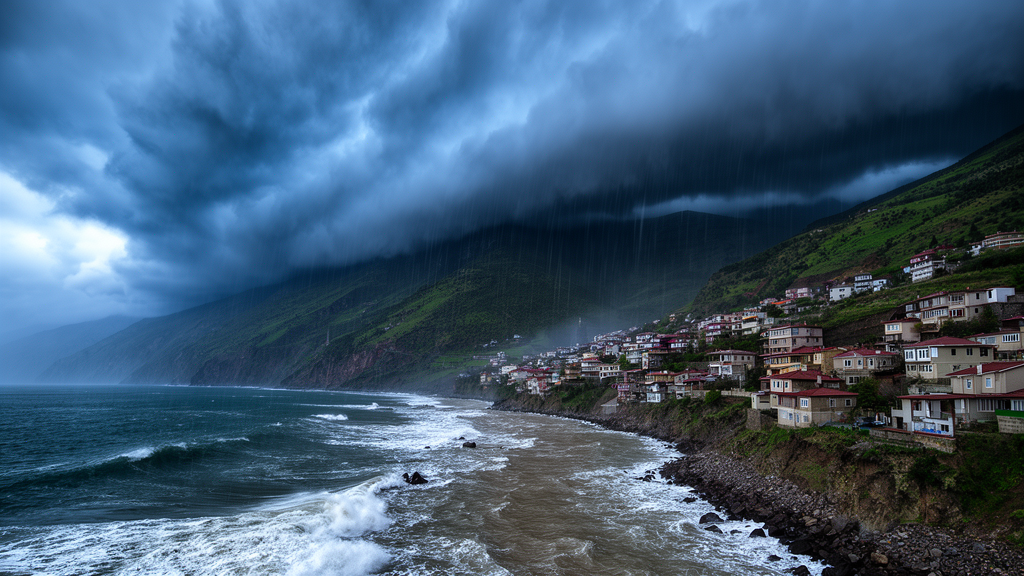
Along Türkiye’s Western Black Sea coast, catastrophe often arrives with rain. Steep mountains rise almost directly from the shoreline, rivers run short and violent, and when the atmosphere delivers more water than the landscape can absorb, the result is flash flooding that has repeatedly claimed lives, swept away bridges, and buried villages under landslides. A new study published in Theoretical and Applied Climatology has now untangled the atmospheric machinery behind these disasters, showing that extreme rainfall in the region is not the product of a single weather pattern but of five distinct synoptic regimes, each with its own season, physics, and hazard profile.
The research, led by Melek Candan İpek Şenbek of the General Directorate of State Hydraulic Works and Istanbul Technical University, together with Mikdat Kadıoğlu and Elçin Tan, examined thirty years of extreme precipitation events between 1995 and 2024. Using the ERA5 reanalysis dataset produced by the Copernicus Climate Change Service, the team identified 637 days on which rainfall exceeded the 90th-percentile threshold, a statistical marker that separates genuinely extreme days from ordinary wet weather. Every one of those days was then assigned to a circulation class through an objective, machine-learning-driven classification rather than subjective judgment.
The method rested on two well-established statistical techniques working in tandem. First, principal component analysis compressed a suite of dynamic atmospheric variables, including mean sea-level pressure, 500-hPa geopotential height, and wind components at both the 850-hPa and 500-hPa levels, into a small number of orthogonal patterns. By deliberately excluding thermodynamic fields such as temperature and humidity from the clustering input, the authors reduced the influence of seasonal heating cycles and forced the algorithm to focus on the shape of the circulation itself. The K-means algorithm was then applied to the principal component scores, partitioning the 637 extreme days into groups of meteorologically similar situations.
Choosing the right number of clusters is the central judgment call in any such classification, and the authors retained a five-cluster solution after weighing statistical metrics, the robustness of the result to different initializations, and, crucially, whether each cluster could be interpreted as a coherent physical mechanism. The payoff was a set of five regimes that read like a field guide to Black Sea flooding: a Dynamic Convective regime, a Thermal Convective regime, a Northerly Orographic regime, a Cyclonic-Frontal regime, and a Southwesterly Orographic regime.
The standout performer was Cluster 4, the Dynamic Convective regime. It was the most frequent class, produced the highest mean precipitation intensity at 9.59 millimeters per day, and delivered the single wettest event in the entire record at 37.29 millimeters per day. Its events clustered overwhelmingly in summer and autumn, when strong dynamic lifting combined with the region’s abundant moisture supply to squeeze extraordinary volumes of water from the air. The August 2021 floods that devastated parts of the Western Black Sea region, examined in earlier atmospheric studies, fall squarely within the kind of warm-season, dynamically driven environment this regime represents.
Close behind in intensity was Cluster 3, the Thermal Convective regime, with a mean of 9.26 millimeters per day and a similar concentration in the warm season. What set this class apart was its thermodynamic character: enhanced moisture availability and relatively high convective available potential energy, or CAPE, the measure of the fuel available to rising air parcels. Notably, the authors found that the highest CAPE values were spatially confined rather than representative of the whole domain, a reminder that convective instability in this region can be a localized phenomenon, igniting over warm coastal waters or heated inland terrain while the broader atmosphere remains comparatively modest.
The remaining three regimes demonstrate a finding with real consequences for flood forecasting: extreme rainfall does not require an unstable atmosphere. Cluster 1, the Northerly Orographic regime, averaged 8.57 millimeters per day and peaked in autumn, when moist northerly flow off the Black Sea collided with the coastal topography and was forced upward. Cluster 5, the Southwesterly Orographic regime, operated on the same principle from the opposite direction, transporting moisture on southwesterly winds during autumn and winter and wringing it out through terrain-induced ascent. Cluster 2, the Cyclonic-Frontal regime, was the weakest at 7.83 millimeters per day and concentrated in winter and spring, with large-scale ascent and frontal lifting doing the work that convection performs in summer. In all three, persistent moisture supply combined with mechanical or synoptic lifting proved sufficient to generate extremes even under weakly unstable conditions.
Statistical testing confirmed that these differences were not noise. Precipitation intensity differed significantly among the five clusters, with a Kruskal-Wallis H statistic of 28.20 and a p-value below 0.001. Yet when the authors examined the year-to-year frequency of each regime across the full 1995 to 2024 period, they found considerable interannual variability but no statistically significant long-term trend in any of the five classes. In other words, the atmospheric recipes for Black Sea extremes have remained broadly stable in their occurrence over three decades, even as individual events have continued to strike with damaging force.
That stability finding carries an important caveat for climate interpretation. The absence of a trend in regime frequency does not mean the hazards themselves are frozen in place; a warmer atmosphere holds more water vapor, and the intensity of rainfall within a given regime can change even if the regime appears just as often. The authors argue that their results should guide how regional climate projections are read: rather than treating extreme precipitation as a single aggregate variable, projections and seasonal assessments should consider each regime’s contrasting physical mechanisms separately, because a future with more frequent Dynamic Convective setups would pose very different risks than one with more Cyclonic-Frontal events.
For disaster-risk managers in one of Türkiye’s most flood-prone regions, the practical message is that the season and the synoptic signature together tell you what kind of threat is coming. A summer event flagged by high CAPE and dynamic lifting demands rapid-response flash-flood warning systems for steep catchments; an autumn northerly flow regime points to orographic enhancement along the coast and prolonged orographic rainfall on windward slopes; a winter frontal regime suggests broader-scale, longer-duration accumulation. By converting three decades of chaotic weather into five physically interpretable archetypes, the study offers forecasters and planners a structured vocabulary for a hazard that has too often seemed to arrive out of nowhere, and it demonstrates how objective clustering of reanalysis data can turn decades of atmospheric history into actionable knowledge.
Subject of Research: Synoptic classification of extreme precipitation events in the Western Black Sea Region of Türkiye
Article Title: Synoptic drivers of extreme precipitation in the western black Sea Region: a cluster-based classification (1995–2024)
Article References: İpek Şenbek, M. C., Kadıoğlu, M., & Tan, E. (2026). Synoptic drivers of extreme precipitation in the western black Sea Region: a cluster-based classification (1995–2024). Theoretical and Applied Climatology, 157(9), Article 598. https://doi.org/10.1007/s00704-026-06527-x
Image Credits: AI Generated
DOI: 10.1007/s00704-026-06527-x
Keywords: extreme precipitation, Black Sea, synoptic climatology, K-means clustering, ERA5 reanalysis, orographic rainfall, convective storms, flood risk, Türkiye, climate variability, principal component analysis, atmospheric circulation
Cite Scienmag News
Violet Maxwell. (October 9, 2026). Five Weather Regimes Drive Deadly Floods on Türkiye’s Black Sea Coast. Scienmag. https://scienmag.com/five-weather-regimes-drive-deadly-floods-on-turkiyes-black-sea-coast/
Violet Maxwell. "Five Weather Regimes Drive Deadly Floods on Türkiye’s Black Sea Coast." Scienmag, 9 October 2026, https://scienmag.com/five-weather-regimes-drive-deadly-floods-on-turkiyes-black-sea-coast/. Accessed 9 October 2026.
Violet Maxwell. "Five Weather Regimes Drive Deadly Floods on Türkiye’s Black Sea Coast." Scienmag. October 9, 2026. https://scienmag.com/five-weather-regimes-drive-deadly-floods-on-turkiyes-black-sea-coast/


