


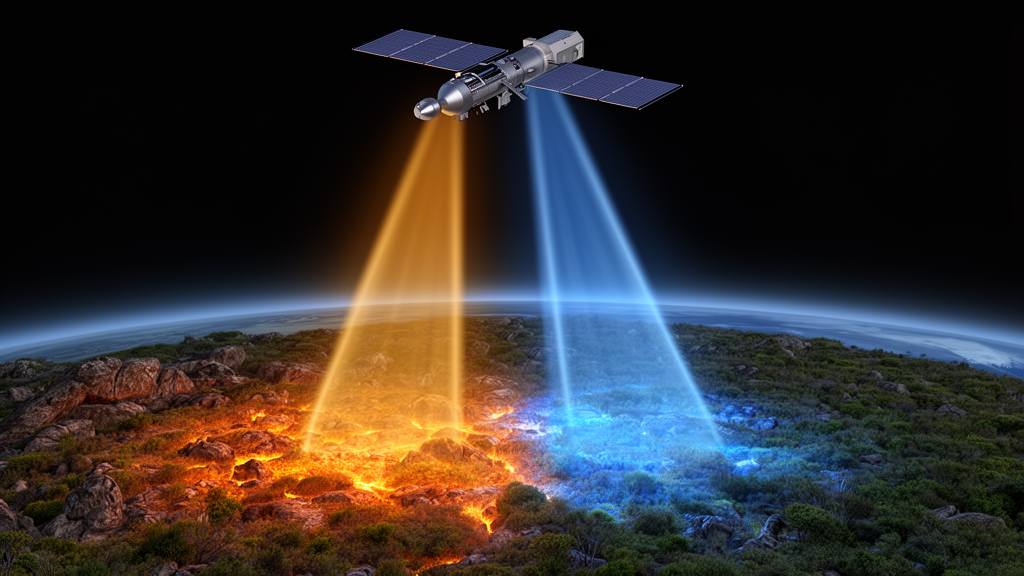
Every infrared thermometer pointed at the ground faces the same stubborn problem: the radiation it measures is a blend of two things that cannot easily be told apart. The surface emits thermal radiation according to its temperature, but it also reflects a fraction of the infrared light streaming down from the atmosphere, and the size of that reflected fraction depends on a property called emissivity. Because the two quantities are tangled together in a single broadband measurement, scientists have long been forced to assume an emissivity value borrowed from satellite products before they can compute land surface temperature. A new study published in Atmospheric Measurement Techniques by Collins Mito of the University of Nairobi now shows that this assumption can be dropped entirely, using nothing more than pairs of ground-based longwave radiation measurements and a carefully controlled retrieval framework.
The physics of the problem is deceptively simple on paper. For an opaque surface, the upwelling longwave irradiance measured just above the ground equals the surface’s own thermal emission, proportional to emissivity times the Stefan-Boltzmann constant times the fourth power of surface temperature, plus the reflected share of downwelling atmospheric irradiance, which is proportional to one minus emissivity. If emissivity is known, the equation can be inverted directly for temperature. If both are unknown, one equation carries two coupled unknowns, and the inverse problem becomes structurally underdetermined. Even adding a second observation in time does not automatically fix things, because the two measurements may be dominated by the same atmospheric forcing and contain little independent information about the surface itself.
Mito’s solution, described as a conditioning-controlled framework, treats the retrieval as an information-limited inverse problem rather than a straightforward algebraic exercise. The method constructs a local population of candidate temporal pairs from high-resolution upwelling and downwelling irradiance series, then screens them through a chain of physical and statistical tests before any nonlinear inversion is attempted. A quasi-steady screening step uses the apparent radiometric temperature, computed directly from upwelling irradiance, to reject pairs spanning more than one kelvin of thermodynamic change. Numerical admissibility checks exclude candidates whose linearized emissivity estimate is badly conditioned or physically impossible. Crucially, an irradiance-identifiability test requires that the change in upwelling irradiance between the two times exceed the contemporaneous change in downwelling irradiance, ensuring the pair contains a resolvable surface-sensitive signal rather than merely tracking the sky.
Surviving candidates are then weighed by both their propagated measurement uncertainty and their marginalized Fisher information, a quantity that measures how much emissivity information remains after allowing surface temperature to vary freely. The search proceeds progressively through temporal radii of one to ten minutes, and a stage is accepted as information sufficient only when enough distinct observations support a stable emissivity centre, with the robust estimate changing by no more than 0.005 between consecutive stages. In the vast majority of cases this stable-centre pathway succeeds; the production pair is then selected on geometric grounds, never ranked by its emissivity value, which guards against circular reasoning. A fixed eight-update Newton-Raphson refinement solves the full nonlinear equation, and correlated uncertainty propagation tracks how measurement error flows through emissivity into the final temperature.
The field evaluation drew on 637 datasets from nine stations in the SURFRAD and BSRN networks, spanning vegetated, mixed, and bare desert environments from Bondville in Illinois to Gobabeb in Namibia. Five datasets lacked the required initial irradiances, leaving 632 usable cases, and every one of them produced a final finite retrieval. Of these, 628 reached the stable-centre selection criterion, with only four requiring the prescribed fallback pathway, and the median selected pair separation was just three minutes. Compared against a ground-based validation-reference temperature, the retrieved surface temperatures showed a bias of only minus 0.162 kelvin, a mean absolute error of 0.432 kelvin, a root-mean-square error of 0.558 kelvin, and a coefficient of determination of 0.9984, meaning typical errors stayed well below one kelvin across radically different landscapes.
Because the field reference temperature itself relies on an externally specified emissivity, it cannot serve as fully independent truth for the emissivity retrieval. The study therefore added a complementary physics-based known-truth experiment, in which both emissivity and temperature were prescribed independently across 6000 synthetic scenes spanning emissivities from 0.85 to 0.99, with exactly 2000 scenes in each of three regimes. Synthetic observations were generated from the exact forward radiative relation, with temporal forcing bootstrapped from the real field cases. In the noiseless experiment, 5924 scenes, or 98.73 percent, yielded successful retrievals. Among successful cases, emissivity bias, mean absolute error, and root-mean-square error were 0.0313, 0.0491, and 0.0658 respectively, while the corresponding temperature statistics were minus 0.335, 1.307, and 3.213 kelvin.
The synthetic experiment also mapped where the method strains. Retrieval errors grew steadily toward the lowest-emissivity regime, where surfaces like bare soils and deserts emit less and reflect more, weakening the radiative contrast that the inversion depends on. This identifies low-emissivity conditions as the most demanding part of the tested retrieval space, and the author is explicit that propagated uncertainties are diagnostics of local sensitivity rather than automatically calibrated confidence intervals. A paired production-noise experiment, applying realistic correlated measurement perturbations to the same truth scenes, quantified robustness to instrument error without retuning any of the retrieval thresholds, and detailed uncertainty coverage was evaluated separately in the paper’s appendices.
One of the more technically distinctive elements is the physical-state-dependent treatment of reciprocal emissivity transformations. Before nonlinear refinement, the framework evaluates whether the local radiative environment supports one of two exact reciprocal mappings of the corrected emissivity anchor, selecting between them using thresholds tied to Stefan-Boltzmann scaling and normalized upwelling contributions. In the field population, the Stefan-Boltzmann-controlled configuration occurred in 102 cases and the reciprocal-conductance configuration in 58, while the remaining 472 cases retained the conservative backbone mapping. The transformation is therefore applied conditionally, according to the physics of each scene, rather than as a universal algebraic correction, and the branch choice is made before any comparison with the validation reference.
The broader significance lies in what the method removes from the workflow. Conventional ground-based surface temperature estimation typically imports emissivity from satellite narrowband products, inheriting spatial mismatch between a point measurement and a kilometre-scale pixel, temporal mismatch between instantaneous and composited products, and spectral mismatch between narrowband and broadband values. By inferring broadband emissivity directly from the paired longwave measurements themselves, the new framework eliminates that entire chain of imported uncertainty. It also demonstrates a methodological principle with reach beyond this specific problem: numerical convergence alone proves nothing about observability, and retrieval reliability must be built by assessing information content before the solver is ever invoked.
Limitations remain, and the study states them plainly. The field temperature reference shares ground-based longwave measurements with the retrieval, so the field arm validates combined retrieval behaviour rather than independent emissivity accuracy. The synthetic experiment provides genuinely prescribed truth but necessarily represents a controlled model of the observed environment. Errors also rise in weak-information, low-emissivity corners of the parameter space. Future work, the author suggests, should target validation against fully independent broadband references, extension to additional low-emissivity surface types, and continued evaluation of uncertainty calibration. For now, the results establish that with the right conditioning controls, two ground-based radiation measurements are enough to untangle one of remote sensing’s oldest coupled unknowns, opening a path to surface temperature products that stand on their own radiometric feet.
Subject of Research: Joint retrieval of broadband land surface temperature and emissivity from paired ground-based longwave irradiance measurements
Article Title: Conditioning-controlled retrieval of broadband land surface temperature and emissivity from paired ground-based longwave irradiance measurements
Article References: Conditioning-controlled retrieval of broadband land surface temperature and emissivity from paired ground-based longwave irradiance measurements. (n.d.). https://doi.org/10.5194/amt-19-6015-2026
Image Credits: AI Generated
Keywords: land surface temperature, surface emissivity, longwave irradiance, SURFRAD, BSRN, remote sensing, inverse problems, Newton-Raphson, uncertainty propagation, radiative transfer, ground-based measurement, Atmospheric Measurement Techniques
Cite Scienmag News
Russell Cooper. (October 9, 2026). New Method Pulls Ground Temperature and Emissivity Apart From Raw Radiation Data. Scienmag. https://scienmag.com/new-method-pulls-ground-temperature-and-emissivity-apart-from-raw-radiation-data/
Russell Cooper. "New Method Pulls Ground Temperature and Emissivity Apart From Raw Radiation Data." Scienmag, 9 October 2026, https://scienmag.com/new-method-pulls-ground-temperature-and-emissivity-apart-from-raw-radiation-data/. Accessed 9 October 2026.
Russell Cooper. "New Method Pulls Ground Temperature and Emissivity Apart From Raw Radiation Data." Scienmag. October 9, 2026. https://scienmag.com/new-method-pulls-ground-temperature-and-emissivity-apart-from-raw-radiation-data/


