


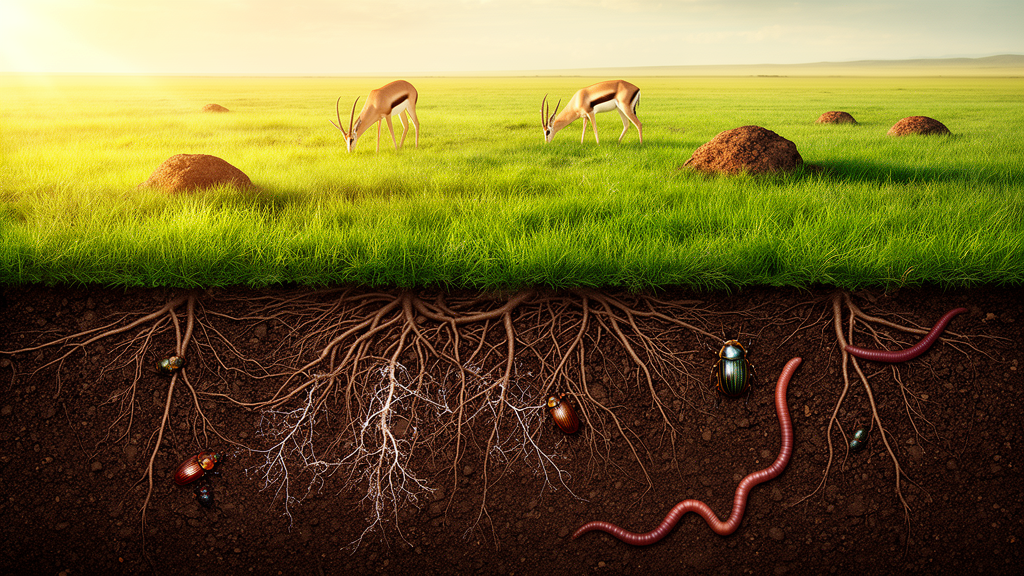
For nearly half a century, ecologists have leaned on one of the field’s most trusted rules of thumb: the Intermediate Disturbance Hypothesis, or IDH. The idea is elegantly simple. Where disturbance is rare, a few dominant species elbow out the competition and diversity stays low. Where disturbance is relentless, only the toughest survivors persist and diversity collapses again. Somewhere in between, at moderate levels of disruption, the greatest number of species can coexist. A new study of the Eurasian meadow steppe, published in Communications Earth & Environment, now delivers a striking caveat to that classic framework: the rule holds for the plants you can see, but it breaks down for the sprawling, invisible web of life beneath the soil.
The research, led by Jinlong Gao and colleagues spanning the Chinese Academy of Sciences and partner institutions, examined a gradient of grazing-related disturbance across the meadow steppe, one of the most extensive grassland ecosystems in Eurasia. Grazing is among the most pervasive human-driven disturbances in grasslands worldwide, reshaping vegetation through defoliation, trampling, and the return of nutrients in dung and urine. Because livestock activity touches nearly every grassland on the continent, understanding how its intensity shapes biodiversity is not an academic curiosity; it is central to managing ecosystems that support herders, store carbon, and regulate water across vast regions.
Above the ground, the findings read like a textbook confirmation of the IDH. Plant communities responded to the disturbance gradient in a unimodal pattern, with diversity, biomass, and stability all peaking at intermediate levels of grazing-related disturbance. In other words, moderately grazed sites hosted the richest and most balanced plant assemblages, while both lightly disturbed and heavily disturbed sites fell short. This is precisely the hump-shaped relationship the hypothesis predicts, and it reinforces the long-standing management intuition that moderate grazing can sustain more diverse and more stable grassland vegetation than either strict exclusion or intensive use.
Below the ground, however, the story took an unexpected turn. Soil multitrophic communities, the combined assemblages of microbes, fungi, and the microscopic animals that feed on them and on each other, did not follow the same hump. Their alpha diversity, the diversity measured within a given site, was essentially insensitive to the disturbance gradient. No matter how hard the grassland was grazed, the number of soil life forms coexisting at a single location changed little. For a field that has often assumed aboveground rules transfer neatly to the soil, this is a consequential result.
Yet the soil communities were not indifferent to grazing; they simply responded along a different axis. Beta diversity, which captures how much community composition differs from place to place, peaked under moderate disturbance. At intermediate grazing intensity, soil communities across the landscape became most dissimilar from one another, suggesting that moderate disturbance reorganizes belowground life in ways that vary from site to site rather than uniformly reducing or enriching it. This spatial differentiation peaked exactly where plant diversity was highest, but the underlying mechanism and trajectory were clearly distinct.
The researchers also probed the architecture of the soil food web itself, mapping the networks of interactions among multitrophic communities. As disturbance increased, network complexity declined, and the character of the remaining connections shifted toward positive associations. In ecological terms, the intricate web of competition, predation, and antagonism that characterizes undisturbed soil gave way to simpler networks dominated by cooperation or mutual tolerance. The authors interpret this pattern as consistent with the stress-gradient hypothesis, the idea that as environmental stress intensifies, organisms increasingly rely on facilitation rather than competition to persist. Severe grazing, in this view, pushes soil communities into a reorganized, more cooperative state.
What could drive such a fundamental divergence between the visible and invisible halves of the grassland? The study points to a likely culprit: the flow of carbon from plants into the soil. Grazing reduces the biomass and productivity of vegetation, and the researchers found corresponding reductions in plant-derived carbon subsidies reaching belowground communities. Dissolved organic carbon, the labile carbon fraction that soil organisms readily consume, was lower under disturbance, and the remaining dissolved organic matter shifted toward more recalcitrant forms that are harder to decompose. In effect, heavy grazing starves the soil food web of its easiest energy source and forces it to subsist on tougher fare, a shift that plausibly explains both the reorganization of interactions and the changing spatial patterns of diversity.
This carbon mechanism matters far beyond the steppe. Soil multitrophic communities are the engines of decomposition, nutrient cycling, and carbon storage in grasslands, and their composition influences how much carbon these ecosystems lock away or release. If grazing decouples the response of plants from the response of soil organisms, then management strategies calibrated solely on vegetation, such as adjusting stocking rates to maximize plant diversity, may fail to safeguard the belowground processes that ultimately sustain the system. The study’s authors argue that their findings call for integrating belowground multitrophic dynamics into grassland resilience frameworks, particularly under global change, where shifting grazing regimes, altered precipitation, and rising temperatures will interact in ways that aboveground monitoring alone cannot anticipate.
The broader theoretical implication is equally provocative. The Intermediate Disturbance Hypothesis has been applied, debated, and tested across ecosystems from coral reefs to forests, and it has often been assumed to operate as a general law of biodiversity. By demonstrating that it holds for plants but not for soil multitrophic communities within the same landscape, the study delivers one of the clearest empirical demonstrations that disturbance responses are compartment-specific. The coupling between aboveground and belowground worlds, so often invoked in ecosystem science, is not automatic; disturbance can actively sever it, leaving plants and soil life marching to different ecological drumbeats.
For the Eurasian meadow steppe and the millions of hectares of grassland like it, the practical message is one of humility and nuance. Moderate grazing genuinely appears to be a sweet spot for plant diversity and stability, vindicating rotational and light-to-moderate stocking approaches. But the soil beneath those optimally grazed pastures is undergoing its own quiet transformation, with networks simplifying, communities differentiating, and carbon flows weakening in ways that no vegetation survey will reveal. As grasslands face intensifying pressure from livestock production and climate change, the study suggests that resilient management will require looking below the surface, treating the soil food web not as a passive mirror of the vegetation above but as a distinct and dynamic player with its own rules of response.
Subject of Research: Effects of grazing disturbance on aboveground plant and belowground soil multitrophic communities in the Eurasian meadow steppe
Article Title: Grazing-related disturbance decouples aboveground and belowground responses in the Eurasian meadow steppe
Article References: Gao, J., Wu, S., Wang, H., Chen, S., Wang, S., Xu, M., Pan, Q., Han, X., & Zhuang, X. (2026). Grazing-related disturbance decouples aboveground and belowground responses in the Eurasian meadow steppe. Communications Earth & Environment. https://doi.org/10.1038/s43247-026-04104-8
Image Credits: AI Generated
DOI: 10.1038/s43247-026-04104-8
Keywords: grassland ecology, grazing, Intermediate Disturbance Hypothesis, soil biodiversity, multitrophic communities, meadow steppe, dissolved organic carbon, stress-gradient hypothesis, community ecology, microbial ecology, ecosystem resilience, global change
Cite Scienmag News
Morgan Morrow. (October 9, 2026). Grazing Disturbance Splits Grassland Life Above and Below the Ground. Scienmag. https://scienmag.com/grazing-disturbance-splits-grassland-life-above-and-below-the-ground/
Morgan Morrow. "Grazing Disturbance Splits Grassland Life Above and Below the Ground." Scienmag, 9 October 2026, https://scienmag.com/grazing-disturbance-splits-grassland-life-above-and-below-the-ground/. Accessed 9 October 2026.
Morgan Morrow. "Grazing Disturbance Splits Grassland Life Above and Below the Ground." Scienmag. October 9, 2026. https://scienmag.com/grazing-disturbance-splits-grassland-life-above-and-below-the-ground/


