


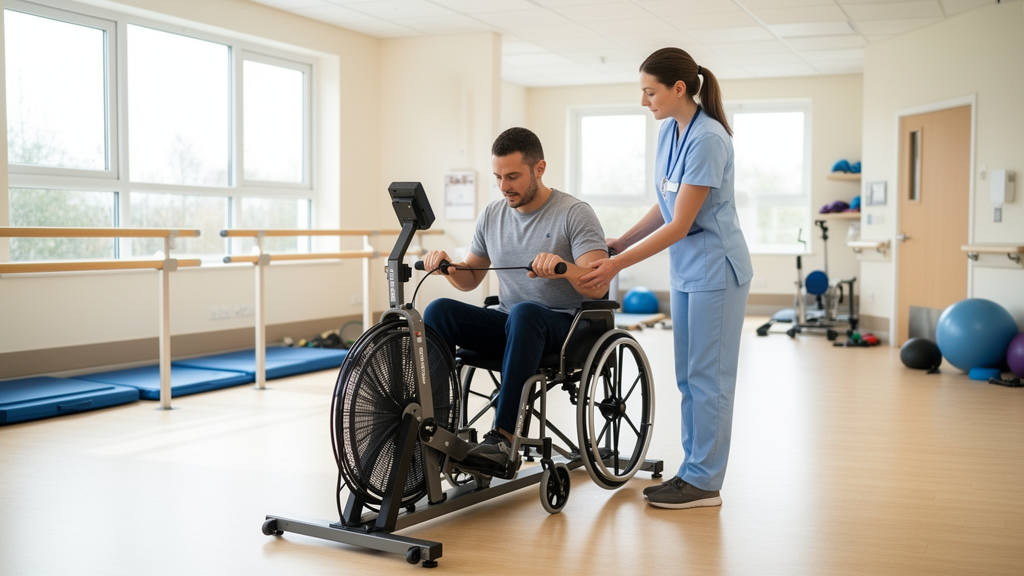
The weeks and months immediately after a spinal cord injury represent one of the most scientifically valuable windows in rehabilitation medicine. The nervous system is still adapting, secondary health complications such as cardiovascular disease and type 2 diabetes have not yet taken hold, and patients are typically resident in specialist centres where physiological testing, supervised exercise, and repeated clinical assessment are all theoretically within reach. Yet a new perspective article published in BMC Medicine argues that in the United Kingdom, this window is being squandered, not because the science lacks promise, but because the structures of the National Health Service make running rigorous exercise trials during inpatient rehabilitation extraordinarily difficult.
The article, led by Shane J. T. Balthazaar of the University of Birmingham together with colleagues from the University of Bath, Keele University, and two of the UK’s regional spinal injuries centres, draws on the direct experience of three recent inpatient exercise-intervention trials, the wider spinal cord injury rehabilitation literature, and the perspectives of senior rehabilitation clinicians. Its central claim is sobering: fragmented care pathways, limited specialist capacity, workforce and bed pressures, complex research governance, and variable clinical practice collectively restrict recruitment, intervention delivery, and long-term follow-up in precisely the patient population where such research could deliver the greatest benefit.
To organise the analysis, the authors applied two widely used implementation science frameworks. The Consolidated Framework for Implementation Research, or CFIR, provides a structured way of mapping the multilevel factors that determine whether an intervention can actually be delivered in a real-world setting, from the characteristics of individuals to the inner workings of clinical systems. The RE-AIM framework, meanwhile, evaluates research impact across five dimensions: reach, effectiveness, adoption, implementation, and maintenance. By viewing the UK’s inpatient spinal cord injury rehabilitation landscape through these lenses, the team was able to move beyond anecdote and identify recurring, systemic obstacles that cut across individual centres and studies.
The physiological rationale for early exercise intervention is compelling. Spinal cord injury dramatically alters cardiovascular control, because disruption of sympathetic pathways below the lesion impairs blood pressure regulation and reduces the active muscle mass available to support circulation. Peak oxygen uptake, a key marker of cardiorespiratory fitness, is typically severely depressed after injury, and physical inactivity during and after rehabilitation accelerates the decline. Over the longer term, this constellation of changes elevates the risk of cardiovascular disease, metabolic dysfunction, and pressure-related complications, all of which erode health-related quality of life and impose substantial costs on health systems. Exercise interventions delivered during the subacute phase, when patients are already engaged with therapy services, could in principle establish durable physical activity habits before these secondary conditions become entrenched.
The trials that informed the perspective illustrate both the ambition and the fragility of this research agenda. Studies such as Arm-Crank Exercise Training, or ACET, and related protocols involving high-intensity interval training, cardiopulmonary exercise testing, and detailed physiological monitoring including electrocardiography and electromyography, require patients to commit considerable time and physical effort at a moment when they are grappling with the psychological aftermath of a life-changing injury. Inertial measurement units and validated questionnaires such as the Leisure Time Physical Activity Questionnaire for Spinal Cord Injury can capture activity patterns, but only if participants can be recruited, consented, assessed, and then followed up after discharge, a chain of events in which any broken link undermines the entire study.
Recruitment emerges as one of the most stubborn challenges. The authors highlight delayed access to specialist rehabilitation as a fundamental problem: patients may spend prolonged periods in acute hospitals or general rehabilitation units before reaching a spinal injuries centre, compressing the time available for research within an already short inpatient stay. Patient readiness is another critical factor. Approaching someone in the early days of adjustment to paralysis with a detailed consent process, baseline physiological testing, and a demanding exercise protocol raises genuine ethical and practical questions about burden. The authors argue for patient-centred and staged recruitment, in which information is introduced gradually, aligned with individual priorities, and timed to respect the patient’s clinical and emotional trajectory rather than the convenience of the trial timeline.
Competing clinical priorities compound the problem. Inpatient rehabilitation is structured around a multidisciplinary team delivering physiotherapy, occupational therapy, nursing care, bladder and bowel management, and psychological support, all within a fixed admission window. Research sessions compete directly with these therapy slots, and clinicians facing bed pressures and staffing shortfalls understandably prioritise clinical need over study procedures. The perspective identifies limited protected research time for clinicians as a key barrier: without dedicated sessions in job plans, research involvement becomes an unpaid addition to already stretched workloads. Research infrastructure also varies widely across centres, meaning that a trial feasible at one specialist unit may be impossible at another simply because of differences in embedded research staff, equipment, and governance support.
Governance, too, exacts a toll. The authors describe complex research and development approval processes that can delay study start-up and consume investigator time, alongside difficulties retaining participants once they are discharged into community settings that may be geographically distant from the recruiting centre. Follow-up assessments, which are essential for determining whether early exercise benefits persist, become logistically fraught when patients return to homes scattered across the country. The authors suggest that pragmatic and flexible trial designs, together with hybrid delivery models that combine inpatient sessions with remote or home-based components, could help bridge this gap, allowing interventions and measurements to continue beyond the hospital walls.
The proposed solutions form a coherent reform agenda. Earlier clinician involvement in study design would ensure that protocols fit clinical realities rather than colliding with them. Protected research time, embedded in clinical job plans, would convert goodwill into sustainable capacity. More coordinated research infrastructure and streamlined governance across the UK’s spinal injuries centres would reduce duplication and accelerate start-up. The authors also point to integrated knowledge translation, in which patients and clinicians help shape research questions from the outset, and to patient and lived experience input as essential for ensuring that studies address outcomes that matter to the people they aim to help. Aligning study procedures with patient priorities, they argue, is not a concession but a prerequisite for meaningful participation and for translating findings into routine practice.
The stakes extend beyond academia. The perspective arrives amid ongoing parliamentary and professional attention to spinal cord injury services in the UK, including work by the All-Party Parliamentary Group and the Multidisciplinary Association of Spinal Cord Injury Professionals, and against a backdrop of National Institute for Health and Care Excellence guidance that depends on an evidence base the current system struggles to generate. If exercise interventions delivered during inpatient rehabilitation can demonstrably improve long-term cardiovascular health, functional independence measured by tools such as the Spinal Cord Independence Measure, and quality of life, then embedding research within routine rehabilitation becomes a matter of health service design, not merely scientific curiosity. The authors’ conclusion is measured but urgent: the subacute phase offers an irreplaceable opportunity to build the evidence that will shape lifelong care after spinal cord injury, and the NHS must reorganise itself so that this opportunity is no longer lost to fragmentation, pressure, and inertia. The work was supported by Heart Research UK, and the authors declare no competing interests, framing their argument not as a complaint but as a practical roadmap for a system capable of turning rehabilitation wards into engines of discovery.
Subject of Research: Barriers to delivering spinal cord injury exercise research during inpatient rehabilitation in the UK NHS
Article Title: Perspectives and challenges for delivering spinal cord injury research and exercise interventions during inpatient rehabilitation in the UK
Article References: Balthazaar, S. J. T., Maher, J. L., Chiou, S.-Y., Bilzon, J. L. J., Chowdhury, J. R., Hariharan, R., El Masri, W. S., & Nightingale, T. E. (2026). Perspectives and challenges for delivering spinal cord injury research and exercise interventions during inpatient rehabilitation in the UK. BMC Medicine. https://doi.org/10.1186/s12916-026-05239-3
Image Credits: AI Generated
DOI: 10.1186/s12916-026-05239-3
Keywords: spinal cord injury, inpatient rehabilitation, exercise intervention, NHS, clinical trials, subacute rehabilitation, implementation science, CFIR, RE-AIM, recruitment, research governance, cardiovascular health
Cite Scienmag News
Cassandra Pierce. (October 9, 2026). Why UK spinal cord injury rehab is a missed window for exercise research. Scienmag. https://scienmag.com/why-uk-spinal-cord-injury-rehab-is-a-missed-window-for-exercise-research/
Cassandra Pierce. "Why UK spinal cord injury rehab is a missed window for exercise research." Scienmag, 9 October 2026, https://scienmag.com/why-uk-spinal-cord-injury-rehab-is-a-missed-window-for-exercise-research/. Accessed 9 October 2026.
Cassandra Pierce. "Why UK spinal cord injury rehab is a missed window for exercise research." Scienmag. October 9, 2026. https://scienmag.com/why-uk-spinal-cord-injury-rehab-is-a-missed-window-for-exercise-research/


