


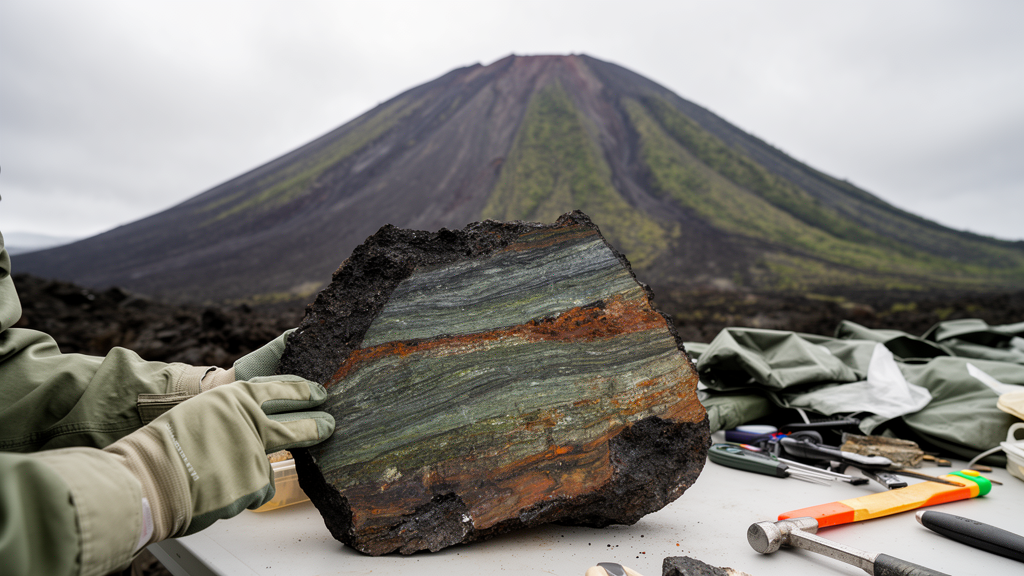
Deep beneath the island arcs and ocean trenches that stitch together the western Pacific, tectonic plates grind past and beneath one another in one of the planet’s most consequential geological processes. When two plates converge, the denser of the two bends and sinks into the mantle, dragging surface rocks to extraordinary depths along the way. An international research team led by the University of Göttingen has now reported the discovery of a rock from Papua New Guinea that records a descent of more than 90 kilometers into a subduction zone a mere four million years ago, making it the most recently formed ultrahigh-pressure eclogite known. What makes the find remarkable is not simply the depth the rock reached, but the thermal story it preserves: a journey that began under surprisingly hot conditions at moderate depth and ended under far colder conditions deeper down, a transition that current models of subduction zones do not predict.
The rock in question is an eclogite, a strikingly beautiful red-and-green rock that forms when basaltic oceanic crust is buried to great depths and recrystallizes under immense pressure. The red comes from garnet, the green from the sodium-rich pyroxene omphacite, and together they signal that the rock has experienced pressures far beyond those at which ordinary crustal minerals are stable. Eclogites are therefore treated by geologists as messengers from the deep, carrying information about conditions in the uppermost mantle back to the surface when subducted material is exhumed. The specimen analyzed in the new study was collected from an outcrop in Taleba Bay on Goodenough Island, in the Milne Bay province of Papua New Guinea, a region where the collision of the Australian and Pacific plates has created one of the most tectonically energetic landscapes on Earth.
To interrogate the rock, the researchers deployed a combination of cutting-edge analytical techniques capable of resolving pressure and temperature conditions at very fine scales. The decisive evidence came from tiny inclusions of coesite, a high-pressure polymorph of silica, trapped inside a host mineral during the rock’s formation. Coesite is a diagnostic mineral for ultrahigh-pressure metamorphism: it only forms at pressures equivalent to burial depths of roughly 90 kilometers or more, and its preservation as minute inclusions requires that the host crystal acted as a sealed pressure vessel, protecting the coesite from transforming back to quartz as the rock rose toward the surface. Finding coesite therefore allowed the team to conclude with confidence that their sample had been subducted to at least 90 kilometers below the surface, where it experienced temperatures of around 800 degrees Celsius.
The truly unexpected result emerged when the researchers compared conditions at different stages of the rock’s burial history. By reconstructing the pressure and temperature pairs recorded at shallower and deeper levels of the subduction path, they found that temperatures at around 45 kilometers depth were only about 100 degrees Celsius cooler than those at the maximum depth of more than 90 kilometers. In other words, the rock passed through a zone of anomalously high temperature at intermediate depth before entering a regime with a much colder geothermal gradient. Because temperature normally increases steadily with depth in a subducting slab, a gradient that steepens only modestly over nearly 50 kilometers of additional burial implies a dramatic thermal transition, one that the team describes as a change from very hot subduction at shallow levels to the more common colder subduction at depth.
Dr Jan Schönig of the Göttingen University Geoscience Center, who led the study, explained the significance of the observation: finding this change from hot to cold subduction was unexpected, he noted, because it contradicts current thermal models of subduction zones. Standard numerical models generally depict subduction zones as cold features overall, because the downgoing slab is much cooler than the surrounding mantle and acts as a thermal sink, chilling the interface region along which rocks descend. Hot conditions are expected to develop gradually with depth as the slab warms and as mantle material flows around it, not to appear early in the burial history and then give way to colder conditions. The Papua New Guinea eclogite records precisely the opposite pattern, forcing geodynamicists to reconsider how heat is distributed within the upper reaches of subduction channels.
Rocks recording higher-than-expected temperatures have been documented before, and anomalous thermal gradients have been inferred from other ultrahigh-pressure localities around the world. What distinguishes the new study is the clarity with which it captures a complete journey from shallow to deep levels, accompanied by an unambiguous shift to a relatively colder gradient. Previous reports could often be explained by later heating events or by uncertainties in the pressure-temperature reconstructions. Here, the coesite inclusions and the associated mineral assemblages pin down the thermal evolution along a continuous path, making this the first time such a hot-to-cold transition during a single subduction episode has been demonstrated so convincingly in a single rock.
The researchers consider two principal explanations for the anomaly, which may also operate in combination. The first is that rocks at shallow subduction depths are heated far more intensely than previously assumed, potentially because of shearing stress along the plate contact. As the downgoing plate grinds against the overriding plate, frictional and mechanical work could generate localized heat in the subduction channel, elevating temperatures at depths of a few tens of kilometers well above what conductive models predict. The second possibility is temporal: the subduction zone in question may simply not yet have had time to cool and evolve toward the lower temperatures expected of a mature system. Young subduction zones, in which cold oceanic material has only recently begun to descend, may transiently record hotter conditions before steady-state thermal structure is established. A combination of shear heating and youthful subduction could plausibly account for the full pattern preserved in the eclogite.
Understanding which of these mechanisms dominates matters far beyond the academic satisfaction of refining a thermal model. Subduction zones are the sites of the planet’s largest earthquakes and much of its explosive volcanic activity, and both hazards are intimately controlled by temperature. Earthquake rupture depends on the frictional properties of the plate interface, which vary with thermal structure, while the melting processes that feed arc volcanoes are governed by the flux of water and heat in the subducting slab and the mantle wedge above it. A subduction zone that runs hotter at shallow depths than models assume could shift the boundaries of seismogenic behavior, altering where large earthquakes nucleate and how deep they extend. Accurate thermal models are therefore a prerequisite for meaningful seismic hazard assessment in convergent margins.
The implications extend to the chemistry of the Earth system as a whole. Subduction zones act as the planet’s long-term recycling valve, returning carbon dioxide and other volatile compounds locked in oceanic crust and sediments to the mantle, a process that has helped stabilize Earth’s climate over millions of years. The temperatures rocks experience during descent control how much carbon and other elements are released from the slab into the overlying mantle and atmosphere through arc volcanism, and how much is carried deeper into the mantle for long-term storage. If shallow levels of young or rapidly shearing subduction zones are systematically hotter than assumed, the fluxes of carbon and other geochemically important species through these systems could differ substantially from current estimates, with consequences for reconstructions of the long-term carbon cycle across geological time.
The study also speaks to one of the deepest questions in geology: how subduction has operated over millions to billions of years and how it continues to shape the planet today. Plate tectonics is the defining feature of Earth among the rocky planets of the solar system, and the thermal regime of subduction zones is central to how the mantle cools, how continents grow and recycle, and how the surface and interior exchange material. Every well-constrained pressure-temperature path from a natural laboratory such as Goodenough Island provides a ground-truth check on the numerical models that extrapolate these processes through deep time. The research, published in Nature Geoscience as a study led by Schönig and colleagues documenting a geothermal gradient change recorded by ultrahigh-pressure eclogite, was supported by funding from the German Research Foundation. As more young ultrahigh-pressure rocks are identified and analyzed with increasingly sensitive techniques, geologists may find that the hot-to-cold transition recorded in this four-million-year-old traveler is not an oddity, but a common and previously overlooked chapter in the life of every young subduction zone.
Subject of Research: Thermal evolution and geothermal gradient changes in subduction zones recorded by ultrahigh-pressure eclogite from Papua New Guinea
Article Title: Two kinds of subduction recorded in one rock
Article References: Two kinds of subduction recorded in one rock. (n.d.). Original publication
Image Credits: AI Generated
DOI: Not provided
Keywords: subduction zones, eclogite, ultrahigh-pressure metamorphism, coesite, geothermal gradient, Papua New Guinea, plate tectonics, shear heating, carbon cycle, earthquakes, volcanism, Nature Geoscience
Cite Scienmag News
Violet Maxwell. (October 9, 2026). Papua New Guinea Rock Reveals a Surprising Hot-to-Cold Shift Inside a Subduction Zone. Scienmag. https://scienmag.com/papua-new-guinea-rock-reveals-a-surprising-hot-to-cold-shift-inside-a-subduction-zone/
Violet Maxwell. "Papua New Guinea Rock Reveals a Surprising Hot-to-Cold Shift Inside a Subduction Zone." Scienmag, 9 October 2026, https://scienmag.com/papua-new-guinea-rock-reveals-a-surprising-hot-to-cold-shift-inside-a-subduction-zone/. Accessed 9 October 2026.
Violet Maxwell. "Papua New Guinea Rock Reveals a Surprising Hot-to-Cold Shift Inside a Subduction Zone." Scienmag. October 9, 2026. https://scienmag.com/papua-new-guinea-rock-reveals-a-surprising-hot-to-cold-shift-inside-a-subduction-zone/


