


Some 34 million years ago, Earth lurched from a hothouse world into an icehouse one. The Eocene–Oligocene Transition, one of the most dramatic climatic upheavals of the entire Cenozoic Era, saw atmospheric carbon dioxide decline, ocean gateways shift, and a vast ice sheet grow across Antarctica for the first time. In the oceans, the transition is written clearly in a sharp rise in oxygen isotope values between roughly 34.4 and 33.6 million years ago. On land, however, the story has remained stubbornly murky, with different regions of the world apparently responding in wildly different ways. Now, a team of geologists and paleontologists led by Paul Botté of Aix-Marseille University has recovered one of the most complete terrestrial records of this pivotal interval from central Anatolia in Türkiye, and their findings are reshaping how scientists understand the climate chaos that accompanied one of the great faunal upheavals in mammalian history.
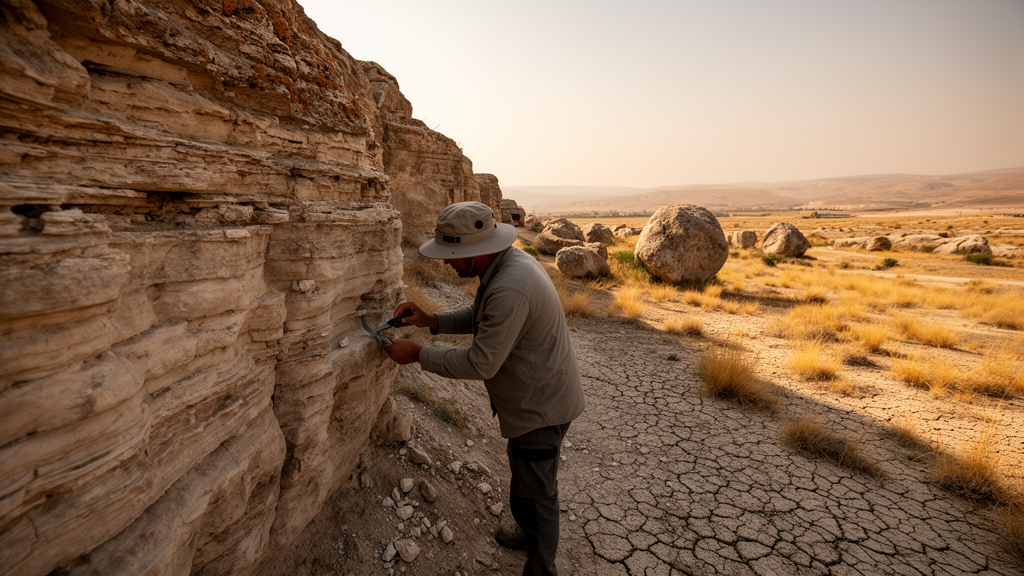
The new study, published in the journal Climate of the Past, focuses on a nearly 200-meter-thick stack of sedimentary rocks exposed near the village of Büyükteflek in the Çankırı Basin, at the northern edge of the Kırşehir Massif in central Anatolia. This region sits within Balkanatolia, a semi-continuous strip of land that stretched from the Alps to the Lesser Caucasus during the Paleogene and that biogeographers now recognize as a critical stepping stone between Asia and western Europe. During the Eocene, Balkanatolia was a mosaic of islands isolated by the Paratethys Sea to the north and east, the Neotethys Ocean to the south, and narrower seaways to the northwest. That isolation bred endemism: for millions of years, the province hosted its own distinctive cast of mammals found nowhere else. Only as tectonic shortening and falling sea levels stitched the islands together, first in the east through Anatolia and later in the west, did land connections to the rest of Laurasia begin to re-emerge.
To pin down the age of the Büyükteflek section, the researchers combined magnetostratigraphy, the record of ancient reversals of Earth’s magnetic field preserved in the rocks, with uranium–lead dating of interbedded volcanic ash layers and marine microfossil biostratigraphy. They drilled and oriented 110 core samples from red clays, silts, and paleosol carbonates, demagnetized them step by step in alternating fields and at progressively higher temperatures, and isolated the characteristic remanent magnetization carried by magnetite and hematite grains. Six distinct magnetic polarity zones emerged from the section. Correlating these with the geomagnetic polarity time scale, anchored by ash beds dated at about 32.1 and 32.6 million years ago, showed that the lower part of the section spans the Priabonian stage of the late Eocene, beginning around 37.7 million years ago, while the upper part records the early Rupelian stage of the Oligocene, including the Eocene–Oligocene Glacial Maximum at about 33.65 million years ago.
The sedimentology tells its own vivid story. The lower part of the section consists of fine-grained red floodplain deposits, channelized sandstones, and paleosols, representing a broad alluvial plain drained by southward-flowing rivers. Two prominent unconformities punctuate the sequence. The first, marked by an erosional surface cut into a well-developed caliche, records the uplift of the Çiçekdağı anticline to the south, a reorganization of the drainage network, and the birth of a northward-flowing system feeding a new lake in the basin. Above the second unconformity, a striking change appears: the soil carbonates switch from pure calcite to dolomite. Because dolomite typically precipitates in hypersaline settings where evaporation outpaces freshwater input, its arrival signals rising lake salinity and a shift toward markedly drier conditions, a conclusion reinforced by the thick Oligocene evaporite deposits found elsewhere in the Çankırı Basin.
The most striking results come from clumped isotope thermometry, a geochemical technique that measures the tendency of heavy carbon and oxygen isotopes to bond together within carbonate minerals. Because this bonding is temperature-dependent, the abundance of these isotope clumps in pedogenic carbonates, the nodules and caliches that form in ancient soils, provides a direct gauge of the temperature at which the carbonate crystallized. The team analyzed 14 carefully screened samples on a Thermo 253+ mass spectrometer, running ten to twenty replicates per sample across 28 analytical sessions to achieve a repeatability of about 30 parts per million. Petrographic examination confirmed that the carbonates retained their original micritic textures with no evidence of burial recrystallization, and the reconstructed temperatures all fell within plausible Earth-surface values, giving confidence that the primary climate signal had survived.
The temperature record divides cleanly into three phases. In the early to middle Priabonian, soil carbonate formation temperatures averaged a temperate 24.4 degrees Celsius. Then, beginning in the middle Priabonian around 37 million years ago, temperatures jumped by roughly 9 degrees Celsius, with samples between the two unconformities averaging 34 degrees. Finally, above the second unconformity, temperatures fell by about 7 to 8 degrees, settling at an average of 27.4 degrees as the Eocene–Oligocene Glacial Maximum approached. Statistical tests confirmed that all three groups differ significantly. Because soil carbonates in mid-latitude seasonal climates tend to form during warm, dry periods of soil dewatering, the researchers interpret these values as tracking warm-season, or summer, temperatures rather than annual means, a reading consistent with pollen-based temperature estimates from slightly older Lutetian deposits in Anatolia.
The warming phase is the headline discovery. Marine records from the Southern Ocean and the North Atlantic have long hinted at a Late Eocene Warming between about 37.5 and 36.5 million years ago, but this is the first quantitative terrestrial record of the event in western Eurasia. Its cause remains debated: some evidence points to rising atmospheric carbon dioxide late in the Eocene, while other work implicates a reorganization of North Atlantic ocean circulation, including the possible onset of a subtropical gyre or an early version of the Atlantic meridional overturning circulation around 36 million years ago. Crucially, the warming in Anatolia coincided with the first of two aridification steps. Reconstructed soil water oxygen isotope values rose by about 1.7 per mil, a pattern the authors attribute to progressive evaporative enrichment of soil moisture, and a modest rise in carbon isotope values hints at increasing plant water stress. Together, the data sketch a late Eocene Anatolia that was both hotter and drier than before.
The second aridification step, beginning around 35.2 million years ago, is the more consequential one. It coincides with the lake retreat recorded at the second unconformity, spans the Eocene–Oligocene Transition itself, and culminates in the cooling and salinity increase of the earliest Oligocene. Notably, this drying began at least 1.5 million years before the peak of Antarctic glaciation, which means it cannot be a simple consequence of the ice sheet’s growth. Instead, the authors suggest it reflects an earlier, spatially uneven cooling of the North Atlantic, where shifting ocean gyres responding to falling carbon dioxide levels redistributed heat and moisture well before the classic glacial maximum. The lake level drop, in other words, was decoupled from global sea level, pointing to a regional hydroclimatic crisis rather than a glacio-eustatic one.
These climatic swings map onto one of the most famous events in mammalian evolution: the Grande Coupure, the great faunal rupture that saw roughly 55 percent of western Europe’s placental mammal genera go extinct as mammals of Asian origin poured in. The timing is telling. The late Eocene warming and the first aridification step cover the mammalian biohorizons MP18 and MP19, exactly when the first Asia-derived taxa, including the anthracotheriid artiodactyl Elomeryx, the possible gelocid Phaneromeryx, and the amphicyonid carnivoran Cynodictis, trickled through Balkanatolia into western Europe. Environmental stress from heat and drought may have weakened Balkanatolia’s endemic fauna, which all but vanished during the Priabonian, while opening ecological space for Asian newcomers that had been present in the province since the Bartonian. Recent diversification modeling supports the idea that climate stress, rather than direct competition with the invaders, drove the decline of Europe’s native lineages.
Yet the story carries an ironic twist. During the second aridification step and the glacial maximum itself, faunal exchange between Balkanatolia and western Europe appears to have stopped, even though the sea-level fall at the glacial maximum fully connected the western Balkanatolian landmass to western Europe. The authors suggest that the drying and cooling created a persistent environmental barrier across central and southern Europe, one possibly sharpened by orographic effects on precipitation from the rising Alps, that blocked the westward march of Asian mammals until exchanges resumed later in the Rupelian. The last known endemic Balkanatolian mammal, the embrithopod Axainamasia sandersi, clung on until around the transition, showing that some island relics persisted even as their world grew hotter, drier, and then colder. What emerges from the hills of central Anatolia is a portrait of a continent in climatic flux, where successive pulses of warming, drying, and cooling did not merely accompany the fall of one fauna and the rise of another, but actively choreographed it.
Subject of Research: Terrestrial climate change in Anatolia across the Eocene–Oligocene Transition and its role in mammalian dispersal
Article Title: Anatolia (Türkiye) during the late Eocene and the Eocene–Oligocene Transition: successive warming and cooling, aridification, and implications for the westward dispersal of Asian terrestrial mammals
Article References: Botté, P., Licht, A., Jourdan, A.-L., Montheil, L., Demory, F., Kaya, M., Ocakoğlu, F., Akkiraz, M. S., İbilioğlu, D., Coster, P., Métais, G., Raynaud, B., & Beard, K. C. (2026). Anatolia (Türkiye) during the late Eocene and the Eocene–Oligocene Transition: successive warming and cooling, aridification, and implications for the westward dispersal of Asian terrestrial mammals. Climate of the Past, 22(9), 1585-1608. https://doi.org/10.5194/cp-22-1585-2026
Image Credits: AI Generated
Keywords: Eocene–Oligocene Transition, Anatolia, clumped isotope thermometry, paleoclimate, aridification, mammal dispersal, Grande Coupure, Balkanatolia, magnetostratigraphy, pedogenic carbonates, Antarctic glaciation, Climate of the Past
Cite Scienmag News
Sloane Callahan. (October 9, 2026). Ancient Turkish Rocks Reveal the Warming and Drying That Paved the Way for Europe’s Great Mammal Invasion. Scienmag. https://scienmag.com/ancient-turkish-rocks-reveal-the-warming-and-drying-that-paved-the-way-for-europes-great-mammal-invasion/
Sloane Callahan. "Ancient Turkish Rocks Reveal the Warming and Drying That Paved the Way for Europe’s Great Mammal Invasion." Scienmag, 9 October 2026, https://scienmag.com/ancient-turkish-rocks-reveal-the-warming-and-drying-that-paved-the-way-for-europes-great-mammal-invasion/. Accessed 9 October 2026.
Sloane Callahan. "Ancient Turkish Rocks Reveal the Warming and Drying That Paved the Way for Europe’s Great Mammal Invasion." Scienmag. October 9, 2026. https://scienmag.com/ancient-turkish-rocks-reveal-the-warming-and-drying-that-paved-the-way-for-europes-great-mammal-invasion/


