


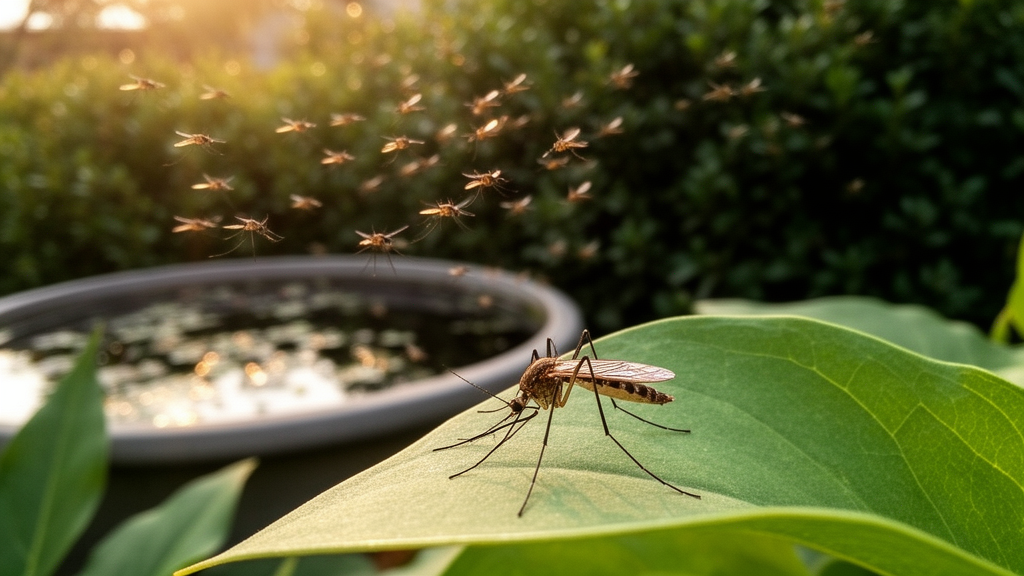
Mosquitoes are among the most closely studied insects on Earth, yet one of the most basic questions about their biology—how far they travel and why—remains surprisingly difficult to answer. A new study published in PLOS Complex Systems argues that the answer has been hiding in plain sight, in the everyday behaviors that dominate a mosquito’s short life: mating, sugar feeding, blood feeding, oviposition, and resting. Héctor M. Sánchez C. of the University of Washington and colleagues show that when mosquito movement is modeled as a sequence of purposeful searching flights rather than as random diffusion, dispersal emerges as a richly structured phenomenon that conventional models systematically miss.
For decades, the dominant mathematical descriptions of mosquito dispersal have belonged to two families: reaction–diffusion equations, which treat mosquito populations as continuous densities that spread smoothly across space, and patch-based metapopulation models, which exchange mosquitoes between habitat patches according to simple flux assumptions. Both approaches have been enormously productive, underpinning predictions of pathogen spread and the planning of control interventions. But they share a critical simplification. In each, the emigration of mosquitoes from one location to another is treated as a statistical process, a flux governed by distance and density, rather than as the outcome of individual insects making decisions.
The new work takes the opposite approach. Sánchez C. and his collaborators built two behavioral state microsimulation models, computational frameworks in which each simulated mosquito occupies a discrete behavioral state—searching for a host, seeking aquatic habitat to lay eggs, looking for sugar, resting—and must locate the resources it needs on a model landscape. Movement in these models is not prescribed by a diffusion coefficient. Instead, individual mosquitoes execute sequences of flights, guided by simple rules of detection and orientation, and population-level dispersal arises as an emergent property of countless individual searches. The shift is conceptually significant: dispersal is no longer an input to the model but a phenomenon the model must explain.
Models of this kind are notoriously laborious. Defining behavioral states, resource distributions, transition rules, and movement mechanics by hand, then solving and analyzing the resulting simulations, is a bottleneck that has kept microsimulation out of mainstream mosquito ecology. To remove that obstacle, the team developed ramp.micro, an open-source R package for building, solving, analyzing, and visualizing behavioral state microsimulation models for mosquitoes. The package, which integrates with the broader R Analysis Platform for Mosquitoes ecosystem, allows researchers to specify landscapes, resource distributions, and mosquito life histories, then run simulations and dissect the resulting movement patterns with reproducible workflows.
The payoff of the behavioral approach is a set of findings that challenge standard intuitions about mosquito dispersal. The most striking concerns population structure. When the authors analyzed simulated mosquito movement patterns with crude statistical tools of the sort often applied to field data, the underlying behavioral structure of the population was not revealed. Mosquitoes that differed sharply in their behavioral states and flight histories could appear, from a coarse snapshot of positions, to belong to a single well-mixed swarm. Only analyses that account for sequences of flights—individuals progressing through behavioral states while trying to accomplish specific goals—exposed the true structure lurking beneath the surface.
This result carries a caution for empirical studies. Mark–release–recapture experiments and genetic estimates of dispersal typically summarize movement as distances traveled or rates of spread, collapsing the rich temporal structure of individual flight sequences. If that structure matters, as the simulations suggest it does, then some of the apparent disagreement among field estimates of mosquito dispersal may reflect not biological variation but measurement artifacts: the same population can look structured or unstructured depending on how its movement is summarized. The study implies that inferring dispersal from observed positions alone risks missing the very organization that governs how pathogens and genes actually move through mosquito populations.
A second finding is equally consequential. Even when the team distributed resources randomly and uniformly across the landscape—with no environmental features, no water bodies, no clusters of hosts, no habitat heterogeneity of any kind—simulated mosquito populations spontaneously formed highly structured spatial communities. Structure emerged from behavior rather than from the environment. The mechanism is intuitive once stated: a mosquito that finds resources returns repeatedly to the places where it found them, and the patchy geometry of individual search histories, aggregated across many insects, breaks the uniformity that the landscape itself possesses. Local searching behavior, in other words, manufactures spatial organization from nothing.
The authors push the analysis further by showing that some of the heterogeneity in simulated mosquito densities can be attributed to properties of a network defined by searching itself. In this view, each mosquito’s sequence of flights traces a path through the landscape connecting the resources it visits, and the aggregate of these paths forms a network whose nodes are resource locations and whose links are realized search trajectories. The topology of this search network—which locations are commonly visited together, which remain isolated from the bulk of movement—predicts where mosquitoes accumulate. Dispersal, on this account, is not merely a property of distance and density but of connectivity generated by how insects search for what they need.
For mosquito-borne pathogen transmission, these dynamics are anything but academic. The intensity of malaria, dengue, and other vector-borne transmission depends critically on how vectors are distributed relative to susceptible hosts, and on how quickly mosquitoes colonize new habitat after interventions such as larval source management or insecticide spraying. Models that assume smooth diffusive spread may misrepresent both processes. If real mosquito populations, like the simulated ones, form tightly structured local communities even in homogeneous environments, then transmission hotspots and barriers to gene flow could arise without any visible environmental cause. Conversely, ignoring resource availability as a driver of movement could lead control programs to misjudge how far and how fast resistant genes, or suppressive gene drive constructs, will spread after release.
The study’s authors argue that the broader lesson is the importance of local context. A mosquito’s movement is shaped not only by how far it can fly but by what it can find, where it can find it, and what behavioral state it happens to occupy when it sets out. Spatial models for mosquito ecology and pathogen transmission, they conclude, would benefit from treating resource availability as a first-class factor affecting movement and dispersal, rather than folding it implicitly into background parameters. The ramp.micro package is offered as a practical step in that direction, giving researchers the tools to build mimetic, behaviorally explicit models without the engineering burden that previously made such models impractical. If the approach scales from simulation to field-relevant landscapes, it may force a reconsideration of what field measurements of mosquito dispersal actually measure—and reveal that the geography of disease is written, in large part, in the searching behavior of a few millimeters of insect.
Subject of Research: Behavioral state microsimulation modeling of mosquito dispersal and resource searching
Article Title: Mosquito dispersal in context
Article References: Mosquito dispersal in context. (n.d.). https://doi.org/10.1371/journal.pcsy.0000108
Image Credits: AI Generated
DOI: 10.1371/journal.pcsy.0000108
Keywords: mosquito dispersal, behavioral states, microsimulation, ramp.micro, PLOS Complex Systems, reaction-diffusion models, resource availability, spatial structure, mosquito ecology, pathogen transmission, population models, search behavior
Cite Scienmag News
Reid Dalton. (October 9, 2026). Why Mosquitoes Stay Local: Behavioral Models Reveal Hidden Structure in Dispersal. Scienmag. https://scienmag.com/why-mosquitoes-stay-local-behavioral-models-reveal-hidden-structure-in-dispersal/
Reid Dalton. "Why Mosquitoes Stay Local: Behavioral Models Reveal Hidden Structure in Dispersal." Scienmag, 9 October 2026, https://scienmag.com/why-mosquitoes-stay-local-behavioral-models-reveal-hidden-structure-in-dispersal/. Accessed 9 October 2026.
Reid Dalton. "Why Mosquitoes Stay Local: Behavioral Models Reveal Hidden Structure in Dispersal." Scienmag. October 9, 2026. https://scienmag.com/why-mosquitoes-stay-local-behavioral-models-reveal-hidden-structure-in-dispersal/


