


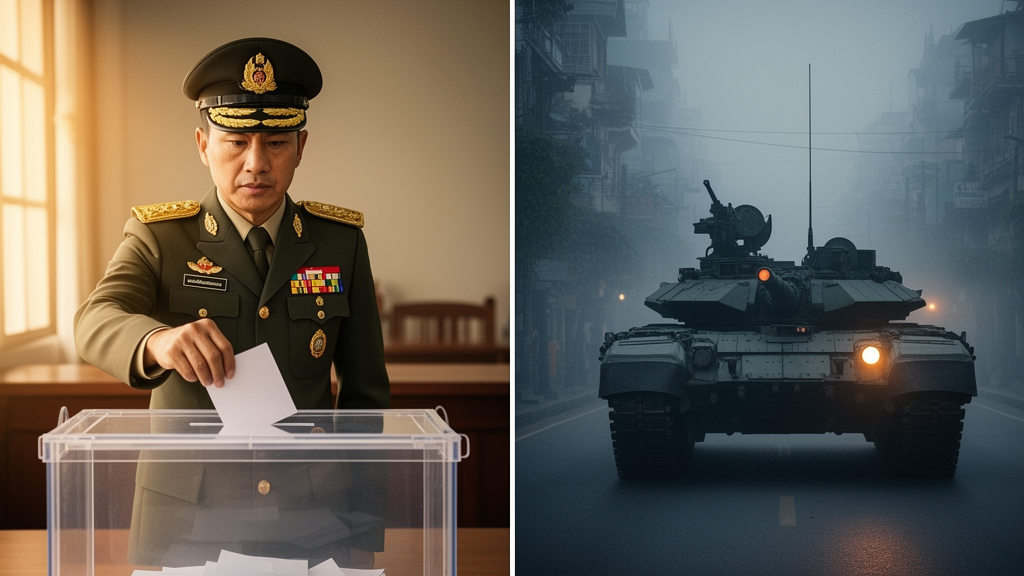
When Myanmar’s military seized power in February 2021, it did so at an extraordinary cost. The coup triggered mass resistance, economic collapse, international condemnation, and a civil conflict that continues to bleed the country. Yet the same armed forces had spent more than a decade wrapped in a constitution of its own design, one that guaranteed it a quarter of parliamentary seats, control of key ministries, and an appointed bloc in every regional legislature. Why launch a coup when the rules already protected you? And why, at almost the same moment, did Thailand’s military confront an even more threatening electoral result in 2023 and respond not with tanks but with constitutional maneuvering and parliamentary arithmetic? A new comparative study published in SN Social Sciences argues that the answer lies not in static conditions but in something scholars have largely overlooked: the accumulated capacity of a military-led coalition to adapt its institutions over time.
The study, authored by Lingkai Kong of the NOVA School of Law in Lisbon, Istanbul University, and the University of Lisbon’s Institute of Social Sciences, introduces the concept of institutional adaptation. Kong defines it as the accumulated ability of a military-led conservative coalition to convert political crises into durable institutional safeguards. The definition is deliberately dynamic. Where existing scholarship on civil-military relations has emphasized institutional legacies, threat perception, or factional balances within the officer corps, those factors explain the conditions a military faces at any given moment. They do not explain how intervention strategies evolve across successive crises. Kong’s framework does, by breaking institutional adaptation into three measurable dimensions: institutional design capability, coalitional embeddedness, and strategic iteration.
Institutional design capability refers to the technical skill with which a military coalition drafts and layers constitutional and legal protections. Coalitional embeddedness captures how deeply those protections are woven into the surrounding political economy, tying courts, bureaucracies, business elites, and electoral bodies into the conservative project. Strategic iteration describes the learning process itself: each crisis becomes a test of the existing institutional toolkit, and each failure or partial success feeds into the next round of design. A military that iterates successfully accumulates a repertoire of intervention techniques, moving progressively from blunt instruments toward refined, deniable ones. A military that fails to iterate is left holding a single, brittle tool that either works completely or not at all.
Thailand, in Kong’s account, is the paradigm case of successful institutional adaptation. The Thai military has intervened in politics repeatedly since the mid-twentieth century, and each intervention generated institutional residue. The 2014 coup, which removed the elected government after months of street protests and a blocked election, was followed not by open-ended junta rule but by an intensive constitution-writing exercise. The 2017 constitution that emerged embedded an appointed senate with the power to participate in selecting the prime minister, entrenched proportional electoral formulas designed to weaken large parties, and empowered a judiciary willing to dissolve parties and disqualify politicians. These were not improvised measures. They were the product of a coalition that had learned, across decades, to translate raw coercive power into legal architecture.
The payoff appeared in 2023. The Move Forward Party, riding a wave of youth support and demanding reforms that touched the military’s core interests, won the largest number of seats in the general election. In an earlier era, such a result might have invited another coup. Instead, the military-aligned coalition relied on the institutional toolkit it had spent years assembling. The appointed senate declined to support the reformist candidate for prime minister, parliamentary coalition-building stalled, and the constitutional court later moved against the party itself. The intervention was executed through constitutional and judicial channels, slow and procedural rather than dramatic, but effective in keeping the reformists from power. Kong characterizes this as the maturation of Thai intervention strategy: the military no longer needs to seize the state because it has learned to steer it from within the rules.
Myanmar followed a sharply different trajectory. The 2008 constitution, drafted under the previous junta and approved through a tightly controlled referendum, was a masterpiece of pre-emptive constitution-making in its own right. It reserved parliamentary seats for appointed military officers, granted the commander-in-chief authority over three security ministries, and created an electoral commission appointed by the executive. But Kong’s analysis shows that these safeguards formed a single-layer design. Unlike Thailand’s layered accumulation of constitutions, senates, courts, and party regulations built across multiple crises, Myanmar’s military wrote one comprehensive document and treated it as sufficient. The institutional design capability was real but was exercised once, in a single concentrated act, rather than iteratively refined.
The 2020 election exposed the brittleness of that single layer. The National League for Democracy won another overwhelming victory, and the military’s allegations of fraud found no institutional remedy. The union election commission rejected the claims, the courts offered no avenue for redress that the military trusted, and the constitutional channels for contesting the result simply did not exist. Because the 2008 constitution had never been stress-tested and updated through successive crises, there was no fallback repertoire. When the institutional channel failed, the military reverted to the only instrument left: direct control through a coup. The result was the costly, destabilizing intervention that existing static theories struggle to explain, since the constitutional safeguards on paper had not actually eroded.
The comparison carries implications well beyond Southeast Asia. Scholars of authoritarian institutions have long argued that constitutions, parties, and legislatures help dictators survive by making commitments credible and by co-opting potential rivals. Kong’s framework adds a temporal dimension to that insight. Institutions do not merely stabilize a regime at a moment in time; their value depends on whether the ruling coalition keeps adapting them as political conditions shift. A military that treats constitution-making as a one-time insurance policy may find the policy has lapsed precisely when it is needed. A military that treats every crisis as a design opportunity builds a self-reinforcing system in which even landslide electoral defeats can be managed without firing a shot.
The study also reframes how observers should read seemingly democratic episodes in hybrid regimes. Thailand’s 2023 crisis was resolved, on the surface, through parliamentary votes and court rulings, procedures that look constitutional from the outside. Kong’s analysis suggests that such proceduralism can itself be the most sophisticated form of military intervention, one that is harder for domestic opponents and international actors to contest because it wears the mask of legality. Conversely, Myanmar’s coup, for all its brutality, may signal institutional weakness rather than strength: a coalition that had exhausted its toolkit. Whether Myanmar’s military can now rebuild institutional adaptation from the wreckage of direct rule, and whether Thailand’s layered system can absorb a rising generation of reformist politics, are the open questions the framework sets up for future research.
For comparative politics more broadly, the research offers a portable analytical lens. Any military-led or dominant conservative coalition, whether in Southeast Asia, the Middle East, or elsewhere, can be assessed along the three dimensions of design capability, embeddedness, and iteration. The prediction is straightforward: coalitions that score high on all three will favor constitutional, judicial, and electoral forms of intervention, while those that score low will fall back on direct coercion when crises arrive. The Thai and Myanmar cases, so often lumped together as examples of entrenched military influence, turn out to sit at opposite ends of an adaptive spectrum. The difference is not how much power the generals hold, but how many times they have practiced converting crisis into law.
Subject of Research: Comparative analysis of how institutional adaptation shapes military intervention strategies in Thailand and Myanmar
Article Title: Institutional adaptation and the evolution of military intervention strategy: a comparative analysis
Article References: Kong, L. (2026). Institutional adaptation and the evolution of military intervention strategy: a comparative analysis. SN Social Sciences, 6(10), Article 516. https://doi.org/10.1007/s43545-026-01820-y
Image Credits: AI Generated
DOI: 10.1007/s43545-026-01820-y
Keywords: institutional adaptation, military intervention, Thailand, Myanmar, civil-military relations, coups, constitutional design, authoritarian institutions, comparative politics, 2021 Myanmar coup, Thai judiciary, hybrid regimes
Cite Scienmag News
Gavin Prescott. (October 9, 2026). Why Thailand’s Generals Chose Ballots While Myanmar’s Chose Tanks: A New Theory of Military Adaptation. Scienmag. https://scienmag.com/why-thailands-generals-chose-ballots-while-myanmars-chose-tanks-a-new-theory-of-military-adaptation/
Gavin Prescott. "Why Thailand’s Generals Chose Ballots While Myanmar’s Chose Tanks: A New Theory of Military Adaptation." Scienmag, 9 October 2026, https://scienmag.com/why-thailands-generals-chose-ballots-while-myanmars-chose-tanks-a-new-theory-of-military-adaptation/. Accessed 9 October 2026.
Gavin Prescott. "Why Thailand’s Generals Chose Ballots While Myanmar’s Chose Tanks: A New Theory of Military Adaptation." Scienmag. October 9, 2026. https://scienmag.com/why-thailands-generals-chose-ballots-while-myanmars-chose-tanks-a-new-theory-of-military-adaptation/


