


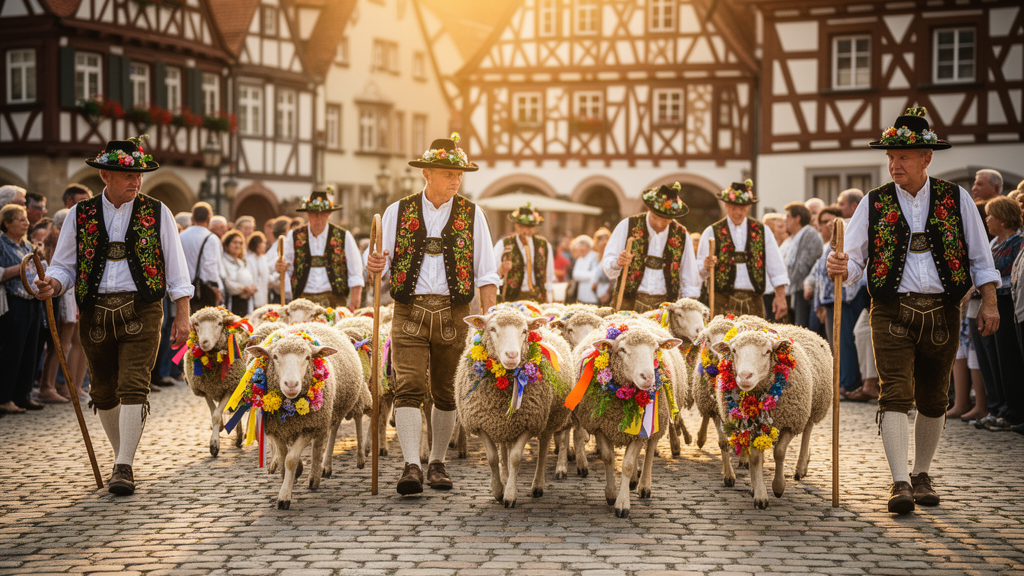
In the small Swabian town of Bad Urach in southern Germany, thousands of people gather every two years for the Schäferlauf, a folk festival officially celebrated since 1723 and added to Germany’s national list of Intangible Cultural Heritage by the UNESCO Commission in 2018. On the surface, it is a colorful spectacle: shepherds demonstrating herding skills, a traditional foot race, a theatrical performance, folk dances, and a grand Sunday parade that in 2025 drew an estimated 25,000 to 30,000 visitors. But new research argues that something far more psychologically significant is unfolding beneath the costumes and brass bands. According to a study published in Geographica Helvetica by Joanna Jurkiewicz and Ilse Helbrecht, cultural geographers at Humboldt-Universität zu Berlin, the festival functions as what they call a “doing” of ontological security – a lived, embodied practice through which people anchor their identities and find stability in an era of overlapping global crises.
The concept of ontological security was developed by sociologist Anthony Giddens, building on the psychologist R. D. Laing, to describe the confidence most people have in the continuity of their self-identity and in the constancy of their social and material surroundings. Without this baseline sense of predictability, individuals tend to experience anxiety and disorientation that can undermine their capacity to act. Catarina Kinnvall’s influential work extended the idea to globalization, arguing that the erosion of what she called the “protective cocoon of relational ties” leaves people searching for stabilizing anchors such as routines and biographical continuity. Much of the existing literature has focused on how people narrate security – through symbolic or mythical stories of an imagined, stable past – a strategy studied extensively in the context of far-right populism and religious nationalism.
Jurkiewicz and Helbrecht’s contribution is to shift the analytical focus from what people say to what people do. Their study, part of a broader qualitative project on geographical imaginations and ontological security in rural areas of Germany and Canada, is based on fieldwork in Bad Urach conducted in 2022 and 2023. The researchers carried out 24 qualitative interviews, two collective mapping sessions with a total of eight participants, participant observation, and document and media analysis. They also employed two image-based techniques: photograph elicitation, in which participants reacted to researcher-selected images including a photograph of the town’s market square during the Schäferlauf, and reflexive photography, in which participants took their own pictures on themes such as home, nature, global crises, and locality. Participants were recruited through snowball sampling and direct contacts, and in the second year the researchers deliberately included people actively engaged in the festival as performers, organizers, or behind-the-scenes supporters.
The interviews revealed that the festival’s stabilizing power begins long before the three days of public celebration. For months in advance, residents meet in clubhouses, community centers, and private homes to rehearse, sew costumes, sing, dance, and cook together. One interviewee recalled how, as a child living near the Amandus Church, they were woken at six in the morning by bells as performers sought water for their horses or a spare button for a uniform, and later peeled potatoes at five in the morning with other members of the local choir association. The researchers describe these preparatory networks as communities of practice – social formations in which knowledge is created and passed on through shared activity. Crucially, these bonds extend beyond the festival itself: the festival’s prominent dance group, the Schäferreigen, performs at other events, and its members organize trips together and form lasting friendships.
The embodied dimension of this security is perhaps most vivid in the traditional costumes, or Tracht. One dancer described wearing a costume so old that its previous wearers are uncountable, noting that she knows many women have danced in it before her and that she will eventually have to give it back. The researchers interpret the passing on of costumes from generation to generation as a material ritual that marks both an ending and a new beginning, connecting the wearer’s body to the history of the community. Security, in this account, is not merely narrated in interviews but felt in and through the body – co-produced by bodies, discourses, and material objects. Even stepping back from active participation does not sever the bond: former dancers become Altschäfer, “old shepherds” who remain embedded in the festival’s backstage economy, serving beer at rehearsals and helping with organization.
The festival also anchors a place identity that persists across distance and disruption. Former residents, the Alt-Uracher, described returning to Bad Urach for the Schäferlauf as almost an obligation; one interviewee remarked that booking a vacation during the festival and missing it is a mistake a person makes only once. As one participant put it, classmates who have ended up all over the world are still expected to come home for the event. The researchers read these rituals of return through Massey’s notion of a “global sense of place”: the anchor is not static but shaped through movement, return, and networks connecting the local to the global. Being a Uracher, in this framing, means always having a place to come back to – a form of spatial knowledge that itself generates security in a globalized world.
Crises, paradoxically, have reinforced the festival’s stabilizing role. Interviewees noted that the COVID-19 pandemic cancelled the official 2021 Schäferlauf, but the town staged a small, scaled-down version as a “sign of loyalty,” and the administration refused the convenient excuse to let the tradition die. By contrast, the town of Heidenheim cancelled its own Schäferlauf after the 2008 financial crisis and has not held it since. The persistence of the Bad Urach festival through disruption, the researchers argue, is what cements its function as a resilient practice that sustains local identity. The study also documents how new rituals can emerge organically within the festival’s framework: the Laurentia, a children’s folk song and simple squatting dance performed by hundreds in the market square after the Saturday theatre performance, is not part of the official programme and only dates back some fifty years, yet it has become an anticipated, place-bound ritual that everyone knows.
The findings are not uniformly celebratory. The researchers emphasize that the festival’s continuity is contested and that its stabilizing force is unevenly distributed. Some residents expressed simple disinterest – one said they could not relate to the music at all, another that they did not have “that gene” for festival participation. More pointedly, interviewees criticized songs in the Schäferreigen that glorify sexualized violence in wartime and an annual theatre play whose author had historical ties to Nazi Germany and whose portrayal of women one female participant found unwatchable, suggesting it be modernized. Another interviewee, a newcomer living in the town’s new residential area rather than the historic core, described the social distance between the two as a wall, saying she felt excluded from local traditions and rituals. In such cases, the researchers conclude, the same continuity that secures some residents can produce ontological insecurity for others, reinforcing boundaries along gendered and established–outsider lines.
The study’s broader significance lies in reframing ontological security as an active, situated, and material practice rather than a purely narrative or symbolic construct. Festivals, the authors suggest, are not merely representations of a past community but sites where community and continuity are actively produced through recurrent, shared, embodied engagements with place and tradition. At the same time, they caution that attachment to continuity can itself become a mechanism of boundary-making, essentializing local identities and upholding existing power structures. Understanding heritage as a present-day practice with a contemporary function, they argue, opens the possibility – and the necessity – of change: examining how narratives of continuity are challenged over time, how festivals respond to critique, and how stabilizing practices might be reworked so that the security they generate does not depend on excluding those who do not fit the inherited script.
Subject of Research: The role of traditional festivals and heritage practices in producing embodied ontological security in times of crisis
Article Title: “Doing” ontological security: on the role of traditional festivals and heritage in times of crisis
Article References: Jurkiewicz, J., & Helbrecht, I. (2026). “Doing” ontological security: on the role of traditional festivals and heritage in times of crisis. Geographica Helvetica, 81(3), 393-405. https://doi.org/10.5194/gh-81-393-2026
Image Credits: AI Generated
Keywords: ontological security, traditional festivals, intangible cultural heritage, Schäferlauf, Bad Urach, qualitative research, place identity, embodied practice, crisis, rural Germany, cultural geography, community
Cite Scienmag News
Courtney Benton. (October 9, 2026). How a 300-Year-Old Shepherd Festival Helps Germans Feel Secure in a Crisis-Ridden World. Scienmag. https://scienmag.com/how-a-300-year-old-shepherd-festival-helps-germans-feel-secure-in-a-crisis-ridden-world/
Courtney Benton. "How a 300-Year-Old Shepherd Festival Helps Germans Feel Secure in a Crisis-Ridden World." Scienmag, 9 October 2026, https://scienmag.com/how-a-300-year-old-shepherd-festival-helps-germans-feel-secure-in-a-crisis-ridden-world/. Accessed 9 October 2026.
Courtney Benton. "How a 300-Year-Old Shepherd Festival Helps Germans Feel Secure in a Crisis-Ridden World." Scienmag. October 9, 2026. https://scienmag.com/how-a-300-year-old-shepherd-festival-helps-germans-feel-secure-in-a-crisis-ridden-world/


