


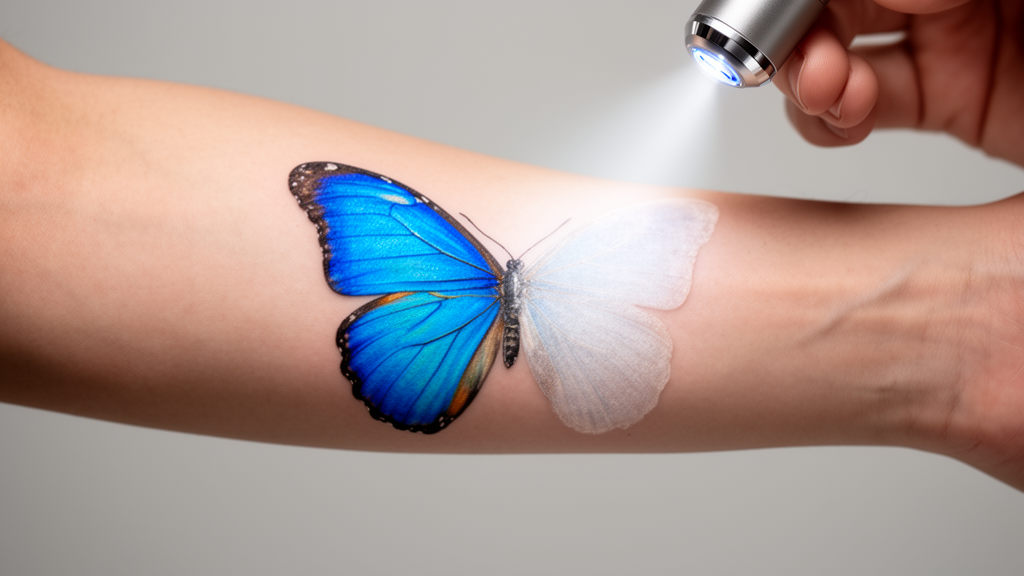
Tattoos have long been defined by one inescapable quality: permanence. Once pigment is deposited in the skin, the design stays put, whether at a job interview, a family gathering, or a medical appointment. A team of engineers at the University of Colorado Boulder now wants to give body art an off switch. In a study publishing October 9 in the Cell Press journal Matter & Light, lead author Carson Bruns and his colleagues describe a new line of multicolored tattoo inks, branded PhotoTat, that switch on and off with different kinds of light, allowing wearers to reveal a vivid design in seconds and erase it from view almost as quickly.
“Tattooing is a very ancient technology that remains mostly untapped as a platform for today’s technologies,” says Bruns, a lead author of the study. For Bruns, the project is also personal: he has many tattoos of his own, including a green lion on his arm, and he views body art as one of the most personal forms of self-expression. “I love body art because of how personal it is,” he says.
The inks are built around a familiar material with a long medical track record. The team starts with polymethyl methacrylate, or PMMA, a plexiglass-like polymer already common in commercial medical technologies, including dermal fillers. During fabrication, the PMMA forms incredibly small spheres that look almost as though they were made of glass. Into these protective spheres, the researchers insert a range of color-changing dyes, encapsulating the photochromic molecules in a biocompatible shell before the ink ever touches skin.
That encapsulation matters for several reasons. Photochromic dyes change their molecular structure when struck by specific wavelengths of light, shifting between a colorless form and a brightly colored form. In their normal state, the dyes inside PhotoTat inks are completely invisible to the human eye. When ultraviolet light shines on them, they convert to their colored forms within a matter of seconds, turning vibrant blue, magenta, or yellow. Encasing the dyes in PMMA spheres helps isolate them from the surrounding tissue while still allowing light to reach them, providing a stable microenvironment in which the reversible color change can occur over and over.
The colors fade back to invisibility over several hours on their own, but the process can be accelerated. Exposing the tattooed area to a bright LED light switches the dyes off faster, giving wearers a deliberate way to erase a design before, say, a formal business meeting. “PhotoTat is like a switch. You turn it on with UV light, but you can turn it off again when you go to grandma’s house,” Bruns says.
Because the inks come in multiple switchable colors, they can be combined. “By mixing these primary colors, we can generate a full color image,” Bruns explains. The system functions much like a photographic print in reverse: instead of fixing an image permanently, the skin becomes a rewritable canvas. In principle, a wearer could even doodle on their own skin with a simple laser pointer, sketching temporary designs that appear where the light lands and vanish hours later or on demand.
The researchers see applications well beyond cosmetics. Many patients undergoing radiation therapy for cancer receive small permanent tattoos on their bodies so that doctors can align the radiation beams accurately during each treatment session. These markers are functional, but they are also permanent, and for some patients they carry a heavy emotional weight. “They’re not beautiful, and they become a permanent reminder of a traumatic experience,” Bruns says. “With PhotoTat, we could turn an involuntary medical tattoo into something that’s only visible to the doctor when you go in the clinic, and then it can be invisible the rest of the time.”
The technology has not yet reached tattoo parlors, and important questions remain before it does. Bruns has not yet determined whether the inks are safe for people, and the team plans to continue improving the designs in the coming years in hopes of eventually making them available to body art fans across the country. Bruns, for his part, has tested the inks on his own body: he has a black outline of fish scales on his leg that he has filled in with PhotoTat inks. With a little light, the scales shift to red, orange, blue, and more, an effect he compares to “magical mermaid scales.”
Bruns also hopes the work changes perceptions on a broader level. “There’s a stigma, in science and in many cultures, around body art,” he says. “I’m proud to be pushing against that.” By coupling one of humanity’s oldest forms of self-expression with modern materials chemistry, the PhotoTat team is reimagining the tattoo as something flexible, private, and interactive, a design that belongs to its wearer not just in ink, but in light.
Subject of Research: Photochromic nanoparticle inks for light-switchable smart tattoos
Article Title: Invisible tattoos that appear with light
Article References: Invisible tattoos that appear with light. (n.d.). Original publication
Image Credits: AI Generated
DOI: Not provided
Keywords: smart tattoos, photochromic inks, PMMA nanoparticles, UV light, Cell Press, Matter & Light, Carson Bruns, University of Colorado Boulder, color-changing dyes, radiation therapy markers, body art, rewritable tattoos
Cite Scienmag News
Courtney Benton. (October 9, 2026). Light-Switch Tattoo Inks Turn Colorful Designs On and Off at Will. Scienmag. https://scienmag.com/light-switch-tattoo-inks-turn-colorful-designs-on-and-off-at-will/
Courtney Benton. "Light-Switch Tattoo Inks Turn Colorful Designs On and Off at Will." Scienmag, 9 October 2026, https://scienmag.com/light-switch-tattoo-inks-turn-colorful-designs-on-and-off-at-will/. Accessed 9 October 2026.
Courtney Benton. "Light-Switch Tattoo Inks Turn Colorful Designs On and Off at Will." Scienmag. October 9, 2026. https://scienmag.com/light-switch-tattoo-inks-turn-colorful-designs-on-and-off-at-will/


