


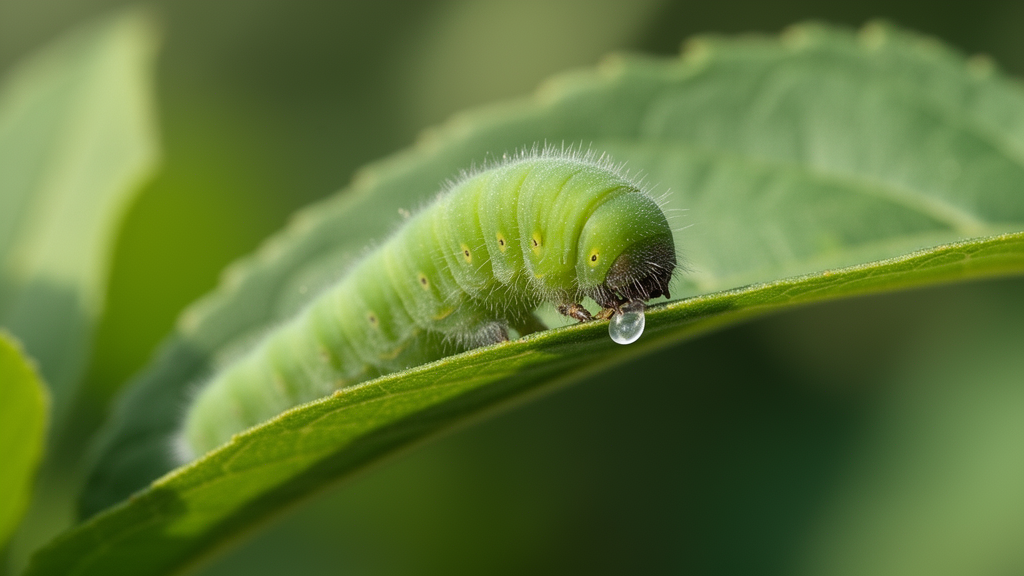
One of the most dramatic stories in evolutionary biology is playing out in the leaves, stems, and fruits that caterpillars devour every night. Plants, rooted in place and unable to flee, have armed themselves with an astonishing chemical arsenal, and among their most notorious weapons are furanocoumarins, compounds that become dangerously reactive when exposed to sunlight. A new study published in PLOS Biology now reveals how a caterpillar’s internal chemistry can disarm these toxins, and why that ability appears to separate the picky eaters from the gluttons of the moth world.
The research, led by Huidong Wang, Shutang Zhou, and colleagues together with Chris Bass, focuses on two very close relatives: the cotton bollworm, Helicoverpa armigera, and the tobacco budworm, Helicoverpa assulta. Both belong to the same genus of noctuid moths, and both are serious agricultural pests, yet their diets could hardly be more different. H. armigera is a celebrated generalist, or polyphage, recorded feeding on hundreds of plant species across dozens of families. H. assulta, by contrast, is a specialist, or oligophage, whose menu is largely confined to plants in the nightshade family, such as tobacco and chili pepper. The question the team set out to answer was whether differences in detoxification biochemistry could underpin this striking divergence in dietary breadth.
Plants in several families, most famously the umbellifers such as wild carrot and parsnip, produce furanocoumarins as a defensive strategy. These molecules are not merely bitter; under ultraviolet light they cross-link DNA and proteins, causing severe cellular damage in any animal foolish enough to eat them. Herbivores therefore face a double burden: they must either avoid sunlit exposure of the toxin inside their own tissues or chemically modify it before it can do harm. Insects that manage this feat gain access to a rich, relatively uncontested food resource, which is why furanocoumarin detoxification has long fascinated chemical ecologists.
Insects typically handle plant toxins in two linked stages, mirroring the detoxification systems of vertebrate livers. Phase I enzymes, dominated by the cytochrome P450 monooxygenases, chemically modify a toxic molecule, for example by adding an oxygen atom or cleaving a chemical side chain. Phase II enzymes then attach a sugar, a glutathione, or another conjugate to the modified compound, making it water-soluble and far less reactive so that it can be excreted. UDP-glycosyltransferases, or UGTs, are among the most important Phase II players, gluing glucose molecules onto toxins. Although both phases are well studied individually, direct evidence that a specific P450 and a specific UGT work as an orchestrated cascade against a defined plant defense has been scarce. The new study provides some of the clearest demonstrations to date.
The investigators began with a comparative genomics sweep across Helicoverpa species and related noctuid moths, asking which detoxification gene families had expanded most dramatically in the genus. The answer was the UGT33 family. Among all UGT lineages examined, UGT33 stood out as the most extensively expanded and the most dynamically diversified in Helicoverpa, a pattern consistent with these enzymes being shaped by an ongoing arms race with plant chemistry. Gene family expansions of this kind are a classic signature of adaptation: when a herbivore encounters a new toxin, duplicated genes are free to mutate, specialize, and take on novel catalytic roles without compromising the original copies.
Correlation, however, is not causation, so the team turned to CRISPR-Cas9 gene editing in the polyphagous H. armigera. By knocking out clusters of UGT33 genes, they created mutant caterpillars lacking this enzymatic repertoire and then challenged them with two furanocoumarins: xanthotoxin and imperatorin. The results were unambiguous. Caterpillars with intact UGT33 clusters tolerated doses of these compounds that proved significantly more damaging to the knockout insects, demonstrating that the expanded UGT33 family is not a genomic relic but an essential working component of furanocoumarin defense.
The next step was to trace the actual metabolic route by which the toxin is dismantled, and here the study delivers its most elegant result. Using combined metabolic profiling and functional assays of purified enzymes, the researchers showed that a specific P450, CYP6AE19, acts first. This enzyme can process xanthotoxin in two ways: it can perform an O-dealkylation reaction that strips a methoxy group to yield xanthotoxol, or it can hydroxylate an aromatic carbon on the ring to produce 5-hydroxyxanthotoxin. Either way, the P450 creates a chemical handle, a free hydroxyl group, on the molecule. That handle is precisely what the UGT33 enzymes need. In the second stage of the cascade, UGT33 glycosyltransferases attach a glucose to the newly created hydroxyl, converting the intermediate into a glucoside that is markedly less toxic to the insect.
This two-step arrangement is biochemically compelling because each phase solves a problem the other cannot. Furanocoumarins are hydrophobic and difficult for sugar-adding enzymes to access directly; the P450 step activates the molecule and increases its polarity, while the glycosylation step locks the modified toxin into an inert, excretable form. Neither enzyme family alone achieves efficient detoxification, which explains why the study emphasizes coordination between CYP6AE19 and UGT33 as the key to tolerance. The finding elevates the classic Phase I-Phase II framework from a textbook generalization to a genetically defined, functionally validated pathway in an insect pest.
The comparison with the specialist H. assulta then revealed the evolutionary stakes. In this oligophagous species, the CYP6AE19-UGT33 partnership is impaired, and the consequences are visible in both biochemistry and survival: the caterpillars detoxify xanthotoxin less effectively and are highly sensitive to the compound. In other words, the generalist and the specialist carry different functional versions of the same detoxification logic, and those differences track their tolerance of the toxins their food plants produce. Because furanocoumarins are concentrated in umbellifers and other plants outside the nightshade specialty of H. assulta, a weak furanocoumarin defense imposes a real ecological constraint, while the robust cascade in H. armigera helps open up a vastly broader menu.
The implications extend well beyond moth biology. Understanding the precise enzymatic machinery that lets a devastating polyphagous pest neutralize chemical defenses could inform pest management strategies, from breeding crop varieties with targeted defensive compounds to designing inhibitors that knock out the insect’s detoxification enzymes and resensitize it to plant toxins. More broadly, the study shows how gene family expansion, functional divergence, and ecological specialization intertwine: a duplicated UGT lineage and a capable P450, working in concert, appear to have helped one species become a global crop pest while its sibling remained a specialist. The arms race between plants and insects continues, but for once, scientists have caught both of the combatant’s hands at work, one modifying the weapon and the other disarming it.
Subject of Research: Coordinated P450-UGT detoxification of furanocoumarins and its role in host plant range divergence in Helicoverpa moths
Article Title: Coordinated P450–UGT detoxification contributes to furanocoumarin tolerance associated with host plant range divergence in Helicoverpa
Article References: Wang, H., Kong, Y., Su, X., Shi, Y., Zhang, J., Wang, Y., Xiao, Y., Geng, X., Song, J., Ye, Y., Zuo, K., Bass, C., & Zhou, S. (2026). Coordinated P450–UGT detoxification contributes to furanocoumarin tolerance associated with host plant range divergence in Helicoverpa. PLOS Biology, 24(9), e3004013. https://doi.org/10.1371/journal.pbio.3004013
Image Credits: AI Generated
DOI: 10.1371/journal.pbio.3004013
Keywords: Helicoverpa armigera, Helicoverpa assulta, furanocoumarins, cytochrome P450, UDP-glycosyltransferase, detoxification, host plant range, CRISPR-Cas9, plant chemical defense, xanthotoxin, herbivorous insects, PLOS Biology
Cite Scienmag News
Gavin Prescott. (October 9, 2026). Enzyme Tag-Team Lets Caterpillarpests Beat Plant Toxins and Expand Their Menu. Scienmag. https://scienmag.com/enzyme-tag-team-lets-caterpillarpests-beat-plant-toxins-and-expand-their-menu/
Gavin Prescott. "Enzyme Tag-Team Lets Caterpillarpests Beat Plant Toxins and Expand Their Menu." Scienmag, 9 October 2026, https://scienmag.com/enzyme-tag-team-lets-caterpillarpests-beat-plant-toxins-and-expand-their-menu/. Accessed 9 October 2026.
Gavin Prescott. "Enzyme Tag-Team Lets Caterpillarpests Beat Plant Toxins and Expand Their Menu." Scienmag. October 9, 2026. https://scienmag.com/enzyme-tag-team-lets-caterpillarpests-beat-plant-toxins-and-expand-their-menu/


