


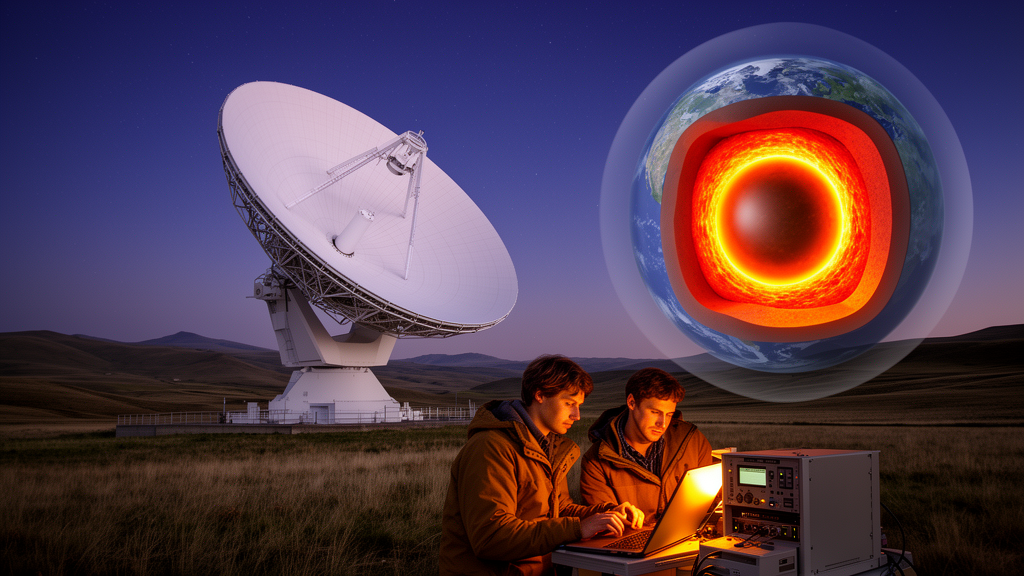
Deep beneath our feet, some 2,900 kilometers down, a molten ocean of iron churns against the rocky mantle above it, and at the very center of the planet a solid iron crystal spins within that liquid shell. Scientists have long tried to infer how tightly these layers grip one another, because the answer shapes everything from the generation of Earth’s magnetic field to the length of our days. Now, a team at the Royal Observatory of Belgium and the Paris Observatory has extracted fresh clues from an unexpected source: the tiny, persistent wobble of Earth’s spin axis as measured by radio telescopes over nearly half a century. Their conclusion is striking. The liquid outer core and the solid mantle appear to be coupled more strongly than current models predict, and the solid inner core seems less rigidly locked to the outer core than researchers had assumed.
The study, published in the journal Solid Earth, analyzed Very Long Baseline Interferometry, or VLBI, observations spanning 1980 to 2025. VLBI works by pointing networks of radio telescopes scattered across the globe at the same distant quasars, the brilliant active nuclei of galaxies billions of light-years away. Because quasars are so remote, they serve as almost perfectly fixed reference points in the sky. By measuring the tiny differences in the arrival times of each quasar’s radio wavefront at different telescopes, geodesists can determine Earth’s orientation in space with extraordinary precision, down to microarcseconds, an angular unit equivalent to resolving a coin on the Moon. That stability is what makes VLBI the only technique capable of tracking Earth’s precession and nutation, the slow conical drift and periodic nodding of the spin axis, against a truly inertial celestial frame.
Nutation is the key to probing the deep interior. The gravitational tug-of-war between Earth and the Sun, Moon, and planets on a perfectly rigid, spherical planet can be calculated with exquisite accuracy. Any deviation between that idealized prediction and what VLBI actually observes must be caused by the real planet’s imperfections: its flattened, fluid-filled, deformable interior, the sloshing of ocean tides, and the elasticity of its rocks. In the language of geophysics, these deviations are captured by a set of quantities called Basic Earth Parameters, which encode the planet’s dynamical ellipticity, the deformability of its layers, and the coupling strengths at the boundaries between the mantle, the liquid outer core, and the solid inner core. Estimating them accurately is equivalent to performing a tomographic scan of the planet’s deepest reaches using nothing but its rotation.
The conventional nutation model in use today, known as MHB2000 and adopted by the International Astronomical Union in 2003, was built on VLBI data covering only two decades, from 1980 to 1999, and fitted with classical least-squares methods. The new work, led by Yuting Cheng, builds on a Bayesian approach pioneered in 2008 but modernizes it substantially. Instead of linearizing the problem, the team used an ensemble Markov Chain Monte Carlo sampler, a statistical engine that deploys hundreds of parallel random walkers to explore the full probability landscape of the parameters. This approach, implemented with the Python package emcee, does not require approximating the relationship between observations and parameters, and it yields not just single best-fit numbers but complete probability distributions, with honest uncertainties attached.
Two technical upgrades proved decisive. First, the team modeled the amplitude of the Free Core Nutation, a natural rotational wobble of the Earth with a period of about 430 days that arises because the planet holds a fluid, flattened core inside a deformable mantle. This mode is excited by poorly understood processes, possibly atmospheric and oceanic loading or abrupt changes in the core’s magnetic field known as geomagnetic jerks, so its strength must be estimated from the data itself. Earlier work represented its variation with straight-line segments; the new study replaced those with smooth cubic splines, which dramatically reduced the tendency of the statistical sampler to get stuck on multiple contradictory solutions. Second, the researchers updated the ocean tidal corrections using the FES2014 global ocean tide atlas, dropping an empirical scaling factor of 0.7 that had been patched into the 2000 model to compensate for crude ocean maps. Modern tidal modeling, it turns out, no longer needs that fudge factor.
The results, consistent across five independent VLBI data series processed by different analysis centers, carry profound geophysical implications. The imaginary part of the coupling constant at the core-mantle boundary, which measures dissipative braking between the liquid core and the mantle, came out larger in absolute value than the 2000 estimate, approaching the two-sigma boundary of the old model. Electromagnetic coupling alone, the standard explanation, struggles to account for it: matching the observed value would require a radial magnetic field of roughly 0.75 millitesla at the boundary and implausibly high, uniform electrical conductivity throughout the lower mantle. The authors point instead to recent theoretical work on topographic coupling, in which the liquid core flows over an irregular, bumpy boundary and internal waves exert a form of drag, a mechanism that could supply the missing dissipation without demanding exotic mantle properties.
The inner core delivered its own surprise. The real part of the coupling constant at the inner core boundary, which reflects how rigidly the solid inner core is attached to the surrounding liquid, came out at roughly half the value in the conventional model. Under a purely electromagnetic interpretation, that weaker coupling implies a magnetic field at the inner core boundary closer to what numerical geodynamo simulations predict, between 0.1 and 0.4 tesla. But the finding also resonates with startling recent seismic discoveries. Independent studies of earthquake waves passing through the planet’s center have suggested that the inner core may deform viscously on timescales of years, and that a mushy, partially molten zone may exist at its boundary. If the inner core boundary is not a surface of hydrostatic equilibrium, as nutation theory has long assumed, the theoretical scaffolding underneath these estimates needs revision.
Even the planet’s bulk deformability showed cracks in the old framework. The compliances that describe how the whole Earth and its fluid core yield under tidal forcing are normally derived from a seismic reference model and extrapolated from seismic frequencies, seconds to hours, up to the daily nutation band using a power law. In the new inversion, one compliance matched expectations while the other, governing the fluid core, came out significantly smaller. Because both are corrected by the same anelastic scaling, a shift in one without the other cannot be fixed by tweaking the extrapolation exponent, pointing to deeper flaws either in the reference Earth model or in the anelastic correction scheme itself. The estimated dynamical ellipticity of the whole Earth, meanwhile, sits at the edge of the old model’s one-sigma range, implying that the core’s equatorial bulge may exceed its hydrostatic value by the equivalent of 370 to 500 meters of radius.
For the researchers, the pattern across so many parameters points in one direction: nutation theory itself is due for a major overhaul, one that integrates realistic core-mantle coupling, fluid dynamics of the outer core, and revised models of the inner core’s behavior into a single consistent framework. The stakes extend beyond pure science. Earth orientation parameters underpin the celestial and terrestrial reference frames on which satellite navigation, spacecraft tracking, and deep-space navigation all depend, so refining them sharpens humanity’s collective aim across the solar system. And every improvement in the precision of these rotation-based probes brings geophysicists closer to answering some of the oldest questions about the engine at the heart of our planet, an engine we cannot visit, cannot drill to, and can only read through the gentle, patient wobble of the world itself.
Subject of Research: Estimation of Basic Earth Parameters and core-mantle coupling from Bayesian inversion of VLBI nutation observations
Article Title: Basic Earth Parameters from VLBI observations using Bayesian inversions in the time domain: updated insights of the Earth's interior
Article References: Cheng, Y., Dehant, V., Rivoldini, A., Rekier, J., & Bizouard, C. (2026). Basic Earth Parameters from VLBI observations using Bayesian inversions in the time domain: updated insights of the Earth's interior. Solid Earth, 17(5), 789-801. https://doi.org/10.5194/se-17-789-2026
Image Credits: AI Generated
Keywords: VLBI, Earth rotation, nutation, core-mantle boundary, inner core, Bayesian inversion, MCMC, Free Core Nutation, geodesy, ocean tides, dynamical ellipticity, Earth's interior
Cite Scienmag News
Grant Pearson. (October 9, 2026). Earth’s Core Is Coupled More Strongly Than We Thought, 45 Years of Radio Telescope Data Reveal. Scienmag. https://scienmag.com/earths-core-is-coupled-more-strongly-than-we-thought-45-years-of-radio-telescope-data-reveal/
Grant Pearson. "Earth’s Core Is Coupled More Strongly Than We Thought, 45 Years of Radio Telescope Data Reveal." Scienmag, 9 October 2026, https://scienmag.com/earths-core-is-coupled-more-strongly-than-we-thought-45-years-of-radio-telescope-data-reveal/. Accessed 9 October 2026.
Grant Pearson. "Earth’s Core Is Coupled More Strongly Than We Thought, 45 Years of Radio Telescope Data Reveal." Scienmag. October 9, 2026. https://scienmag.com/earths-core-is-coupled-more-strongly-than-we-thought-45-years-of-radio-telescope-data-reveal/


