


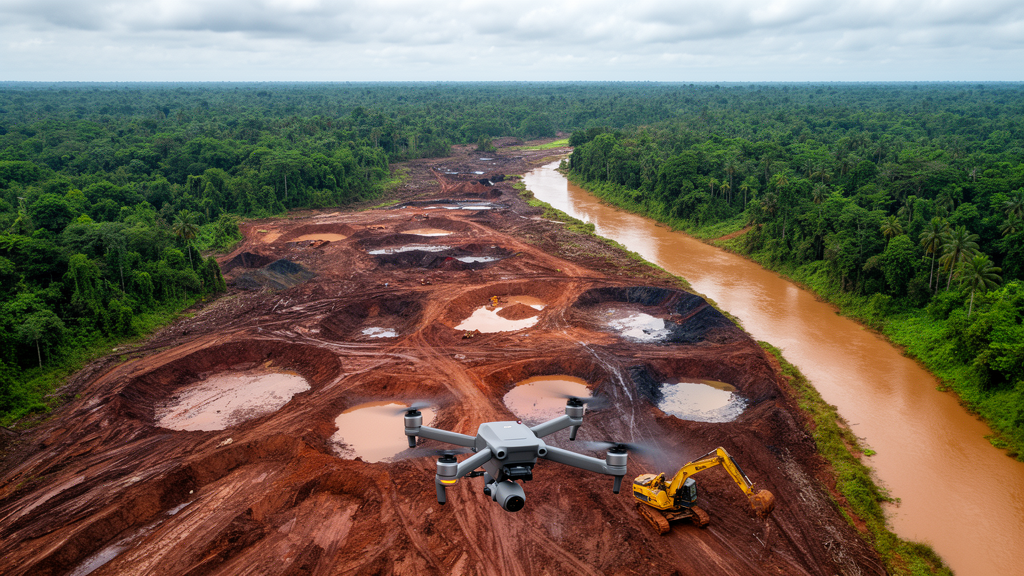
Ghana’s gold rush has gone digital, at least on paper. Across the country, satellite constellations scan forest canopies for the telltale scars of illegal excavation, machine learning algorithms classify mining footprints from orbital imagery, and blockchain pilots promise to trace every gram of gold from pit to export. Yet a sweeping new systematic review suggests that this technological arsenal, however impressive, is failing to deliver on its promises, and the reasons why reveal as much about power and poverty as they do about pixels and code.
The review, published in the journal Environmental Management by Albert Abraham Arhin and Monica Addison of Kwame Nkrumah University of Science and Technology in Kumasi, Ghana, together with Nicholas Opoku of the Indian Institute of Technology (Indian School of Mines) in Dhanbad, India, synthesizes 25 empirical and policy-relevant studies published between 2020 and 2025. Following the PRISMA 2020 guidelines for systematic reviews, the team assessed the evidence across four domains: technology deployment, environmental sustainability, workforce and socioeconomic impacts, and institutional governance. Their conclusion is blunt: technically viable solutions routinely fail to produce expected outcomes in practice because they are not aligned with the governance structures and livelihood realities of the communities they target.
To explain this persistent mismatch, the researchers introduce a concept they call technology–governance–livelihood alignment. The idea is deceptively simple. A monitoring system can only be as effective as the institutions willing and able to act on its outputs, and enforcement can only succeed if the people being regulated have viable alternatives to the activities being policed. When any one of these three elements, technology, governance, or livelihoods, is out of step with the others, even the most sophisticated intervention collapses. In Ghana’s artisanal and small-scale mining sector, known locally as galamsey, all three are frequently misaligned at once.
The technical capabilities themselves are not in dispute. The review found that satellite-based monitoring and machine learning models are demonstrably capable of detecting illegal mining activity and environmental degradation. Studies using Sentinel-1 radar time series have mapped and monitored small-scale mining operations across Ghana, while recent machine learning assessments have quantified the impacts of galamsey on forest vegetation in districts such as Wassa Amenfi East. These tools can identify where mining is expanding, where forest cover is being lost, and where water bodies are being fouled with sediment and chemicals. The problem lies downstream of detection: knowing where illegal mining is happening does not automatically mean anyone will stop it.
That is because the institutional landscape governing Ghana’s mining sector is fragmented in ways that no algorithm can resolve. The review highlights how responsibility is dispersed across national regulatory bodies, customary and traditional authorities, and local government assemblies, each with different mandates, capacities, and incentives. Enforcement capacity is limited, and political dynamics complicate matters further; recent research cited in the review connects party political campaigning to the illegal extraction of gold in Ghana. Military-style crackdowns, such as past operations against galamsey, have been widely criticized for failing to address root causes while criminalizing rural livelihoods. When a satellite flags a new excavation site, the question of who responds, with what authority, and with what resources, remains stubbornly unanswered.
The livelihood dimension is equally decisive. Artisanal and small-scale mining employs hundreds of thousands of Ghanaians, many of them young people with few other economic options, and studies cited in the review document how government bans on the sector have devastated youth livelihoods and disrupted imagined futures in mining communities. Miners who fear losing their only source of income have little incentive to cooperate with monitoring systems, however accurate. Formalization efforts, which aim to bring small-scale miners into the legal economy, have repeatedly stumbled over grassroots perspectives that see little benefit in licensing regimes they cannot afford or navigate. Any digital intervention that ignores this economic reality risks becoming an instrument of surveillance rather than a tool of sustainability.
The environmental stakes of getting this wrong are severe and well-documented. The review confirms that mercury contamination and deforestation are the most thoroughly studied harms associated with artisanal gold mining in Ghana. Mercury is used to amalgamate gold in the ore-processing stage, and research in the Ashanti Region has assessed both the presence of the metal in mining areas and the limited awareness of health risks among exposed populations. Aquatic mercury pollution from artisanal and small-scale gold mining has been documented across sub-Saharan Africa, with consequences that travel up the food chain and downstream through river systems. Meanwhile, forest loss dynamics linked to illegal mining have been traced in districts such as Amansie South, and Global Forest Watch data continue to record tree cover loss across Ghana’s forest zones.
Yet for all the attention to environmental damage, the review identifies a glaring blind spot: workforce and gender impacts remain critically understudied. Women occupy marginal and often precarious positions in the mining economy, occupying the fringes of the sector in roles that are less visible and less remunerated, as research from the Prestea–Huni Valley Municipality has shown. Studies examining gender equality in artisanal and small-scale mining against the United Nations’ Sustainable Development Goals have found progress toward gender equity to be limited, and systematic reviews of women’s positions in the sector across sub-Saharan Africa confirm persistent structural disadvantage. The new review argues that without understanding who works in these mines, under what conditions, and with what exposure to harm, digital interventions cannot be designed to be socially inclusive, and may even entrench existing inequalities by concentrating information and power in the hands of those already advantaged.
The review’s authors do not dismiss digital technology; they insist on integration. Their four-objective contribution framework, which rated studies as having high, medium, or low contributions across the four assessment domains, revealed how unevenly the evidence base is distributed: technology deployment and environmental monitoring are comparatively well covered, while socioeconomic and institutional dimensions lag behind. Successful interventions, they conclude, require strategies that combine technological innovation with governance reform spanning national regulatory bodies, customary and traditional authorities, and local government assemblies acting as the development authorities of their areas, together with livelihood-sensitive approaches that give miners a stake in formalization rather than a reason to evade it. Blockchain-based supply chain transparency, for instance, only works if the gold entering the chain is legally produced in the first place, which brings the problem right back to governance and incentives.
The alignment lens offered by the review arrives at a moment when Ghana’s galamsey crisis has become a national political flashpoint, with civil society campaigns, religious leaders, and international observers all pressing for action against the destruction of rivers and forests. The study’s message to policymakers is sobering but constructive: there is no technological silver bullet. Satellites can see the destruction, and algorithms can predict where it will spread next, but stopping it requires institutions that can act coherently across levels of government, traditional authorities whose legitimacy miners actually recognize, and economic alternatives that make compliance rational for the people whose livelihoods depend on the diggings. Until technology, governance, and livelihoods are brought into alignment, Ghana’s gold fields will remain a place where the most advanced Earth-observation systems in the world watch, in high resolution, as the forests continue to fall.
Subject of Research: Digital technologies, governance, and livelihoods in sustainable artisanal and small-scale gold mining in Ghana
Article Title: Digital Transformation and Smart Mining for Sustainable Small-Scale Mining in Ghana: A Systematic Review of Technology–Governance–Livelihood Interactions
Article References: Arhin, A. A., Addison, M., & Opoku, N. (2026). Digital Transformation and Smart Mining for Sustainable Small-Scale Mining in Ghana: A Systematic Review of Technology–Governance–Livelihood Interactions. Environmental Management, 76(10), Article 335. https://doi.org/10.1007/s00267-026-02595-x
Image Credits: AI Generated
DOI: 10.1007/s00267-026-02595-x
Keywords: artisanal and small-scale mining, galamsey, Ghana, remote sensing, machine learning, blockchain, mercury contamination, deforestation, governance, formalization, livelihoods, gender
Cite Scienmag News
Sloane Callahan. (October 9, 2026). Satellites and Algorithms Alone Cannot Fix Ghana’s Illegal Gold Mining Crisis. Scienmag. https://scienmag.com/satellites-and-algorithms-alone-cannot-fix-ghanas-illegal-gold-mining-crisis/
Sloane Callahan. "Satellites and Algorithms Alone Cannot Fix Ghana’s Illegal Gold Mining Crisis." Scienmag, 9 October 2026, https://scienmag.com/satellites-and-algorithms-alone-cannot-fix-ghanas-illegal-gold-mining-crisis/. Accessed 9 October 2026.
Sloane Callahan. "Satellites and Algorithms Alone Cannot Fix Ghana’s Illegal Gold Mining Crisis." Scienmag. October 9, 2026. https://scienmag.com/satellites-and-algorithms-alone-cannot-fix-ghanas-illegal-gold-mining-crisis/


