


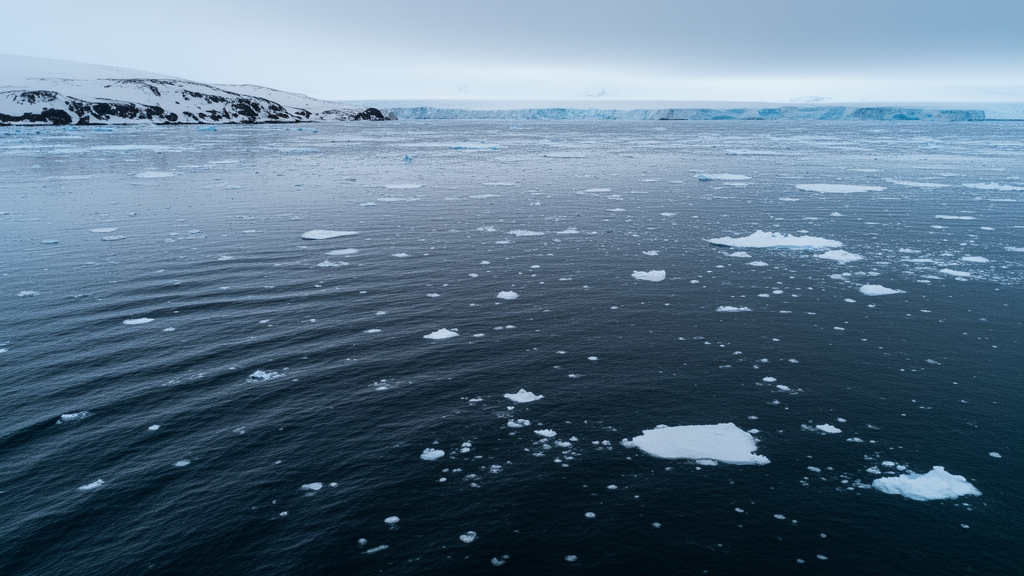
A new generation of climate simulation is painting a starker picture of the North Atlantic and Arctic than the models that have underpinned international climate assessments to date. A team of researchers led by Mehdi Pasha Karami of the Swedish Meteorological and Hydrological Institute has run the high-resolution version of the EC-Earth3 global climate model, known as EC-Earth3-HR, through an exceptionally long and carefully tuned set of simulations spanning 350 pre-industrial years, the full historical period from 1850 to 2014, and a future projection to 2100 under the moderate SSP2-4.5 emissions scenario. Published in Earth System Dynamics as a highlight paper, the study reports that the Arctic could become nearly ice-free in September as early as 2040, several years ahead of what the standard-resolution version of the same model suggests, while the Atlantic Meridional Overturning Circulation, the vast ocean conveyor belt that helps keep Europe temperate, weakens more sharply than previously simulated by this model family.
The technical achievement behind these numbers is considerable. EC-Earth3-HR resolves the atmosphere at roughly 40 kilometres horizontally with 91 vertical levels, and the ocean at 0.25 degrees with 75 depth layers, roughly double the atmospheric resolution and a much finer ocean grid than the standard-resolution configuration used in the sixth phase of the Coupled Model Intercomparison Project, CMIP6. Finer grids matter enormously in this part of the world, because the Arctic is stitched together by narrow straits such as the Fram Strait, the Bering Strait and the passages of the Canadian Arctic Archipelago, through which warm Atlantic water and fresh Arctic outflow must be routed correctly if the simulated climate is to behave realistically. Higher ocean resolution also sharpens the representation of the Gulf Stream and the North Atlantic Current, whose positions control sea surface temperature gradients that feed back into atmospheric circulation and storm tracks.
Crucially, the team did not simply crank up the resolution. Earlier high-resolution experiments under the High Resolution Model Intercomparison Project, HighResMIP, were constrained by short spin-ups of only 30 to 50 years and limited tuning, and in some cases performed no better than their coarser counterparts. The new model, by contrast, underwent a dedicated tuning campaign. The atmosphere was first tuned in standalone runs forced with prescribed sea surface temperatures, targeting a top-of-atmosphere radiative imbalance close to observational estimates, while monitoring surface temperature and precipitation to avoid unphysical drift. The ocean and sea ice components were then tuned through fifteen coupled experiments of 50 to 180 years each under fixed 1981 forcing, iteratively adjusting parameters governing ocean mixing, eddy diffusivity, snow thermal conductivity and sea ice albedo. The result was a model stable enough to sustain a 350-year pre-industrial control run with negligible drift in surface temperature, sea ice, upper-ocean heat content and overturning strength.
The evaluation against observations is broadly encouraging. Global mean surface air temperature in EC-Earth3-HR tracks the ERA5 reanalysis closely, and the model reproduces the observed warming since 1950 better than the standard-resolution ensemble, which runs consistently too warm at the surface of the ocean. Global mean sea surface temperature sits near the HadISST observational dataset. The model also captures the observed amplitude of Atlantic overturning variability measured by the RAPID-MOCHA array at 26.5 degrees north, and it reproduces both the trend and the rapid loss event in Arctic sea ice during the early 2000s. Not every bias disappears: sea surface temperature errors of up to about five degrees Celsius persist along the North American east coast and in the southern subpolar gyre, land temperatures run roughly two degrees too cold, and the double Intertropical Convergence Zone bias survives. But the pattern of improvement is real, and the model’s sea ice and overturning behaviour is now close enough to reality to lend weight to its projections.
Those projections are the headline. Under SSP2-4.5, a middle-of-the-road scenario chosen because it aligns most closely with current stated policies, September Arctic sea ice area in the high-resolution model falls below one million square kilometres, the conventional threshold for practically ice-free conditions, from around 2040, reaching fully ice-free by 2050. The standard-resolution version of the same model does not cross that threshold as early. The high-resolution simulation also warms less overall, both globally and in the Arctic, yet weakens the overturning circulation more. By 2100 the model’s Arctic has warmed by about seven degrees relative to pre-industrial conditions, roughly double the global anomaly of 3.2 degrees, a vivid expression of Arctic amplification. The strongest near-term sea ice losses are projected for the Central Arctic Basin and the Canadian Arctic Archipelago, while the end-of-century winter ice edge retreats most dramatically in the Barents, Greenland and Bering Seas.
The fate of the Atlantic Meridional Overturning Circulation emerges as the study’s deepest contribution. The AMOC transports warm, salty water northward in the upper Atlantic; that water cools, becomes denser and sinks at high latitudes, driving a southward return flow at depth. Reconstructions suggest the circulation has weakened since the mid-twentieth century and may now be weaker than at any time in at least 1,600 years, though the observational record is debated. Climate models agree it will weaken further, but disagree on how fast. In EC-Earth3-HR, the AMOC index drops from about 21 sverdrups to about 13 sverdrups over the twenty-first century, a reduction of roughly 39 percent, compared with about 25 percent in the standard-resolution ensemble. The simulated overturning cell becomes shallower and less extensive, and a pronounced cooling anomaly, the so-called North Atlantic warming hole, develops in the eastern subpolar gyre, concentrated in the upper few hundred metres.
To understand why, the researchers dissected the three great convection regions of the North Atlantic: the Labrador Sea, the Irminger Sea and the Greenland Sea. In all three, surface waters become progressively lighter through the twenty-first century as warming and freshening increase stratification, suppressing the winter deep mixing that feeds dense water into the deep ocean. A volumetric diagnostic, the Deep Mixed Volume, shows deep convection collapsing toward zero by around 2020 in the Greenland Sea and by about 2050 in the Labrador and Irminger Seas. Yet the team is careful to note a subtlety that is often lost in public discussion: deep convection and the overturning circulation are related but not interchangeable. Even after deep mixing ceases entirely in their simulation, roughly two-thirds of the AMOC’s strength persists, because dense water formed elsewhere continues to sink and because the descent of waters crossing the Greenland-Scotland ridges sustains part of the overturning.
The study’s methodological innovation is a new volume-budget framework for diagnosing deep-water formation that does not rely on vertical velocity fields, which many model archives do not store. Instead, it infers sinking from the net horizontal transports of water crossing the lateral boundaries of each convection region, above and below a reference depth of 1,000 metres, with volume conservation dictating the implied downward transfer. Applied to the historical period, the framework attributes about 52 percent of the overturning at 45 degrees north to the Irminger Sea, 22 percent to the Labrador Sea, 14 percent to the Greenland-Iceland-Norwegian Seas and 12 percent to deep Arctic inflow. The budgets close to within 0.1 sverdrups, and the regional decomposition proves robust to alternative choices of reference depth.
Projected forward, the picture is regionally lopsided in a way that matters. By the 2070 to 2100 period, deep-water formation in the Labrador Sea collapses from 3.9 to 0.2 sverdrups, effectively shutting down, while the Greenland Sea loses 62 percent of its contribution and the Irminger Sea only 13 percent. The Labrador Sea therefore emerges as the dominant driver of long-term AMOC weakening, a conclusion reinforced by the strongest correlation between regional deep-water formation and overturning strength over the full simulation. Paradoxically, the Irminger Sea, which contributes the most to sustaining the circulation today, is the most resilient basin, partly because its diagnosed sinking includes the downstream descent of dense overflow waters spilling over the Denmark Strait. Total deep-water formation across the three basins falls by 5.8 sverdrups, slightly exceeding the 5.6 sverdrup decline in the overturning itself, with the small difference compensated by increased deep inflow from the Arctic.
For a general audience, the message is twofold. First, the Arctic’s summer sea ice may vanish within about fifteen years under a moderate emissions pathway, earlier than many standard-resolution assessments imply, with consequences for Arctic ecosystems, Northern Hemisphere weather patterns and the amplification of regional warming. Second, the weakening of the Atlantic overturning is not a single-number story: it is the sum of distinct regional processes, some collapsing quickly and others eroding slowly, and understanding which basin fails first is essential for anticipating how sea surface temperatures, European climate and extreme events will respond. The authors caution that their results rest on a single-member simulation and that ensemble studies, along with refinement of the new diagnostic against observations, will be needed to firm up the timing. But the demonstration that a properly tuned, high-resolution model can reproduce observed sea ice decline and overturning variability, and then project sharper changes than its coarser predecessor, is a significant step toward narrowing the uncertainty that has long shrouded the future of the North Atlantic.
Subject of Research: High-resolution climate modelling of Arctic sea ice decline and Atlantic Meridional Overturning Circulation weakening under climate change
Article Title: Historical Climate and Future Projection in the North Atlantic and Arctic: Insights from EC-Earth3 High-Resolution Simulations
Article References: Karami, M. P., Koenigk, T., Wang, S., Navarro Labastida, R., Kruschke, T., Carréric, A., Ortega, P., Wyser, K., Fuentes Franco, R., de Boer, A. M., Sicard, M., & Aldama Campino, A. (2026). Historical Climate and Future Projection in the North Atlantic and Arctic: Insights from EC-Earth3 High-Resolution Simulations. Earth System Dynamics, 17(4), 1151-1176. https://doi.org/10.5194/esd-17-1151-2026
Image Credits: AI Generated
Keywords: Arctic sea ice, AMOC, North Atlantic, deep-water formation, EC-Earth3, climate modelling, Labrador Sea, Irminger Sea, Greenland Sea, SSP2-4.5, HighResMIP, Arctic amplification
Cite Scienmag News
Violet Maxwell. (October 9, 2026). High-Resolution Climate Model Projects an Ice-Free Arctic by 2040 and a Sharply Weakening Ocean Conveyor. Scienmag. https://scienmag.com/high-resolution-climate-model-projects-an-ice-free-arctic-by-2040-and-a-sharply-weakening-ocean-conveyor/
Violet Maxwell. "High-Resolution Climate Model Projects an Ice-Free Arctic by 2040 and a Sharply Weakening Ocean Conveyor." Scienmag, 9 October 2026, https://scienmag.com/high-resolution-climate-model-projects-an-ice-free-arctic-by-2040-and-a-sharply-weakening-ocean-conveyor/. Accessed 9 October 2026.
Violet Maxwell. "High-Resolution Climate Model Projects an Ice-Free Arctic by 2040 and a Sharply Weakening Ocean Conveyor." Scienmag. October 9, 2026. https://scienmag.com/high-resolution-climate-model-projects-an-ice-free-arctic-by-2040-and-a-sharply-weakening-ocean-conveyor/


