


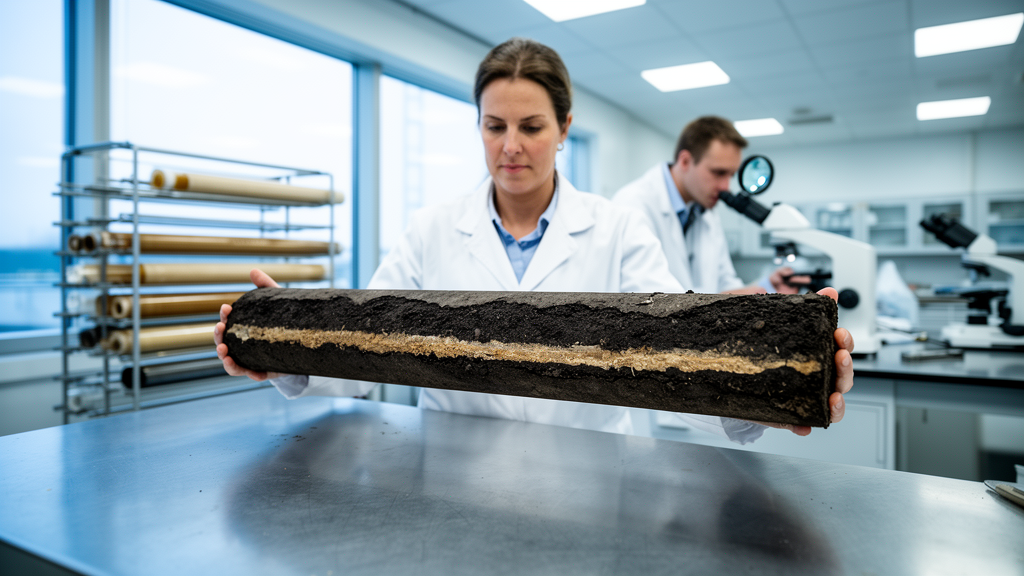
Beneath the grey waters of the southern North Sea, roughly 20 metres below present sea level, lies a vanished landscape of soils, wetlands and rivers that once stretched across what is now open ocean. A team of scientists led by the University of Leeds has now recovered five sediment cores from this drowned terrain, and what they found inside has surprised even the researchers themselves. The cores, collected as part of the European Research Council-funded Rates of Interglacial Sea-level Change and Responses (RISeR) project, reveal an unexpectedly extensive record of Middle Pleistocene terrestrial deposits preserved in the shallow subsurface of the Dutch sector of the North Sea. Rather than the marine sediments many might expect from a seabed site, the cores are dominated by evidence of dry land: in situ peat beds, ancient soil horizons and river deposits that together paint a picture of a long-lost continental interior.
The cores were drilled in July 2020 from the geotechnical drilling vessel MV Normand Flower, operated by Fugro, over just two days of fieldwork. In total, the team retrieved approximately 62 metres of sediment, with the deepest hole reaching 54.3 metres below the lowest astronomical tide. The drilling sites sit within the Hollandse Kust Zuid (HKZ) offshore wind farm zone, an area of roughly 225 square kilometres located 18 to 36 kilometres west of the Dutch coast, where water depths reach about 28 metres. That location was no accident. The team deliberately targeted the wind farm because it lies south of the maximum limits reached by Middle and Late Pleistocene ice sheets, which minimised the chance that glacial erosion had destroyed the sedimentary record, and because the site had already been imaged by an extraordinary wealth of high-resolution seismic survey data collected for wind farm development.
That seismic dataset proved central to the entire endeavour. Between 2016 and 2017, the survey company Fugro conducted comprehensive geophysical investigations on behalf of the Netherlands Enterprise Agency, imaging the shallow subsurface with a subbottom profiler, a single-channel sparker and a high-resolution multi-channel sparker. The single-channel sparker data, collected with a GSO 100-tip source operating at 200 to 300 joules and a peak frequency of 825 hertz, allowed the researchers to map two distinct high-amplitude reflector surfaces in the top 50 metres of sediment. Both reflectors correspond to peat deposits, which have distinctive acoustic properties because organic material attenuates and reflects sound differently from mineral sediments. The upper peat surface is continuous across most of the wind farm site, while the lower peat appears scattered but is attributed to the same stratigraphic level. By targeting boreholes where these peat reflections were present, the team maximised their chances of recovering sediments spanning one or more glacial-interglacial cycles.
Drilling in one of the busiest industrialised shallow seas in the world required careful negotiation of competing interests. The seabed of the HKZ zone is criss-crossed by cables and pipelines, dotted with platforms, and littered with shipwrecks, crashed aircraft and magnetic anomalies, some of which may be unexploded ordnance dating from the two World Wars. The researchers had to map all of these hazards before selecting safe drilling locations. Timing also mattered: final site investigations for the wind farm were underway in 2020, leaving only a narrow window before turbine construction began in July 2021. The wind farm, which now contains 139 turbines with a capacity of 1.5 gigawatts, enough to power 1.5 million Dutch households, was inaugurated in September 2023 and has been fully operational since December of that year. The scientific cores therefore represent a rare collaboration between academic research and the offshore energy industry, extracted from ground that is now literally the foundation of Europe’s renewable energy transition.
Because of pandemic-era operational restrictions, no scientists were aboard the drilling vessel. Instead, the team relied on remote communication while Fugro’s crew handled positioning and drilling. Surface positioning used two StarPack global navigation satellite system receivers, with underwater positioning provided by a Kongsberg Simrad HiPAP 500 ultra-short baseline system. Water depths were measured by multiple independent methods, including echosounders, the drill string itself, and conductivity-temperature-depth probes, and all depths were reduced to the lowest astronomical tide. Open-hole drilling removed the well-documented Holocene sands of the upper seabed, after which semi-continuous liner sampling began at 10 to 12 metres below the seafloor using thin-walled Shelby tubes 7.62 centimetres in diameter. The recovered cores were then transported to the British Ocean Sediment Core Research Facility at the National Oceanography Centre in Southampton, where they were split, imaged with X-ray radiography and laminography, and archived. Since 2021 they have been held in cold storage at the University of Leeds.
The sedimentary sequence inside the cores tells a striking story. Each of the five cores contains an upper and a lower peat unit, separated by semi-consolidated clays, silts, sands and gravels. The lowermost peat is primarily in situ woody peat, but its thickness varies dramatically between sites: in core RISeR_S1 it is less than 0.3 metres thick, an order of magnitude thinner than the roughly 3 metre thick peat deposit in RISeR_S7. In several cores the contact between the lower peat and overlying sediments is abrupt and erosional, while in others it grades gradually into clays, suggesting different histories of flooding and burial. Below the lower peat, the team identified a palaeosol, an ancient soil horizon, recognised by rooting features visible in X-ray laminography, a decalcified upper zone underlain by levels enriched with millimetre-scale calcium carbonate nodules, and distinctive steel-blue hues. These soils formed on land, in the open air, and their presence deep in the seabed is unambiguous evidence of a terrestrial environment.
Integrating the core descriptions with the seismic reflection data revealed how far these units extend laterally. The surface of the upper peat can be traced in the seismic profiles between cores RISeR_S1 and RISeR_S7, and between RISeR_S4 and RISeR_S6, even where a small channel form interrupts the continuity. However, a large channel incision separates the eastern part of the wind farm, where cores RISeR_S5 and RISeR_S6 were drilled, from the western part, so the team cannot yet confirm by seismic tracing alone that the peats on either side represent the same surface. The lower peat is laterally discontinuous between all the core sites, meaning correlations must rely on facies associations with the overlying and underlying units. The researchers caution that the vertical resolution of the multi-channel sparker data is limited to 50 to 100 centimetres, so thinner layers may be invisible, and sound-attenuating peat can mask the dominant lithology of adjacent units. These correlations, they stress, must ultimately be tested with biostratigraphical and geochronological laboratory analyses.
The interpretation of the wider sequence is where the findings become genuinely unexpected. While the in situ peats and their underlying palaeosols are unquestionably terrestrial, the intervening sands and clays could reflect fluvial deposits from the Rhine-Meuse system, including floodplains and channel-fills, or intertidal to shallow marine conditions in lower delta plains and lagoons. Notably, the team found no clear evidence of marine inundation within the cored interval, and the general lack of shells suggests open marine environments are not recorded there. The stacking of terrestrial soil-overprinted units without intercalated marine levels, yet preserved 40 to 50 metres below present sea level, requires a depositional model involving fluvio-deltaic cycles, slow subsidence rates and considerable elapsed time. The researchers tentatively assign the stratigraphy to a temporal window between 1.5 and 0.5 million years ago, after the southern North Sea basin was largely infilled by river deltas but before marine inundation during the sea-level highstands of the Middle and Late Quaternary interglacials. This is a marked contrast to the Late Pleistocene, Eemian age of around 129,000 to 116,000 years ago assigned in the initial wind farm site reports.
Establishing a firmer chronology is the team’s next challenge, and it is a formidable one. The sediments are far too old for radiocarbon dating, which reaches only about 50,000 years, and the traditional chronological framework for the Quaternary North Sea rests on pollen zonation schemes from the Netherlands and Britain that are complicated by variable pollen concentrations and the reworking of older taxa. The researchers are now pursuing detailed palynological analysis to tie the cores into the Dutch pollen chronostratigraphy, alongside experimental luminescence dating and palaeomagnetic investigation. Palaeomagnetic work is particularly promising because it could place the deposits before or after the Brunhes-Matuyama reversal at 774,000 years ago, cleanly separating Early from Middle Pleistocene. Together these parallel approaches should cross-validate the ages and the correlations between the five cores.
The stakes extend well beyond academic curiosity. The heterogeneous Quaternary sediments of the southern North Sea form the physical foundation for a rapidly expanding offshore wind industry, and understanding their architecture is critical input for ground models and geohazard assessment. More broadly, new chronologies for the RISeR cores will allow the vast archive of high-resolution seismic data gathered by the wind industry over the past decade to be transformed into modern geological subsurface models, enabling landscape-scale reconstructions of palaeoenvironmental change for chosen interglacials. During glacial lowstands, the exposed land south of the ice margins also served as a corridor for human migration into northwestern Europe, so refining the history of these drowned landscapes has implications for archaeology as well as climate science. In recovering a lost world from beneath the turbine foundations, the RISeR project demonstrates how industry and science can drill toward the same seabed and both come away with something valuable.
Subject of Research: Middle Pleistocene terrestrial stratigraphy recovered from sediment cores in the southern North Sea
Article Title: The RISeR cores: unexpected and extensive Middle Pleistocene terrestrial stratigraphy in the southern North Sea
Article References: McGuire, A. M., Cartelle, V., Rush, G., Busschers, F. S., Cohen, K. M., Hodgson, D. M., & Barlow, N. L. M. (2025). The RISeR cores: unexpected and extensive Middle Pleistocene terrestrial stratigraphy in the southern North Sea. Scientific Drilling, 34(1/2), 29-39. https://doi.org/10.5194/sd-34-29-2025
Image Credits: AI Generated
Keywords: North Sea, RISeR cores, Middle Pleistocene, palaeosols, peat deposits, seismic reflection, offshore wind, sea-level change, Quaternary stratigraphy, scientific drilling, Rhine-Meuse, palaeolandscape
Cite Scienmag News
Violet Maxwell. (October 9, 2026). Sunken Ice Age World Found Beneath North Sea Wind Farm Cores. Scienmag. https://scienmag.com/sunken-ice-age-world-found-beneath-north-sea-wind-farm-cores/
Violet Maxwell. "Sunken Ice Age World Found Beneath North Sea Wind Farm Cores." Scienmag, 9 October 2026, https://scienmag.com/sunken-ice-age-world-found-beneath-north-sea-wind-farm-cores/. Accessed 9 October 2026.
Violet Maxwell. "Sunken Ice Age World Found Beneath North Sea Wind Farm Cores." Scienmag. October 9, 2026. https://scienmag.com/sunken-ice-age-world-found-beneath-north-sea-wind-farm-cores/


