


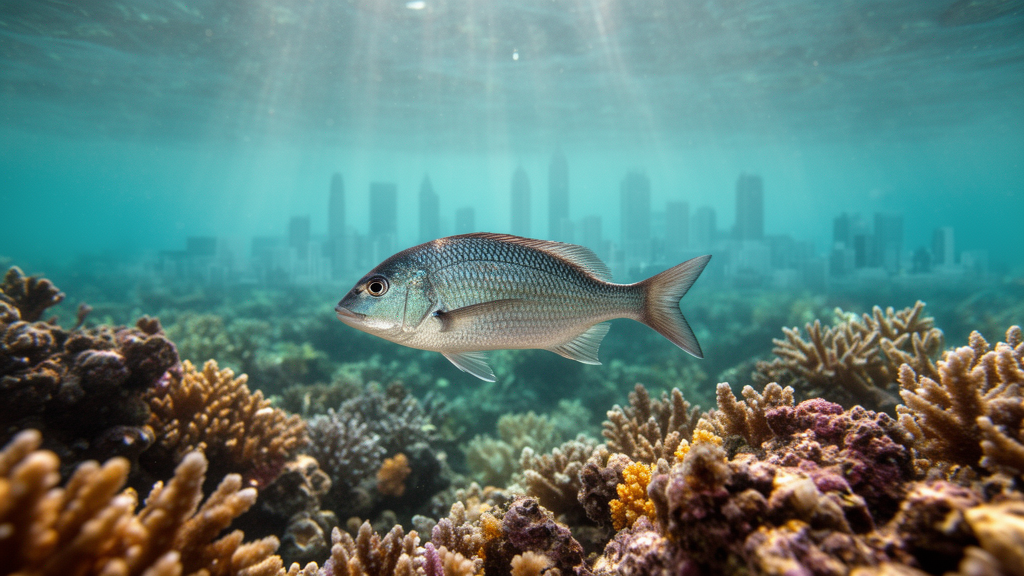
Along the sunlit coastlines of Okinawa, the blue damselfish seems to be thriving. Its electric-blue body flashes among coral branches at sites where the shoreline is lined with concrete, roads, and resorts, and where the water carries the runoff of a densely populated island. Conventional monitoring would record its abundance and move on, satisfied that the population is doing well. But a new study published in Nature Communications by researchers at the Okinawa Institute of Science and Technology (OIST), the French National Centre for Scientific Research (CNRS), and the Indiana University School of Medicine tells a far more unsettling story. When the scientists read the activity of the fish’s genes across the entire genome, they found that fish living near heavy human activity can be well fed and plentiful while simultaneously carrying the molecular fingerprints of chronic physiological stress. The finding suggests that the organisms themselves may be the most honest recorders of environmental degradation, capable of revealing impacts that water sampling and species counts simply cannot detect.
The research addresses a gap that has long frustrated ecologists studying coastal urbanization. Around the world, coastal environments are under mounting pressure from agricultural, industrial, and residential development, and Okinawa is a striking example: less than 40 percent of the island’s coastline remains natural and unaltered. This matters enormously for young coral reef fish, which spend the earliest and most vulnerable stages of their lives in calm, shallow nursery waters close to shore. Those areas offer relative safety from predators and access to abundant food, but their proximity to land also exposes the juveniles to the full suite of human impacts, from pollution to altered temperature regimes. How these conditions shape fish during this critical window, and whether the effects persist into adulthood, has remained poorly understood because the standard toolkit of environmental monitoring was never designed to answer questions about the inner state of an animal.
Emma Gairin, research fellow and former PhD student in OIST’s Marine Eco-Eco-Devo Unit and first author of the study, explained the limitation of the classical approach. Traditional ecological and environmental monitoring relies on water sampling or on counting how many fish species are present at a site, but neither method reveals much about the actual health of the fish living there. To understand what a fish is experiencing, she argued, looking at gene activity is key. The problem is that doing this reliably in wild animals has historically been impractical. Field studies of gene expression have typically focused on only a handful of genes at a time, and gene activity is influenced by many confounding factors, including temperature and salinity. With so few data points, it is extremely difficult to determine whether differences in gene activity between fish from different locations are genuinely tied to human activity or merely reflect natural variation in the environment.
The team’s solution was ambitious in scale. Rather than tracking a few candidate marker genes, they examined the activity of all genes in fish collected from multiple sites, looking for clear environmental signatures that would only emerge when the whole transcriptome was considered together. They collected blue damselfish, Chrysiptera cyanea, from 18 different sites across Okinawa’s main island, spanning a gradient of urbanization that ranged from nearly pristine reefs in the island’s rural north to heavily urbanized coastlines in the developed south. Some of the sampling sites, Gairin noted, were visibly dirty and polluted, yet the damselfish were there all the same. Their presence, however, was not evidence of well-being. Just because an animal persists in a degraded habitat does not mean it is escaping the physiological consequences of living there.
The transcriptomic results delivered a surprise that carries a warning for the wider field of pollution monitoring. Many of the genes traditionally used as markers of pollution failed to track urbanization at all. Their activity was more often explained by other variables, such as temperature or the nutritional status of the fish. Only when the researchers analyzed gene activity across the genome as a whole did the signature of human activity emerge with clarity. Using this landscape-scale approach, the team identified 425 genes in juvenile fish and 585 genes in adult livers whose activity was associated with urbanization but not with any of the other environmental factors they had measured. Among these urbanization-linked genes were ones involved in inflammation and immune responses, which were more active in fish captured from urbanized areas, a molecular indication that their bodies were mounting defensive reactions to their environment.
To interpret what these wild-caught patterns meant, the researchers turned to a controlled comparison. They raised blue damselfish in the laboratory under different feeding conditions and compared the gene activity of those fish with that of the wild-caught adults. The comparison revealed a striking and somewhat paradoxical picture. Adult fish from urbanized coastal areas showed gene activity patterns resembling those of well-fed laboratory fish, indicating that they were nutritionally better off than their appearance in degraded habitat might suggest. Yet these same urban fish simultaneously displayed elevated immune and inflammatory gene activity, revealing a genuine trade-off between nutritional status and physiological stress. The fish were, in effect, eating well and suffering at the same time, and only a genome-wide view of gene expression could capture both sides of that equation.
These findings may help resolve a long-standing puzzle in reef ecology: why do young reef fish settle in highly urbanized, sometimes visibly degraded coastal areas when cleaner, more natural habitats are available nearby? One plausible explanation is that urbanized environments are enriched with organic matter, making food abundant and easily accessible to settling juveniles. Senior author Professor Vincent Laudet, head of OIST’s Marine Eco-Evo-Devo Unit, framed the phenomenon as a junk food effect. He compared it to teenagers frequenting a fast food chain, where there is plenty to eat and it is cheap, but it may not be good for their health. For young fish, an urbanized coastal environment may present exactly the same bargain: plentiful food offered at a physiological cost that only becomes visible when the animal’s internal biology is examined.
The technical significance of the study lies in its demonstration of landscape transcriptomics as a monitoring paradigm. By sampling the same species across many sites spanning an urbanization gradient and controlling for confounding variables such as temperature and salinity, the researchers showed that genome-wide gene activity can integrate the many different environmental influences acting on an organism into a single, readable biological signal. Individual marker genes, by contrast, proved unreliable because their expression responds to multiple pressures at once. The multi-gene, multi-site design allowed the urbanization signal to be separated from the noise of natural environmental variation, producing a set of hundreds of genes whose activity specifically tracks human impact rather than any other measured factor. This is precisely the kind of integrated signal that conventional water quality measurements and biodiversity counts are structurally incapable of providing.
The broader implication, according to Laudet, is that organisms themselves can be recruited as living sensors of environmental change. Instead of simply measuring the environment around an animal, scientists can ask the animal what it has experienced. Genome-wide gene activity, he concluded, integrates the many different environmental influences acting on an organism and can reveal physiological effects that remain invisible when researchers measure water quality or merely count which species are present. And there is no reason, he argued, why the approach should be limited to fish or to coral reefs. In principle, any animal in any ecosystem could become a recorder of the conditions it endures, turning wildlife into a distributed network of biological monitoring stations. For coastlines like Okinawa’s, where abundant fish populations can mask hidden physiological costs, that perspective may fundamentally change how environmental health is assessed in the age of accelerating coastal urbanization.
Subject of Research: Landscape transcriptomics of blue damselfish revealing hidden physiological stress in urbanized coastal habitats
Article Title: Fish may look fine in urban waters but their genes tell a different story
Article References: Fish may look fine in urban waters but their genes tell a different story. (n.d.). Original publication
Image Credits: AI Generated
DOI: Not provided
Keywords: blue damselfish, Okinawa, transcriptomics, coastal urbanization, gene expression, coral reef fish, physiological stress, environmental monitoring, inflammation, junk food effect, Nature Communications, marine ecology
Cite Scienmag News
Juliet Wilcox. (October 9, 2026). Hidden Stress in City Fish: Genes Reveal What Healthy Reefs Conceal. Scienmag. https://scienmag.com/hidden-stress-in-city-fish-genes-reveal-what-healthy-reefs-conceal/
Juliet Wilcox. "Hidden Stress in City Fish: Genes Reveal What Healthy Reefs Conceal." Scienmag, 9 October 2026, https://scienmag.com/hidden-stress-in-city-fish-genes-reveal-what-healthy-reefs-conceal/. Accessed 9 October 2026.
Juliet Wilcox. "Hidden Stress in City Fish: Genes Reveal What Healthy Reefs Conceal." Scienmag. October 9, 2026. https://scienmag.com/hidden-stress-in-city-fish-genes-reveal-what-healthy-reefs-conceal/


