


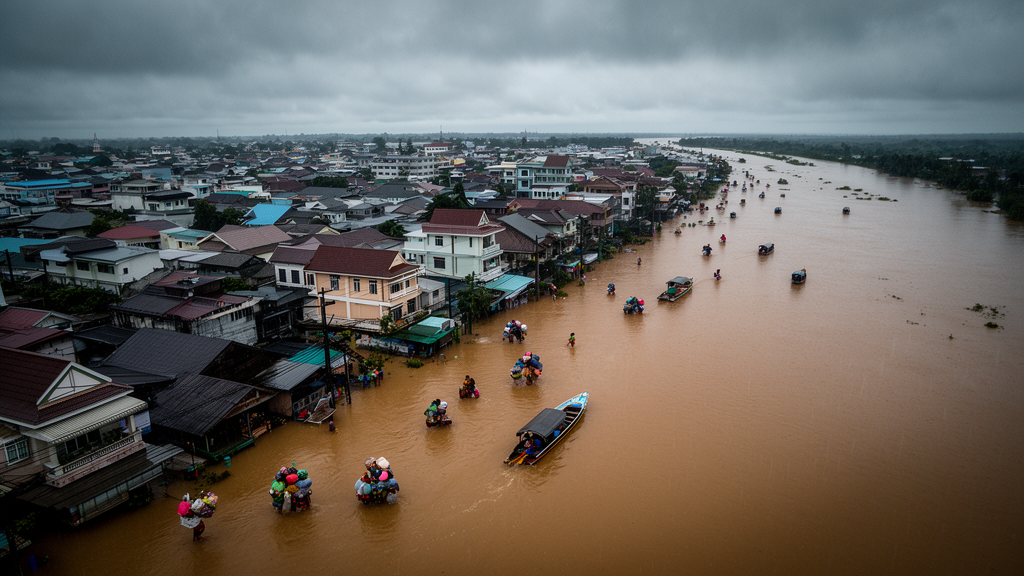
The Chao Phraya River basin, the watery heartland that feeds Thailand’s rice bowl and its capital Bangkok, is entering a future in which its most devastating floods arrive far more often than history suggests. A new study published in Theoretical and Applied Climatology by Dibesh Khadka of the Asian Institute of Technology and colleagues finds that although average annual rainfall across the basin may rise by only a modest four to six percent by the final quarter of this century, the floods that matter most will grow dramatically larger. Flood volumes, the researchers conclude, could swell by nineteen to thirty-one percent, and the catastrophic hundred-year flood of the historical record may recur every thirty to thirty-five years instead of once a century. The 2011 disaster, which inundated vast swaths of central Thailand and ranks as roughly an eighty-year event, could return every twenty-five to thirty years.
The study’s central argument is a challenge to how flood risk has traditionally been measured. Most engineering assessments focus on peak discharge, the single highest rate of water flow at a gauging station. But in a low-gradient delta basin like the Chao Phraya, where water spreads across floodplains for weeks at a time, the total volume of water coursing through the system is a better indicator of damage. The 2011 flood, which caused losses estimated in the tens of billions of dollars, was not primarily a flash flood of extreme instantaneous flow; it was a slow-motion deluge in which enormous volumes of water overwhelmed reservoirs, embankments, and drainage networks over months. By shifting the analytical lens from peak flow to flood volume, the researchers capture the kind of hazard that actually destroys crops, factories, and homes in monsoon Asia.
To build their projections, the team assembled climatic observations from thirty-six stations across the basin, then turned to an ensemble of thirty climate models run under two future scenarios from the latest generation of Coupled Model Intercomparison Project experiments. The moderate SSP2-4.5 pathway assumes intermediate emissions and warming, while the high SSP5-8.5 pathway represents a fossil-fuel-intensive future. Rather than coupling these climate projections to a heavy process-based hydrological model, which can demand enormous computation when run across thirty models and multiple decades, the researchers trained a multilayer perceptron, a class of artificial neural network, to translate monthly climate inputs into monthly streamflow. The approach reflects a broader trend in hydrology, where machine learning models are increasingly used to simulate river behavior at a fraction of the computational cost of physical models.
The neural network performed convincingly against the historical record. During both training and testing periods, the model achieved coefficients of determination and Nash-Sutcliffe efficiency values above 0.75, thresholds commonly regarded in hydrology as indicating satisfactory simulation of observed streamflow. The Nash-Sutcliffe efficiency, a standard metric that compares modeled flows against observed ones, ranges from negative infinity to one, with values near one indicating close agreement. This level of skill matters because any projection of future flood hazard inherits the errors of the streamflow model that generates it. A model that cannot reproduce past floods cannot be trusted to anticipate future ones. With the network validated, the researchers could rapidly generate streamflow estimates for each of the thirty climate models under both emissions scenarios, producing a statistically robust ensemble of future flood behavior.
The climate projections themselves reveal a subtle but dangerous asymmetry. Annual rainfall across the basin increases only modestly, yet the seasonal and extreme characteristics of that rainfall change much more sharply. Rainfall during August through October, the peak of the monsoon season when soils are already saturated and reservoirs are near capacity, is projected to intensify by nine to fourteen percent. Five-day precipitation extremes, a measure of the heaviest multi-day downpours that drive runoff into rivers, rise by nine to twelve percent. This concentration of additional water into the wettest weeks of the wettest season is precisely the pattern that hydrologists warn about under climate change: a modest shift in the mean can translate into a large shift in the tails of the distribution, where floods live.
When these rainfall changes are routed through the trained network, the result is a nonlinear amplification of flood volumes. The nineteen to thirty-one percent increase in flood volume far exceeds the four to six percent rise in annual rainfall, illustrating how saturated catchments, full reservoirs, and intense late-monsoon storms compound one another. Frequency analysis of the simulated flood record drives the point home with stark numbers. The historical hundred-year flood, the benchmark against which much of Thailand’s flood infrastructure has been designed, is projected to recur every thirty to thirty-five years by 2076 to 2100. The 2011 event, an eighty-year flood in the historical record, becomes a twenty-five to thirty-year event. In practical terms, a generation growing up in the basin today could experience disasters of that magnitude two or three times before mid-century.
The projections arrive against a backdrop of worsening vulnerability. Flooding in the Chao Phraya basin has already become more severe and more frequent, threatening agriculture, livelihoods, and one of Southeast Asia’s largest economies. The 2011 flood remains a defining case study: it submerged industrial estates north of Bangkok, disrupted global supply chains for automobiles and computer components, and prompted a rapid assessment by the World Bank for resilient recovery planning. Subsequent research has debated whether different dam operations, guided by better weather forecasts, could have mitigated the disaster, and whether local rainfall or river overflow was the dominant cause. What is not disputed is that the basin’s exposure has grown as population, industry, and agriculture have concentrated on the floodplain.
The study also identifies pressures that will compound the climate signal. Rising flood volumes will collide with reduced conveyance efficiency in the river system, as channels lose capacity, and with ongoing sedimentation that raises riverbeds and pushes water onto the land. Projected sea-level rise at the delta’s outlet will further impede drainage, backing water up into the lower basin during high flows. Together these factors mean that the effective flood hazard will grow faster than the raw increase in flood volumes alone would suggest. The authors argue that meeting this challenge requires a paradigm shift in flood management, away from a reliance on structural control alone and toward integrated, adaptive water management. They point to engineering improvements, digital operations for reservoirs and drainage, and nature-based strategies as complementary pillars of long-term climate resilience.
For Thailand, the findings carry a difficult arithmetic. Design standards based on stationary statistics, the assumption that the flood record of the past describes the flood risk of the future, will systematically underestimate the hazard that infrastructure must withstand. Retention areas, diversion canals, and reservoir operating rules calibrated to historical hydrology may need re-evaluation under the projected regime, in which the same rainfall produces substantially more water in the river. The study’s computationally efficient framework offers a practical tool for that re-evaluation, allowing planners to test how different management strategies perform across a large ensemble of climate futures without the computational burden of full hydrological simulation for every model and scenario. As monsoon extremes intensify across South and Southeast Asia, the Chao Phraya basin becomes a case study in a broader truth: the floods of the coming decades will not simply be bigger versions of the past, and the systems built to tame them must learn to adapt as quickly as the climate changes around them.
Subject of Research: Projected changes in hydro-climatic extremes and flood risk in the Chao Phraya River Basin, Thailand
Article Title: Assessment of hydro-climatic extremes and implications for flood risk and resilience in the Chao Phraya River Basin, Thailand
Article References: Khadka, D., Babel, M. S., Mahmood, R., & Baghel, T. (2026). Assessment of hydro-climatic extremes and implications for flood risk and resilience in the Chao Phraya River Basin, Thailand. Theoretical and Applied Climatology, 157(9), Article 603. https://doi.org/10.1007/s00704-026-06531-1
Image Credits: AI Generated
DOI: 10.1007/s00704-026-06531-1
Keywords: Chao Phraya River, flood risk, climate change, hydro-climatic extremes, monsoon, machine learning, multilayer perceptron, CMIP6, flood volume, Thailand, return period, climate resilience
Cite Scienmag News
Violet Maxwell. (October 9, 2026). Thailand’s Monster Floods Set to Strike Three Times More Often by Century’s End. Scienmag. https://scienmag.com/thailands-monster-floods-set-to-strike-three-times-more-often-by-centurys-end/
Violet Maxwell. "Thailand’s Monster Floods Set to Strike Three Times More Often by Century’s End." Scienmag, 9 October 2026, https://scienmag.com/thailands-monster-floods-set-to-strike-three-times-more-often-by-centurys-end/. Accessed 9 October 2026.
Violet Maxwell. "Thailand’s Monster Floods Set to Strike Three Times More Often by Century’s End." Scienmag. October 9, 2026. https://scienmag.com/thailands-monster-floods-set-to-strike-three-times-more-often-by-centurys-end/


