


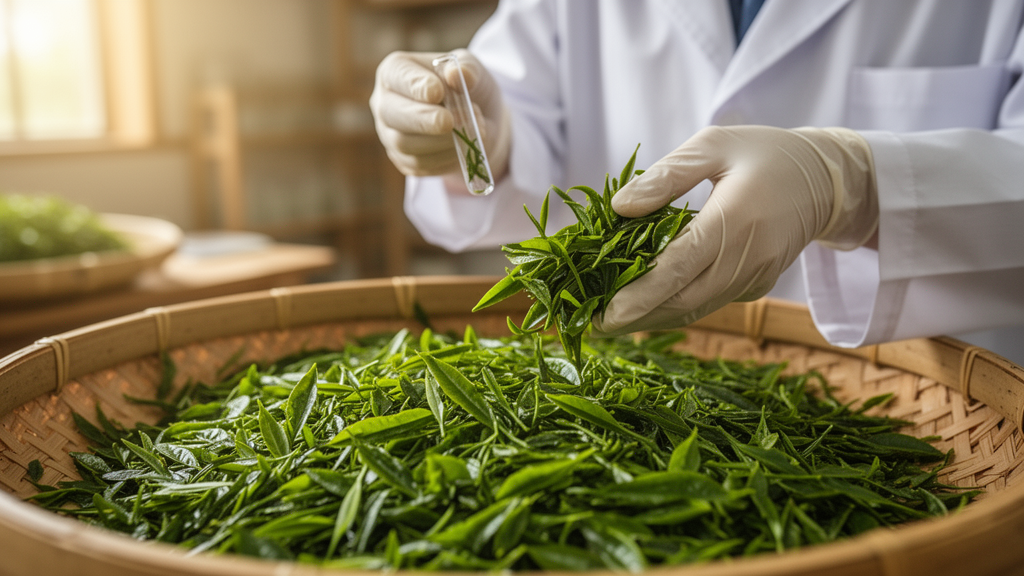
Tea is the second most consumed beverage on Earth, and for more than a century scientists have explained its character through the chemistry of a single plant. L-theanine, an amino acid unique to Camellia sinensis, delivers the gentle umami note prized in fine green teas. Epigallocatechin gallate, or EGCG, the dominant catechin, supplies the astringency that makes the mouth pucker and acts as the drink’s principal antioxidant. Generations of phytochemists traced these compounds to biosynthetic pathways inside the tea plant, assuming that genotype plus environment equals flavor. A sweeping new review in npj Science of Food argues that this plant-centric model is fundamentally incomplete, and that the real architects of tea quality are microbes operating at every stage from the soil around the roots to the human gut.
The review, led by Miao Qi and Liyong Luo of Southwest University in Chongqing, assembles evidence that has long sat scattered across soil science, food microbiology, and nutrition research. Its central concept is the tea plant holobiont: the plant together with the rhizosphere, endosphere, and phyllosphere microbiota that live on and inside it. Processing microbes and the consumer’s gut bacteria are treated as downstream ecological partners in an extended field-to-gut framework. The proposition is deceptively simple. Tea quality, encompassing both flavor and health attributes, does not arise from host metabolism alone but from plant-microbe co-metabolism followed by successive microbial transformations after harvest and after swallowing.
The anomalies that break the old model are striking. A single cultivar grown under different soil microecological conditions develops measurably different quality attributes, even when the plant genetics are identical. Post-fermented dark teas such as Pu-erh and Fu brick tea lose large fractions of their catechins while gaining theabrownins and entirely new aroma compounds, transformations driven by microbial communities whose metabolic repertoire exceeds anything the plant can do. And the same tea can produce divergent physiological responses in different people, a pattern that plant chemistry alone cannot explain but that differential microbial processing in the gut plausibly can. Continuity from plantation to gut, the authors stress, does not mean a single microbiome travels intact along the chain. It may involve direct microbial transmission, ecological filtering or replacement, or simply the carryover of metabolites made by upstream microbes.
The story begins underground. Tea plantation soils host microbial communities whose assembly reflects a persistent tension between deterministic niche-filtering and stochastic dispersal, and the balance shifts with context. Across a 105-year chronosequence, fungal assembly drifted progressively from stochastic toward deterministic control, while bacterial communities remained stochastically assembled throughout, likely buffered by their faster turnover and broader metabolic versatility. Geography matters too: Zhengyan rock-tea soils, famous for oolong terroir, yielded communities assembled predominantly through stochastic processes, whereas nearby Banyan and Zhoucha soils showed deterministic dominance. Abiotic filters such as soil pH, exchangeable magnesium and calcium, clay content, and altitude constrain which microbes establish, while the host genotype selectively recruits distinct consortia at the rhizosphere interface.
Management decisions can impose selective pressures that rival natural edaphic variation, sometimes with uncomfortable consequences. Organic farming raises keystone species richness and produces more complex, stable microbial networks, and pecan-tea intercropping produces analogous structural gains. Prolonged nitrogen over-application does the opposite, eroding bacterial diversity and destabilizing community structure. Fertilization regimes optimized for short-term yield may therefore quietly strip away the microbial diversity that underpins long-term flavor complexity. Notably, soil fungal diversity indices correlate positively with multiple quality attributes in finished tea, although the authors are careful to note that this correlation does not by itself establish causation; controlled inoculation trials are needed to determine whether diverse fungi genuinely generate richer precursor pools or whether both simply respond to shared soil health.
What the rhizosphere community actually does is increasingly well characterized, and it is a story of dual-function agents. A potassium-solubilizing Burkholderia species isolated from tea roots dissolves insoluble potassium through organic acid excretion, raising available soil K and promoting accumulation in roots and leaves. Rhizosphere bacteria secrete hydrolases that accelerate organic matter turnover and release indole-3-acetic acid, coupling nutrient cycling with hormonal control of root development. Synthetic consortia built from representative strains enhanced ammonia uptake and promoted theanine biosynthesis under controlled conditions. On the defensive side, Bacillus megaterium inhibits mycelial expansion and conidial germination across a broad range of root-infecting fungi while simultaneously solubilizing phosphate and releasing siderophores. Trichoderma asperellum TC01 activates the jasmonic acid and ethylene signaling pathway, cutting anthracnose severity by roughly 58 percent. The same microbes often do both jobs at once, which means any practice that depletes dual-function populations may weaken plant defense and reduce flavor precursor supply simultaneously.
Perhaps the most provocative claim concerns theanine, the signature umami compound long assumed to be exclusively plant-made. Sun and colleagues first identified L-theanine biosynthetic capacity in endophytic bacteria of the genus Luteibacter, whose gamma-glutamyltranspeptidases synthesize the amino acid efficiently. In a controlled inoculation study, Pseudomonas knackmussii combined with ethylamine supplementation increased leaf theanine content nearly fourfold. Catechins may have microbial sources too: endophytic fungi including Pseudopestalotiopsis camelliae-sinensis and Didymella sinensis were documented as independent catechin and EGCG producers in axenic culture, though the authors caution that optimized culture conditions differ materially from the competitive interior of a living leaf, and isotope-labeling experiments will be needed to quantify the true in planta contribution. The review frames this as a microbial bypass running in parallel with plant-endogenous synthesis, and raises an uncomfortable question for breeders: programs that evaluate genotypes solely through host-genome markers may systematically underestimate the microbiome’s contribution to final metabolite levels.
Gene-level specificity makes the bypass concept more than a loose association. An endophytic strain designated V4 simultaneously downregulates catechin-associated genes CsLAR and CsANS while upregulating theanine synthase CsTS, directly adjusting the leaf’s astringent-to-umami ratio. Colonization by wild-type Herbaspirillum sp. ZXN111 reduced L-theanine accumulation, whereas a mutant lacking a single gene function increased it markedly. That flavor tuning can hinge on individual microbial gene products opens a path toward targeted genetic modification of selected endophytes as a precision tool for metabolite adjustment. Meanwhile, the phyllosphere bacterium Herbaspirillum camelliae secretes a characterized tannase that degrades EGCG and epicatechin gallate, releasing gallic acid, one of the most biochemically defined endophytic bioconversions documented in tea.
Processing then acts as a sequence of ecological filters. Fresh leaves arrive at the factory carrying a structured phyllosphere inoculum dominated by Sphingomonas and Methylobacterium, and each manufacturing step reshapes it. In Keemun black tea, rolling was the single step most predictive of the final bacterial community profile; high-temperature fixation in green tea can drive viable microbial load to negligible levels. Dark teas take the opposite trajectory, deliberately cultivating successional ecosystems in which bacteria shift from Proteobacteria toward Firmicutes and fungi rise to dominance. During the flowering stage of Fu brick tea, Aspergillus cristatus was associated with 20 to 45 percent reductions in major catechins, a near-doubling of gallic acid, and marked increases in methyl salicylate and linalool that generate the tea’s characteristic floral profile. Temperature and moisture act as habitat filters on this succession: wet-piling at around 60 percent moisture promoted Rhizomucor dominance, while dry-piling below 30 percent selectively enriched Aspergillus. Across ripened Pu-erh, Liubao, and Tibetan teas, only six dominant microorganisms and six key aroma compounds were shared, a striking testament to how sensitive flavor outcomes are to both community composition and process parameters.
The final act unfolds in the human gut, where most high-molecular-weight tea polyphenols escape systemic absorption and encounter the resident microbiota. Here the evidence turns causal. Antibiotic-induced microbiota depletion completely abrogated the anti-obesity and metabolic benefits of Fuzhuan brick tea in mice, and fecal microbiota from tea polyphenol-treated donors alleviated memory impairment and synaptic plasticity deficits when transplanted into recipient animals. Mechanistically, theabrownin from Pu-erh tea suppresses microbial bile salt hydrolase activity, altering bile acid profiles and attenuating intestinal FXR-FGF15 signaling to reduce hepatic steatosis, a mode of action in which a microbial enzyme, not a host protein, is the drug target. Because tea polyphenols have low oral bioavailability and their conversion depends on each person’s resident microbes, individual gut communities may partly explain why the same cup produces different effects in different people. The authors propose metabotype-informed nutrition as an emerging research direction, while cautioning that tea-specific metabotypes have not yet been validated in large prospective cohorts. Microbiome-guided cultivation and controlled fermentation, by contrast, offer immediate translational opportunities, from targeted biofertilizers to defined starter cultures. The cup of tea, it turns out, is never just the plant. It is a rolling ecological collaboration that begins in the soil and ends, remarkably, in us.
Subject of Research: Microbial drivers of tea flavor and bioactivity across cultivation, processing, and gut metabolism
Article Title: From rhizosphere to gut: microbial drivers of tea flavor and bioactivity
Article References: Qi, M., Xie, J., Li, S., Zeng, L., & Luo, L. (2026). From rhizosphere to gut: microbial drivers of tea flavor and bioactivity. npj Science of Food, 10(1), Article 288. https://doi.org/10.1038/s41538-026-01156-0
Image Credits: AI Generated
DOI: 10.1038/s41538-026-01156-0
Keywords: tea, Camellia sinensis, holobiont, rhizosphere microbiome, endophytes, L-theanine, EGCG, fermentation, Aspergillus cristatus, gut microbiota, polyphenols, personalized nutrition
Cite Scienmag News
Morgan Morrow. (October 9, 2026). Microbes, Not Just the Plant, Decide How Your Tea Tastes and Works. Scienmag. https://scienmag.com/microbes-not-just-the-plant-decide-how-your-tea-tastes-and-works/
Morgan Morrow. "Microbes, Not Just the Plant, Decide How Your Tea Tastes and Works." Scienmag, 9 October 2026, https://scienmag.com/microbes-not-just-the-plant-decide-how-your-tea-tastes-and-works/. Accessed 9 October 2026.
Morgan Morrow. "Microbes, Not Just the Plant, Decide How Your Tea Tastes and Works." Scienmag. October 9, 2026. https://scienmag.com/microbes-not-just-the-plant-decide-how-your-tea-tastes-and-works/


