


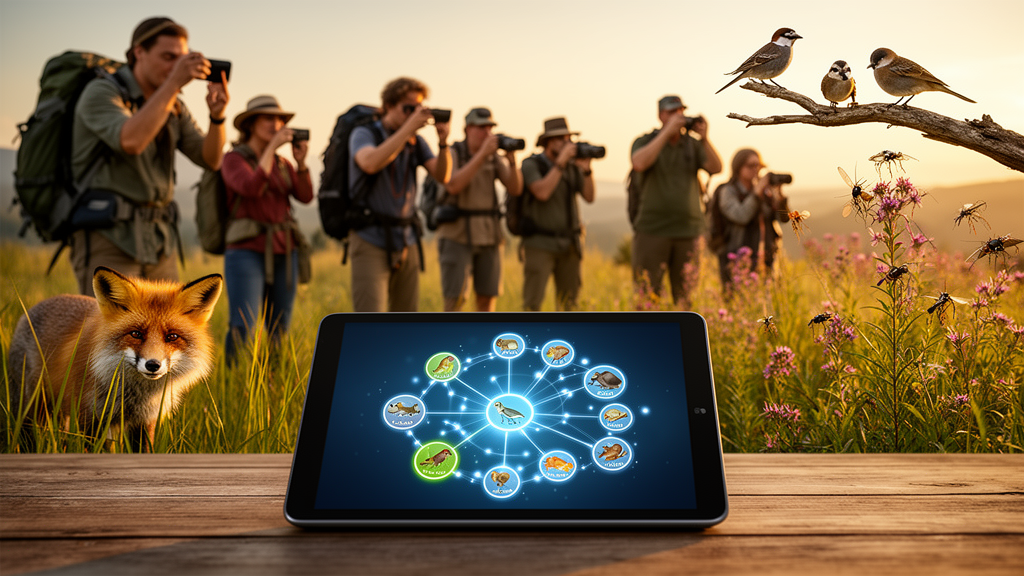
Every photograph uploaded to a wildlife app carries the possibility of capturing something ecologists have struggled to document for more than a century: the moment one species consumes another. Feeding events are among the most consequential interactions in nature, channeling energy and nutrients through ecosystems, yet they are notoriously difficult to observe. They are fleeting, often nocturnal, and frequently hidden inside burrows, canopies, or the bodies of hosts. Traditional methods for reconstructing diets, from dissecting stomachs to DNA metabarcoding of feces, are resource-intensive and come with their own biases. Now a team of researchers has turned to an unexpected ally in this effort: millions of volunteers armed with cameras, whose casual snapshots of predation, grazing, and scavenging are being stitched together into a searchable global food web.
The project, called Who Eats Whom, was launched in 2019 on iNaturalist, one of the world’s largest citizen science platforms, which holds hundreds of millions of geolocated, time-stamped photographs of wildlife. The idea is elegantly simple. Volunteers who happen to photograph an animal in the act of feeding, whether a glaucous-winged gull tearing into a starfish, a giraffe browsing a duiker-berry tree, or an American crocodile snatching an invasive lionfish, can submit their images to the project. Each feeding event generates two linked observations, one for the consumer and one for the consumed, and the iNaturalist community collectively proposes and refines the taxonomic identifications for both. Metadata tags then bind the pair together as a documented trophic interaction, complete with photographic evidence.
The scale of participation has grown far beyond what the founders initially promoted. Since its launch, Who Eats Whom has amassed nearly 14,000 observations of feeding interactions contributed by close to 2,000 observers spread across more than 100 countries. Remarkably, most of these contributions have come from volunteers who discovered the project on their own while browsing the iNaturalist database, rather than through targeted recruitment campaigns. This organic growth suggests that the photographic bycatch of ordinary biodiversity observation, images of feeding that people capture incidentally while documenting species, represents a vast and largely untapped reservoir of ecological information covering a geographic and taxonomic breadth that no targeted field study could ever achieve.
In 2025, the team began building a web application to transform this raw trove of observations into a usable scientific resource, releasing it in early 2026. The platform draws on the iNaturalist Application Programming Interface to collate data in real time, meaning the database grows dynamically as new observations pour in. The site restricts itself to so-called research-grade observations, those in which the iNaturalist community has reached high agreement on the identity of both species involved. The developers are careful to note that research-grade status confirms the taxonomy but does not independently verify that feeding actually occurred in every image, a distinction that matters for rigorous use. Even so, the filtering yields a network that, as of January 2026, connects 1,863 species through 1,607 unique feeding interactions, a figure the team expects to climb toward hundreds of thousands as iNaturalist itself continues its rapid expansion.
The technical architecture of the platform is designed around accessibility and scalability. Users type in a species of interest and can ask either what it eats or what eats it, then explore the results through five complementary visualization modes. A grid view displays the underlying photographs, putting faces, so to speak, on every interaction. A graph view and a network view render the data as directed networks in which nodes represent species and arrowheads point toward the consumer, with line widths encoding how frequently an interaction has been documented. A map view plots interactions geographically, while a global view renders the entire database as one sprawling interactive food web. Every search can also be exported as a CSV file, lowering the barrier for researchers who want to fold the data into their own analyses.
For ecologists, the applications are numerous. The database can supply basic natural history information about the dietary needs or natural enemies of poorly studied species, a gap that remains enormous given that the feeding ecology of most organisms on Earth has never been formally documented. It can surface rare or previously unrecorded interactions, flag highly connected prey species that may serve as keystone food sources, and expose taxa or regions where data are so sparse that targeted fieldwork is warranted. Conservation biologists could use it to model the potential trophic ripple effects of an invasive species or to search for candidate biological control agents. The temporal and spatial metadata attached to each observation open further avenues, from tracking how diets shift across seasons and life stages, a field known as feeding phenology and ontogeny, to cataloging which interactions currently exist so that they can be protected before they vanish.
The researchers are candid about the limitations inherent in unstructured citizen science data. Because observations are not collected under controlled sampling protocols, the database inevitably mirrors the biases of the people behind the cameras. Large, conspicuous, charismatic, and terrestrial organisms are overrepresented, while small, cryptic, aquatic, and nocturnal interactions remain comparatively rare. Who Eats Whom is therefore best understood as a living natural history archive rather than a representative sample of the planet’s trophic relationships. Even in well-studied and relatively simple ecosystems, food webs are extraordinarily complex, and constructing complete ones has proven stubbornly difficult. Yet incomplete food webs still carry genuine scientific value, particularly when analyzed with quantitative network methods, and centralized repositories like this one create the capacity to merge photographic evidence with complementary techniques such as DNA metabarcoding, producing more robust and multi-layered pictures of ecological networks than any single method could deliver alone.
Beyond the laboratory, the project has been deliberately shaped as a tool for education and public engagement. Food webs are a staple of secondary school science curricula, and questions about what animals eat resonate far beyond academia, whether a gardener wondering which plants best support native pollinators or a hiker curious about the predator lurking at the top of a local trail. The team is co-developing guidelines with the iNaturalist community for classifying the different types of feeding interactions, distinguishing parasitism from herbivory, nectar feeding from scavenging, and plans future updates including improved search queries, richer network visualizations, a dedicated R package for programmatic access, and a community vetting system for data quality. With an organized corps of volunteers reviewing submissions in real time and the sophisticated iNaturalist identification machinery working underneath, the database is effectively self-improving.
There is a philosophical dimension to the project as well. When John Muir wrote that trying to pick out anything by itself reveals it hitched to everything else in the universe, he was describing precisely the relational view of nature that Who Eats Whom seeks to operationalize. The wonder inspired by organisms such as Maculinea caterpillars, which mimic the pheromones and even the sounds of ant queens to be adopted into colonies and fed by worker ants, lies not in their existence as isolated species but in the astonishing specificity of their relationships. By shifting attention from species in isolation to the diversity of connections among them, the project offers a corrective to a reductionist habit in Western science and makes those connections visible and tangible to anyone with a web browser.
What began as a modest effort to harvest the accidental bycatch of wildlife photography has matured into the first global food web built from verifiable citizen science images, a complement to existing interaction databases such as Global Biotic Interactions and a citizen science project in its own right. Its creators anticipate that letting the public visualize and manipulate the tangled web of who consumes whom could deepen appreciation for the interconnected natural world and, perhaps, strengthen the resolve to conserve it. In the meantime, every hiker, gardener, and beachcomber with a smartphone holds the potential to add another thread to the map, one photograph of lunch in the wild at a time.
Subject of Research: A citizen science-derived global database of feeding interactions between species built from iNaturalist photographs
Article Title: Who Eats Whom? A global food web derived from citizen science
Article References: Allf, B. C., Mallavarapu, A., Kikuchi, D. W., Vasudeva, N., & Dunn, R. R. (2026). Who Eats Whom? A global food web derived from citizen science. PLOS Biology, 24(9), e3003988. https://doi.org/10.1371/journal.pbio.3003988
Image Credits: AI Generated
DOI: 10.1371/journal.pbio.3003988
Keywords: citizen science, food webs, iNaturalist, species interactions, trophic ecology, biodiversity, ecological networks, predation, natural history, conservation, data visualization, public engagement
Cite Scienmag News
Margaret Porter. (October 9, 2026). Thousands of Amateur Photos Weave a Global Map of Who Eats Whom. Scienmag. https://scienmag.com/thousands-of-amateur-photos-weave-a-global-map-of-who-eats-whom/
Margaret Porter. "Thousands of Amateur Photos Weave a Global Map of Who Eats Whom." Scienmag, 9 October 2026, https://scienmag.com/thousands-of-amateur-photos-weave-a-global-map-of-who-eats-whom/. Accessed 9 October 2026.
Margaret Porter. "Thousands of Amateur Photos Weave a Global Map of Who Eats Whom." Scienmag. October 9, 2026. https://scienmag.com/thousands-of-amateur-photos-weave-a-global-map-of-who-eats-whom/


