


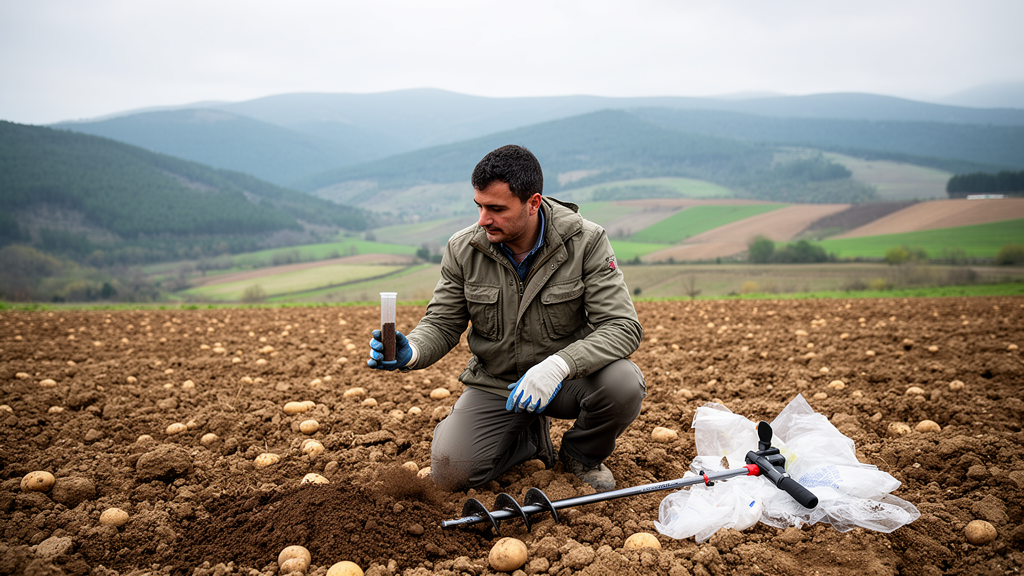
Potato is one of the most widely consumed staple crops on Earth, and because its edible tubers develop in direct contact with the soil, it has long been recognized as a potential pathway for human exposure to potentially toxic elements. A new study of the Sila Massif in Calabria, southern Italy, has now mapped exactly where arsenic and lead accumulate in the region’s agricultural soils and traced how much of each element ends up in the flesh and skin of cultivated potatoes. The findings, published in Discover Sustainability, offer a detailed picture of soil-to-crop transfer in a geologically distinctive mountain terrain and provide a measured assessment of what those concentrations mean for the people who eat the harvest.
The research team, led by I. Guagliardi of Italy’s National Research Council together with colleagues from the Center for Ecological-Noosphere Studies in Yerevan, Armenia, collected 126 agricultural topsoil samples and 45 potato tubers from fields across the Sila Massif. Arsenic and lead concentrations in both soils and potato tissues were determined using inductively coupled plasma mass spectrometry, a technique sensitive enough to detect these elements at very low levels, while soil acidity was measured potentiometrically. The soils turned out to be predominantly slightly acidic, with a mean pH of 5.74, a condition that matters because acidity strongly influences how readily trace elements dissolve in soil water and become available for plant uptake.
The mean concentrations recorded were 2.85 milligrams per kilogram for arsenic and 31.3 milligrams per kilogram for lead in the topsoils. Both figures describe a landscape in which these elements are present but not dramatically elevated on average. What the spatial analysis revealed, however, was that the distribution is far from uniform. Instead of a smooth background level across the massif, the researchers identified localized enrichments of both elements, patches where concentrations rise noticeably above the regional norm. These hotspots appear to reflect the geological character of the Sila Massif itself, particularly the weathering of granitoid and metamorphic rocks that underlie the area, along with localized inputs from human activity.
This geological signature is central to interpreting the results. Granitoid rocks naturally contain minerals that release arsenic as they break down over millennia, and the slow chemical weathering of such bedrock can seed overlying soils with trace levels of toxic elements without any industrial involvement. Distinguishing geogenic enrichment from anthropogenic contamination is one of the persistent challenges in environmental geochemistry, and the Sila Massif study illustrates why it matters: a farmer looking at an arsenic hotspot cannot assume a polluter is to blame, nor can regulators assume nature is. The spatial patterns documented here give both groups a baseline against which future changes could be judged.
The most technically interesting part of the work concerns what happens between soil and tuber. The researchers calculated transfer factors, ratios that express how efficiently an element moves from soil into plant tissue, and found that both arsenic and lead showed limited transfer, on the order of ten to the power of minus three. In practical terms, only a tiny fraction of the arsenic and lead present in the soil made its way into the potato. This is consistent with the chemistry of both elements: lead tends to bind strongly to soil particles and organic matter, while arsenic, though more mobile under certain conditions, is generally taken up by plants in modest quantities relative to its soil concentration.
Yet the tissue-by-tissue comparison produced a striking result. Arsenic and lead concentrations were consistently higher in the potato skin than in the flesh, and the soil-to-skin transfer exceeded the soil-to-flesh transfer by a factor of 4.5 for arsenic and 2.8 for lead. The pattern makes physiological sense: the skin is the tuber’s interface with the soil, the first tissue to contact soil particles, soil water, and any adhering dust, so it acts as a partial barrier that intercepts elements before they reach the interior. For consumers, the implication is straightforward. Peeling removes a disproportionate share of the toxic element load, a simple kitchen practice that meaningfully reduces exposure from this particular food source.
To translate concentrations into health consequences, the team performed a dietary exposure assessment based on consumption of potato flesh, the fraction people actually eat most. For adults, the estimated exposure and associated risk indicated no appreciable health concerns from arsenic or lead in Sila Massif potatoes. The picture was more nuanced for the youngest consumers. For lead, the researchers estimated a margin of exposure of 1.5 for developmental neurotoxicity in young children, a relatively lower margin that reflects the higher vulnerability of small bodies to dietary exposure. Children eat more food per kilogram of body weight than adults, and their developing nervous systems are especially sensitive to lead, a metal for which no safe threshold has been established.
A margin of exposure of 1.5 does not mean that children eating these potatoes will be harmed; it is a benchmark used by risk assessors to gauge how close an estimated exposure sits to levels at which effects have been observed in studies. Regulatory guidance typically treats margins of exposure for lead-related developmental neurotoxicity with caution when they approach low single digits, so the finding signals a need for attention rather than alarm. The authors emphasize that potatoes may contribute to cumulative dietary exposure, particularly among sensitive population groups, and should therefore be considered within broader dietary risk assessments that tally up every source of arsenic and lead in a person’s diet, from rice and leafy vegetables to drinking water.
The study’s methodology also carries lessons for how such assessments are done elsewhere. By sampling both soils and tubers from the same agricultural landscape, and by separating flesh from skin rather than analyzing whole tubers, the researchers captured a level of detail that whole-tuber studies miss. The fresh-weight basis of the tuber measurements matters too, since water content dilutes concentrations and comparisons across studies can mislead if dry and fresh weights are conflated. The work was supported by a bilateral research agreement between Italy’s National Research Council and Armenia’s Ministry of Education, Science, Culture and Sport, a collaboration aimed specifically at unveiling soil-to-potato transfer factors of potentially toxic elements using geochemical compositional data analysis.
For the Sila Massif itself, the message is one of reassurance with a footnote. The region’s potatoes, on the evidence of this study, are not a significant arsenic or lead hazard for the general adult population, and the limited soil-to-tuber transfer reflects both the chemistry of these elements and the slightly acidic but not extreme soil conditions under which the crop is grown. The localized enrichments mapped in the soils are a reminder that geology, not only industry, shapes the trace element landscape of farmland, and that understanding the natural background is the essential first step in spotting genuine contamination. For young children, whose diets concentrate risk in ways adult assessments can overlook, the study argues for keeping staple crops like the potato firmly on the radar of public health monitoring, even when the individual contribution looks small.
Subject of Research: Arsenic and lead accumulation in agricultural soils and cultivated potatoes in the Sila Massif, southern Italy
Article Title: Arsenic and lead spatial distribution and tissue specific accumulation in soils and cultivated potato of the Sila Massif Southern Italy
Article References: Guagliardi, I., Ricca, N., Beglaryan, M., Pipoyan, D., & Tepanosyan, G. (2026). Arsenic and lead spatial distribution and tissue specific accumulation in soils and cultivated potato of the Sila Massif Southern Italy. Discover Sustainability. https://doi.org/10.1007/s43621-026-04947-3
Image Credits: AI Generated
DOI: 10.1007/s43621-026-04947-3
Keywords: arsenic, lead, potato, soil geochemistry, Sila Massif, Calabria, transfer factors, dietary exposure, ICP-MS, food safety, heavy metals, risk assessment
Cite Scienmag News
Violet Maxwell. (October 9, 2026). Toxic Traces in the Spud Belt: Arsenic and Lead Map the Soils of Italy’s Sila Massif. Scienmag. https://scienmag.com/toxic-traces-in-the-spud-belt-arsenic-and-lead-map-the-soils-of-italys-sila-massif/
Violet Maxwell. "Toxic Traces in the Spud Belt: Arsenic and Lead Map the Soils of Italy’s Sila Massif." Scienmag, 9 October 2026, https://scienmag.com/toxic-traces-in-the-spud-belt-arsenic-and-lead-map-the-soils-of-italys-sila-massif/. Accessed 9 October 2026.
Violet Maxwell. "Toxic Traces in the Spud Belt: Arsenic and Lead Map the Soils of Italy’s Sila Massif." Scienmag. October 9, 2026. https://scienmag.com/toxic-traces-in-the-spud-belt-arsenic-and-lead-map-the-soils-of-italys-sila-massif/


