


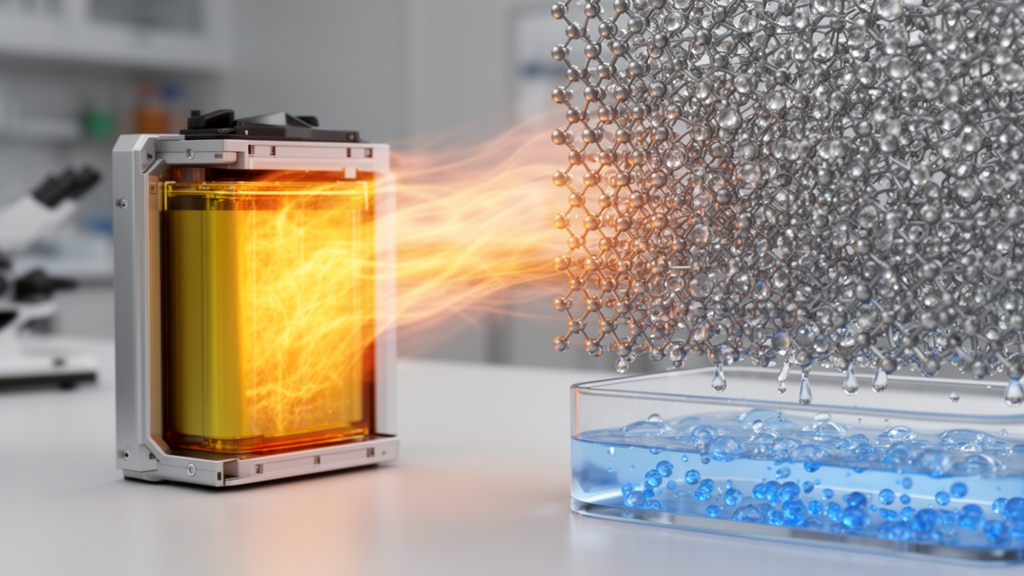
Every time a lithium-ion battery delivers current, a portion of its energy never reaches the device it powers. Instead, it leaks away as low-grade heat, warming the cell and, in large packs, posing a genuine engineering problem. Cooling systems are usually treated as a necessary cost: fans, heat sinks, and liquid loops that spend energy to move unwanted heat out of the system. A team of researchers from City University of Hong Kong, The Hong Kong Polytechnic University, South China University of Technology, and their collaborators has now flipped that logic on its head. In a study published in Nature Communications, they demonstrate an architecture in which the heat a battery discards during discharge becomes the very energy source that drives the production of clean drinking water from air, while the water-harvesting material in turn keeps the battery cool. The result is a closed thermal loop in which two previously separate problems cancel each other out.
The water-harvesting side of the pairing relies on atmospheric water harvesting, or AWH, a technology that has attracted intense interest as a route to drinking water in arid regions without access to rivers, lakes, or desalination plants. Most AWH devices use porous sorbents that grab water vapor from ambient air overnight and then release it when heated, so the vapor can be condensed and collected. The bottleneck is regeneration: desorbing water from the sorbent requires a substantial input of heat, and nearly all practical designs have leaned on sunlight to supply it. That dependence ties water output to weather, daylight hours, and the intensity of solar irradiation, and it means the sorbent sits idle or underperforming whenever the sun is weak or absent. The new work asks a different question: if heat is needed anyway, why not borrow it from a source that is already producing it as a waste product?
The answer the researchers settled on is a metal-organic framework, a class of crystalline materials built from metal nodes connected by organic linkers into an extremely porous lattice. The specific sorbent chosen, MOF-303, is well known in the AWH literature for its strong affinity for water and its ability to uptake and release vapor in cycles. Crucially, the enthalpy of regeneration for this material, the amount of heat needed to drive water out of its pores, sits in a range that aligns closely with the thermal output of a battery under heavy discharge. That alignment is the heart of the symbiosis. When the battery discharges at currents between 12 and 20 amperes in the negative direction, the waste heat it generates is sufficient to push the MOF layer past its desorption threshold, triggering the release of captured water without any external heater or solar concentrator.
The experimental demonstration is striking in its specifics. Within 46 minutes of operation, the MOF sorbent layer exceeded 50 degrees Celsius, hot enough to liberate water vapor, which was then condensed and collected in a sealed setup. The released vapor represents water that was previously adsorbed from ambient air, meaning the device completes a full harvesting cycle powered entirely by energy that would otherwise have been thrown away. At the same time, the adsorption process on the sorbent acts as a heat sink for the battery: as water molecules bind within the MOF pores, they draw thermal energy out of the adjacent cell, passively stabilizing its temperature. The researchers measured a reduction in peak battery temperature of roughly 10 degrees Celsius, a meaningful margin in a field where every degree of overheating accelerates degradation and raises safety concerns.
The headline performance figure is a water production rate of 1.39 grams of water per gram of sorbent per day. To put that in context, the team reports that this represents a 117 percent increase over comparable solar-driven AWH systems. The improvement does not come from a better sorbent or a cleverer condenser; it comes from the fact that the heat supply is continuous and decoupled from the weather. A solar-driven harvester only regenerates while the sun is up and strong, whereas a battery-coupled harvester regenerates whenever the battery works, which in most applications is exactly when cooling is needed most. The thermal demands of the two systems are not merely compatible but complementary, each peaking precisely when the other can absorb it.
Behind the experiments sits a substantial computational effort. The team used finite-element simulations to model the heat transfer dynamics of the coupled system, validating the measured temperature profiles and water release behavior against the numerical predictions. These simulations also served a diagnostic purpose, allowing the researchers to identify the parameters that govern thermal efficiency in the integrated design: the thermal conductivity of the interface between cell and sorbent, the heat capacity of the assembly, and the kinetics of adsorption and desorption all emerge as levers that determine how much of the battery’s waste heat is actually captured and put to work. That kind of parametric map matters for anyone hoping to scale the concept beyond a laboratory prototype, because it indicates where engineering effort will pay off most.
The implications extend well beyond the specific pairing of MOF-303 and a lithium-ion cell. The authors frame the work as establishing a general closed-loop thermal cycle that repurposes energy-storage waste heat to power atmospheric water harvesting, and they suggest the strategy could enhance thermal efficiency across a variety of energy and environmental systems through internal heat recovery. Data centers, electric vehicle packs, grid-scale storage installations, and industrial electronics all generate large quantities of low-grade heat that is currently vented to the environment. Any of these could, in principle, host a sorbent layer that converts that heat into a useful output, whether water or something else, while simultaneously easing the cooling burden. The concept of symbiotic heat sharing turns what engineers call waste heat recovery from an add-on into a design principle.
There are also practical attractions for deployment in off-grid and resource-constrained settings. A device that produces water as a byproduct of energy storage requires no solar panel, no fuel, and no separate power supply for regeneration, which simplifies the system and reduces cost. In remote telecommunications towers, disaster relief camps, or military outposts where batteries are charged and discharged daily and drinking water is scarce, the same hardware could serve double duty. The passive nature of the cooling is equally significant: because the sorbent draws heat away through the adsorption process itself, there is no pump, fan, or compressor to fail, and the thermal management works even during power interruptions. The 10-degree reduction in peak temperature would translate directly into longer cycle life and improved safety margins for the cells.
Challenges remain before such systems reach commercial maturity. The study was conducted on laboratory-scale hardware, and scaling the thermal coupling from a single cell to a large battery pack, where heat distribution is far less uniform, will require careful engineering. The long-term stability of the MOF under repeated thermal cycling, its behavior in dusty or humid field environments, and the logistics of condensing and storing the harvested water all need attention. The published version of the paper is also an early-release, peer-reviewed accepted manuscript subject to further edits, so some quantitative details may be refined in the final record. Nevertheless, the core demonstration stands: the regeneration enthalpy of a well-chosen sorbent can be matched to the thermal output of a working battery, and the two systems can be made to serve each other. In a decade preoccupied with both energy efficiency and water scarcity, a technology that turns one problem into the solution for the other is exactly the kind of cross-disciplinary thinking the field has been waiting for.
Subject of Research: Thermally coupled MOF-based atmospheric water harvesting and battery thermal management
Article Title: Symbiotic heat sharing in MOF-based atmospheric water generators for battery thermal management and sorbent regeneration
Article References: Chen, W., Luo, M., Tan, Y., Yan, L., Liao, T., Liu, W., Liu, F., Chen, Z., Yao, J., Liang, X., Fang, Y., Wang, S., Ke, Y., Suwardi, A., Yuen, A. C. Y., Tan, S. C., & Ravi, S. K. (2026). Symbiotic heat sharing in MOF-based atmospheric water generators for battery thermal management and sorbent regeneration. Nature Communications. https://doi.org/10.1038/s41467-026-76774-z
Image Credits: AI Generated
DOI: 10.1038/s41467-026-76774-z
Keywords: atmospheric water harvesting, MOF-303, metal-organic frameworks, battery thermal management, waste heat recovery, sorbent regeneration, thermal symbiosis, energy efficiency, water-energy nexus, finite-element simulation, low-grade heat, Nature Communications
Cite Scienmag News
Faith Mcneil. (October 9, 2026). Battery Waste Heat Powers Water From Air in Symbiotic New System. Scienmag. https://scienmag.com/battery-waste-heat-powers-water-from-air-in-symbiotic-new-system/
Faith Mcneil. "Battery Waste Heat Powers Water From Air in Symbiotic New System." Scienmag, 9 October 2026, https://scienmag.com/battery-waste-heat-powers-water-from-air-in-symbiotic-new-system/. Accessed 9 October 2026.
Faith Mcneil. "Battery Waste Heat Powers Water From Air in Symbiotic New System." Scienmag. October 9, 2026. https://scienmag.com/battery-waste-heat-powers-water-from-air-in-symbiotic-new-system/


