


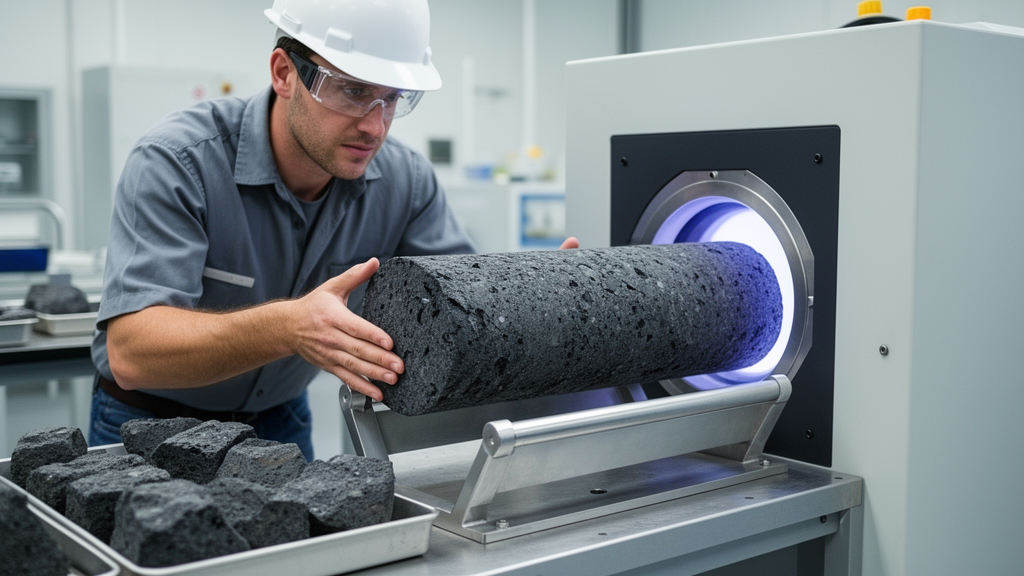
X-ray fluorescence core scanners have quietly become one of the most powerful tools in the geosciences, gliding along kilometers of sediment cores and spitting out element-by-element chemical profiles without destroying a single grain. But there has always been a catch: the technology was built for soft, flat, homogeneous mud. Hard-rock cores, especially the fractured, vesicular, uneven basalts dredged up from the deep ocean, were considered hopeless targets. A new study led by Ashley M. Morris of the University of Utah and published in Scientific Drilling now shows that with the right workflow, even the most stubborn basalt cores can yield fast, reliable, high-resolution chemistry, potentially transforming how scientists mine decades of archived drilling material for hidden geochemical secrets.
The research team tested their approach on basaltic cores recovered during International Ocean Discovery Program Expedition 396, which drilled the Mid-Norwegian Margin in 2021 to investigate the massive volcanism that accompanied the opening of the Northeast Atlantic and the emplacement of the North Atlantic Igneous Province. Across five sites, the expedition recovered 587 meters of basaltic rock from eight holes, with an average recovery of 61 percent. Morris and colleagues focused on three of those sites: Hole U1566A on the western flank of the Kolga High, with at least 14 discrete lava flows; Hole U1571A on the Skoll High, which captured the upper termination of seaward-dipping reflectors; and Hole U1574A on the Eldhø Outer High, which penetrated 94 meters of pillow basalts and hyaloclastites. These rocks were anything but scanner-friendly, riddled with vesicles, chilled margins, brecciated flow tops, and secondary carbonate and zeolite veins.
The physics of X-ray fluorescence explains why flat surfaces matter so much. The instrument bombards a sample with high-energy X-rays that knock inner-shell electrons out of atoms; when outer-shell electrons drop in to fill the vacancies, they emit X-rays characteristic of each element. A detector counts these fluoresced photons, producing intensity data that correlate with concentration. Anything between the beam and the sample, including air and dust, gets measured too. Sediment cores can be smoothed and covered with a thin Ultralene film for near-perfect contact, but basalt offers no such luxury. The traditional workaround has been portable handheld XRF instruments, which let the analyst pick a homogeneous-looking spot. That flexibility comes at a price: every measurement location is a human choice, introducing selection bias, and only a handful of analyses, often one to three per 1.5-meter core section, end up representing many meters of rock.
To adapt core scanning to hard rock, the team modified the standard procedure. Instead of measuring at regular centimeter intervals, they identified every rock fragment large enough to fill the scanner’s 10-by-12-millimeter irradiation area, then raised and leveled each piece within the core liner using moldable clay protected by Kimtech wipes to prevent contamination. Each fragment’s position was logged at millimeter scale. The scanner took measurements at three voltages, 10, 30, and 50 kilovolts, each optimized for a different suite of elements; because all elements of interest fell in the 30-kilovolt range, only that spectrum was used. The critical quality-control trick was argon: since argon is the only reliably measurable component of air, positive argon counts flag measurements with poor detector contact. Measurements with argon counts above 1,000 were discarded, as were outliers beyond three standard deviations of total spectrum throughput or argon counts.
The filtering produced 293 usable analyses from 47.7 meters of core at U1566A, 189 analyses from 29.4 meters at U1571A, and 237 analyses from 40.0 meters at U1574A, for a total of 719 filtered measurements from 797 raw scans. To convert raw intensities into concentrations, the team calibrated the core-scan data against calibrated discrete pXRF analyses collected on the same archive core halves during the expedition, using an Olympus Delta handheld spectrometer whose own calibration curves were built from ten standard reference materials. Matching analysis locations to within one centimeter of depth, they ran robust regressions on 35 pXRF-core-scan data pairs, a technique preferred over simple linear regression because it does not assume Gaussian error distributions. Eleven elements, including Ca, K, Ti, Fe, Mn, Ni, Cu, Zn, Sr, Y, and Zr, were successfully calibrated to apparent concentrations.
The validation came from comparison with independent datasets: 241 pXRF analyses and 60 conventional bulk-rock analyses by XRF and inductively coupled plasma mass spectrometry performed on the working halves of the same cores. The team compared immobile element ratios such as Ti/Zr, Y/Zr, Ni/Mn, and Zn/Mn, which track mantle source composition and fractional crystallization, alongside mobile-element ratios like K/Zr and Sr/Y, which fingerprint alteration. Analysis of variance and Tukey honestly significant difference tests quantified whether the three holes were genuinely chemically distinct. The verdict was encouraging: the core-scan data reproduced the regional trends seen in the pXRF and bulk-rock data, with Hole U1571A basalts standing out with lower Y/Zr and K/Zr and higher Sr/Y, consistent with the three sites recording different stages of rifting, from subaerial initiation to peak magmatism to late-stage shallow marine eruption.
But the study also delivered cautionary lessons. Uncalibrated intensity ratios sometimes told misleading stories. The Ni/Mn and Zn/Mn ratios in raw data suggested a progressive increase from U1566A to U1571A to U1574A, yet after calibration the values clustered tightly, matching the pXRF and bulk-rock results. The reason is fundamental: the relationship between X-ray intensity and concentration is non-linear, so raw intensity ratios can manufacture apparent trends that do not exist in concentration space. A second lesson involved potassium: the calibrated K/Zr data disagreed with the other datasets, but the culprit was traceable to a calibration built on only three pXRF pairs, because potassium in the pXRF analyses frequently fell below detection limits. The message is clear: calibration is essential, and a calibration is only as good as the number and quality of the paired analyses behind it.
Where the technique truly shines is in revealing fine-scale variability that discrete sampling misses entirely. The core-scan dataset, collected in just four days, is 280 percent larger than the pXRF dataset. Chemical stratigraphy plots exposed anomalies invisible to conventional methods: a brecciated basalt flagged by positive titanium, strontium, and zircon excursions; an altered pyroclastic layer marked by a 103 percent nickel spike; and, most strikingly, a visually homogeneous section of aphyric basalt in core U1566A-27R2 that showed five large strontium anomalies with increases of 108 to 741 percent, likely from vesicles filled with carbonate-bearing material. Meanwhile, a neighboring section packed with seven different lithofacies showed remarkably little chemical variation. Composition, in other words, does not always follow appearance, and only dense chemical sampling can tell the difference.
The implications extend well beyond one expedition. The Scientific Ocean Drilling 2050 Science Framework has emphasized the need for better core characterization as the community reorganizes around the post-IODP era, and kilometers of legacy core material collected over 50 years were never analyzed with consistent methods. Rapid, non-destructive, high-resolution chemistry could help scientists target the most valuable samples for destructive analyses and even train machine-learning classifiers, which require large datasets, to automate lithological identification in basaltic cores. The workflow does carry inherent biases: small, fragile, or highly vesicular fragments that cannot be leveled are excluded, and fewer elements can be calibrated than a scanner measures. Still, the authors argue that with careful filtering, honest calibration, and appropriate statistical testing, X-ray fluorescence core scanning can finally do for hard-rock cores what it has long done for mud: turn silent cylinders of stone into rich, continuous chemical narratives.
Subject of Research: Adapting X-ray fluorescence core-scanning techniques to basaltic hard-rock cores for high-resolution geochemical characterization and sample selection
Article Title: Recommendations for using core X-ray fluorescence data on basaltic rock as a tool to assess compositional variability
Article References: Morris, A. M., Lambart, S., Alvarez Zarikian, C. A., Millett, J. M., Jones, M. T., Planke, S., Betlem, P., Chatterjee, S., Christopoulou, M., Ferré, E. C., Filina, I. Y., Frieling, J., Scherer, R. P., Varela, N., Xu, W., & Yager, S. L. (2026). Recommendations for using core X-ray fluorescence data on basaltic rock as a tool to assess compositional variability. Scientific Drilling, 35(1), 21-37. https://doi.org/10.5194/sd-35-21-2026
Image Credits: AI Generated
Keywords: X-ray fluorescence, core scanning, basalt, IODP Expedition 396, geochemistry, scientific drilling, North Atlantic Igneous Province, pXRF calibration, chemostratigraphy, sample selection, legacy cores, Mid-Norwegian Margin
Cite Scienmag News
Violet Maxwell. (October 9, 2026). Core X-ray Scanning Gets a Hard-Rock Makeover for Basalt Chemistry. Scienmag. https://scienmag.com/core-x-ray-scanning-gets-a-hard-rock-makeover-for-basalt-chemistry/
Violet Maxwell. "Core X-ray Scanning Gets a Hard-Rock Makeover for Basalt Chemistry." Scienmag, 9 October 2026, https://scienmag.com/core-x-ray-scanning-gets-a-hard-rock-makeover-for-basalt-chemistry/. Accessed 9 October 2026.
Violet Maxwell. "Core X-ray Scanning Gets a Hard-Rock Makeover for Basalt Chemistry." Scienmag. October 9, 2026. https://scienmag.com/core-x-ray-scanning-gets-a-hard-rock-makeover-for-basalt-chemistry/


