


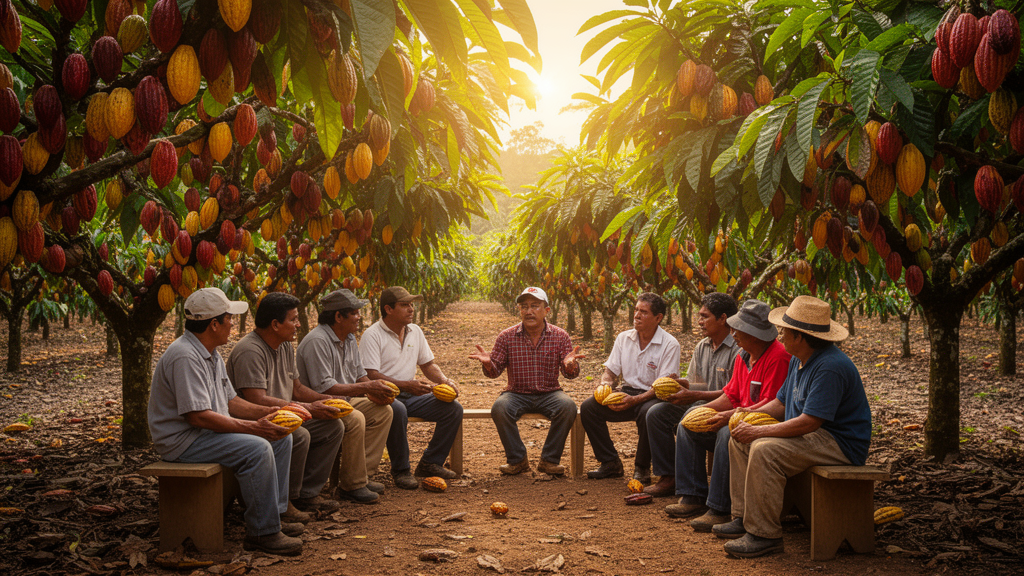
In the humid lowlands of Ecuador, where cocoa trees shade the understory of smallholder farms and the beans that become fine chocolate anchor rural livelihoods, a quiet experiment in collective decision-making has revealed something surprising about how communities forge shared visions of the future. Researchers working with cocoa farming groups in two very different regions of the country found that structured deliberation could either build consensus from disagreement or deepen agreement that already existed, depending on the social and ecological starting point of each community. The findings, published in PLOS Sustainability and Transformation, offer a rare quantitative window into how ordinary farmers reason about sustainability when they are given the tools to weigh competing futures on their own terms.
The study, led by Moritz Egger, Michael Curran, and Johanna Jacobi together with colleagues in Ecuador and Switzerland, set out to address a persistent weakness in sustainability science. Most assessment frameworks used in agriculture are designed by experts and imposed from the outside, with criteria chosen by analysts rather than by the people whose lives the assessments are meant to improve. When smallholder farmers are asked to evaluate development pathways, they are often handed a menu of indicators they did not create, in a language and logic that may not reflect their own priorities. The research team wanted to know what happens when that logic is inverted, when farmers first generate their own criteria for what a sustainable future looks like and then deliberate together over which futures best satisfy those criteria.
The method unfolded in two stages. First, the researchers used a participatory technique called Photovoice, in which farmers photograph aspects of their own environment and livelihoods and use the images to articulate what matters to them. From this process, each farmer group generated its own set of sustainability criteria, grounded in local experience rather than external checklists. These criteria then became the foundation for a series of two-day workshops involving eight farmer groups and thirty-six participants across two contrasting regions: the Ecuadorian Amazon and the coastal lowlands. In the workshops, farmers evaluated four distinct scenarios for the future of their farming systems using three complementary techniques: intuitive ranking, in which participants simply ordered the scenarios by preference; urgency ratings, which captured how pressing participants considered the issues embedded in each scenario; and swing-weighting, a structured method from decision analysis that asks participants to assign relative importance to criteria by imagining the difference each would make when moved from its worst to its best state.
What makes the study methodologically distinctive is the set of indices the researchers developed to measure deliberation itself. Rather than simply recording final rankings, they calculated measures of individual deliberative reasoning, capturing how coherently each participant connected criteria to scenario preferences, and measures of intersubjective consensus, capturing how tightly the group’s judgments converged. These indices were computed both before and after the deliberation phase, allowing the team to observe not just where groups ended up but how the process of talking together changed their reasoning. This before-and-after design transforms what is often a purely qualitative observation, that deliberation seems to help groups agree, into something that can be quantified, compared, and potentially transferred to other participatory planning contexts.
The two regions told strikingly different stories. In the Amazon, where the farmer groups began with intuitive preferences for the four scenarios that diverged noticeably from one another, deliberation produced a remarkable convergence. By the end of the workshops, every Amazonian group had arrived at the same ranking of scenarios, a consensus that had not existed when the sessions began. Just as significantly, the weights that farmers assigned to their sustainability criteria shifted during deliberation, moving toward long-term environmental and social concerns and away from shorter-term or more narrowly economic considerations. In other words, the act of discussing trade-offs with peers did not merely smooth over disagreements; it appears to have changed what participants valued, prompting them to give greater weight to the slower, less visible benefits of environmental stewardship and social cohesion.
On the coast, the dynamics were almost the inverse. The coastal groups entered the workshops already sharing a strong preference for an environmentally restorative scenario, one that emphasized rebuilding ecological health in their farming landscapes. Here, deliberation did not change the overall ranking of scenarios at all. Instead, it reinforced the existing consensus, substantially increasing the degree of agreement on how the sustainability criteria themselves should be prioritized. The coastal experience suggests that deliberation is not only a tool for resolving conflict but also a mechanism for consolidating and sharpening shared values that a community already holds, making implicit agreement explicit and robust enough to support collective action.
Across both regions, the researchers observed a subtler and more intellectually intriguing pattern. In some groups, the alignment between intuitive rankings of scenarios and the rankings derived from the formal criteria-based weighting grew closer after deliberation, suggesting that participants had learned to reason in ways that connected their gut preferences to their articulated values. In other groups, the two modes of judgment actually diverged further, which the authors interpret as a sign that deliberation can surface trade-offs that participants had not previously recognized. When a farmer realizes that the scenario she instinctively favors performs poorly on a criterion she deeply cares about, the resulting tension is not a failure of the method but a genuine insight, one that a purely intuitive or purely technical evaluation would have concealed.
The modest but consistent increases in the importance-consensus and individual reasoning indices across the workshops indicate that these were not dramatic conversions but incremental refinements, the kind of slow alignment that real-world collective decision-making typically requires. This matters for anyone designing sustainability interventions, because it suggests that a single workshop cannot manufacture consensus where the underlying conditions for it are absent, but it can reliably tighten the connection between what people value and what they choose, and it can do so in a way that is visible and measurable. The deliberation indices proposed in the study provide a transferable framework for tracking learning, reasoning, and consensus in participatory planning, something that has long been called for in the literature on deliberative democracy and environmental governance but rarely operationalized with this level of specificity.
The broader implications reach well beyond Ecuadorian cocoa. Smallholder agriculture is where many of the world’s sustainability transitions will be won or lost, and the study demonstrates that the raw material for those transitions, locally grounded criteria, shared narratives, and the willingness to weigh trade-offs openly, already exists within farming communities. What is often missing is a process that can articulate and consolidate these shared visions without hijacking them with externally defined metrics. Deliberative multicriteria evaluation, when anchored in community-generated criteria from the very start, appears to fill that gap. For policymakers, NGOs, and researchers seeking context-sensitive interventions, the message is that the deliberation itself is not a soft preliminary to the real analysis; it is the analysis, and it can be measured, compared, and improved.
There is also a caution embedded in the findings. Because deliberation can both stabilize and reconfigure preferences, practitioners cannot assume that a consensus reached through discussion is simply the sum of pre-existing individual views, nor that it will remain static once trade-offs become clearer over time. The Ecuadorian cocoa farmers showed that communities are capable of sophisticated, self-directed reasoning about their own futures, but the process demands time, skilled facilitation, and genuine openness to the possibility that the outcome may surprise everyone, including the participants. In a world where sustainability planning is too often a box-ticking exercise performed on communities rather than with them, this study offers a concrete, quantifiable demonstration that giving people the tools to deliberate on their own terms changes not only the answers they reach but the values they bring to reaching them.
Subject of Research: Deliberative multicriteria evaluation of sustainability pathways in Ecuadorian cocoa farming communities
Article Title: Consolidation of shared sustainability visions through deliberative multicriteria evaluation in Ecuadorian cocoa farming communities
Article References: Egger, M., Curran, M., Aubert, A., Kearney, N., Ventura, D., Zambrano Mohauad, G. A., Santos Ordóñez, A. P., & Jacobi, J. (2026). Consolidation of shared sustainability visions through deliberative multicriteria evaluation in Ecuadorian cocoa farming communities. PLOS Sustainability and Transformation, 5(9), e0000279. https://doi.org/10.1371/journal.pstr.0000279
Image Credits: AI Generated
DOI: 10.1371/journal.pstr.0000279
Keywords: cocoa farming, Ecuador, deliberation, multicriteria evaluation, sustainability transitions, smallholder agriculture, Photovoice, consensus, participatory planning, swing-weighting, Amazon, environmental governance
Cite Scienmag News
Courtney Benton. (October 9, 2026). Talking It Through: How Deliberation Helps Ecuadorian Cocoa Farmers Agree on Sustainable Futures. Scienmag. https://scienmag.com/talking-it-through-how-deliberation-helps-ecuadorian-cocoa-farmers-agree-on-sustainable-futures/
Courtney Benton. "Talking It Through: How Deliberation Helps Ecuadorian Cocoa Farmers Agree on Sustainable Futures." Scienmag, 9 October 2026, https://scienmag.com/talking-it-through-how-deliberation-helps-ecuadorian-cocoa-farmers-agree-on-sustainable-futures/. Accessed 9 October 2026.
Courtney Benton. "Talking It Through: How Deliberation Helps Ecuadorian Cocoa Farmers Agree on Sustainable Futures." Scienmag. October 9, 2026. https://scienmag.com/talking-it-through-how-deliberation-helps-ecuadorian-cocoa-farmers-agree-on-sustainable-futures/


