


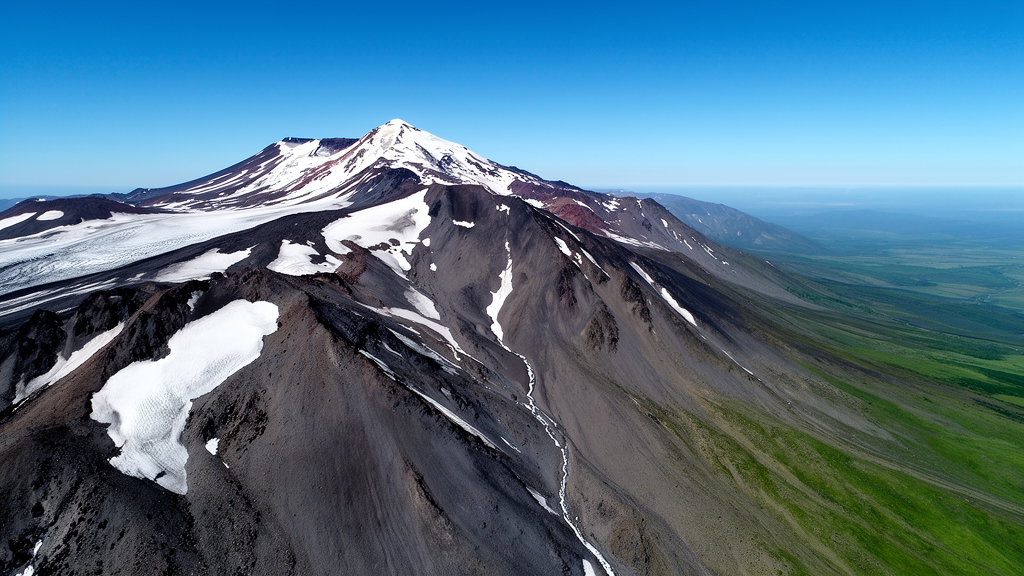
High in the Ñuble region of south-central Chile, the glaciers of the Nevados de Chillán volcanic complex are vanishing at a pace that has startled even the scientists who study them. A new seven-decade analysis, published in The Cryosphere, has for the first time quantified the geodetic mass balance of all 28 documented glaciers on the complex, and the picture it paints is stark: every single glacier lost volume over the past 71 years, and the rate of loss has accelerated by roughly 40 percent since the year 2000. The findings carry immediate consequences for the farms, forests and communities downstream that depend on summer meltwater from these shrinking ice bodies.
The research team, led by Millie Spencer of the University of Colorado Boulder together with colleagues at Chilean universities, reconstructed glacier change from 1954 to 2025 by differencing a remarkable chain of digital elevation models. The earliest baseline came from a 1968 Instituto Geográfico Militar topographic map built from 1954 aerial photographs, which the team scanned, georeferenced and digitized contour by contour. They then compared this historical surface with the Shuttle Radar Topography Mission DEM from February 2000, a bias-corrected ASTER stereo DEM from 2018, and a Pléiades stereo DEM from April 2025 obtained from Chile’s water directorate under the national Transparency Act. Each dataset was resampled to a common 30-meter grid and rigorously co-registered over stable, ice-free terrain using the Nuth and Kääb algorithm, ensuring that apparent elevation changes reflected real ice loss rather than geolocation error.
To sharpen the recent record, the team also flew an uncrewed aerial vehicle campaign in March 2024, during the peak ablation season when snow cover is minimal. A DJI Mavic 3 Enterprise equipped with real-time kinematic GPS captured more than 2,000 images over the Cerro Blanco and Las Termas subcomplexes, achieving centimeter-level positioning without ground control points. Structure-from-motion photogrammetry in Agisoft Metashape converted the overlapping imagery into digital elevation models with ground resolutions as fine as 7.8 centimeters per pixel. These drone surveys covered 11 glaciers and served as an independent check on the satellite-derived estimates, with the two methods agreeing closely and reinforcing confidence in the overall signal.
The headline numbers are dramatic. Total glacier area on the complex collapsed from 16.02 square kilometers in 1975 to 2.91 square kilometers in 2000 and just 1.90 square kilometers by 2019, an 88 percent reduction in 44 years. Both glaciers of the Puerto los Baños subcomplex disappeared entirely between 2000 and 2019, along with three glaciers on the north face of Las Termas, while several Cerro Blanco glaciers fractured into smaller ice bodies. The largest remaining glacier, Glaciar Nevado on the Cerro Blanco subcomplex, now covers roughly 0.68 square kilometers, a remnant of what once draped the volcano’s flanks.
Mass balance calculations tell the same story in vertical terms. Across the whole complex, mean annual specific mass balance was −0.42 ± 0.20 meters water equivalent per year from 1954 to 2000, accelerating to −0.60 ± 0.38 meters water equivalent per year from 2000 to 2025, with an independent ASTER-based estimate of −0.61 ± 0.06 for 2000 to 2018 corroborating the acceleration. The Cerro Blanco subcomplex, which hosts the complex’s summit at 3,151 meters, lost mass fastest after 2000 at −0.70 ± 0.38 meters water equivalent per year, while Glaciar Nevado itself thinned at −0.72 ± 0.38 over the same period. Cumulative thinning on Cerro Blanco reached a striking 28 meters between 1954 and 2024, with localized losses of 40 to 60 meters since 2000 on some glacier tongues.
Perhaps the most revealing result is spatial. Statistical analysis using Global and Local Moran’s I showed strong spatial autocorrelation in elevation change across all epochs, but the character of that clustering shifted over time. In the long-term record, significant clusters were predominantly low-loss zones corresponding to high-elevation accumulation areas where ice persisted. By the 2000 to 2025 period, 97.4 percent of glacier pixels fell within significant clusters, and 93.4 percent of those were high-loss clusters, meaning thinning had become near-uniform across glacier surfaces. Topographic variables such as elevation, slope and aspect explained at most 12 percent of the variance and never reached statistical significance, suggesting that climatic forcing, not local terrain, now dominates the melt pattern.
The hydroclimatic context makes the glacier decline unsurprising but urgent. At the Diguillín meteorological station below the complex, annual precipitation declined by 19 millimeters per year over the full record, and by 79.2 millimeters per year after 2000; at the higher Las Trancas station, the post-2000 decline reached 116.8 millimeters per year. Mean and minimum temperatures rose significantly throughout the record, and post-2000 summer maximum temperatures accelerated sharply, climbing at 0.189 degrees Celsius per year in January and 0.260 degrees per year in March. These trends align with the Central Chile Mega Drought and broader warming across the southern Andes, and the team found no evidence of abrupt regime shifts, describing the changes instead as continuous monotonic acceleration.
Crucially, the river data suggest the glaciers may have already passed a critical threshold known as peak water. Streamflow in the Río Diguillín declined by 32.4 cubic meters per second per year over the full record, but after 2000 the decline exploded to 213.1 cubic meters per second per year, a more than 550 percent increase in the rate of loss. Significant post-2000 reductions in February and March streamflow, the months when seasonal snow has typically melted away and glacier melt dominates runoff, are consistent with the complex’s shrinking ice volume no longer sustaining earlier meltwater contributions. Even as thinning rates accelerate, they now act on a far smaller ice reservoir, so total melt available for runoff is falling. The authors caution that confirming this attribution requires in-situ or modeling analysis of glacier melt contributions, since declining precipitation also plays a role.
The study also grapples with complications unique to a glacierized, active volcano. Eruptions from the Las Termas subcomplex intensified dramatically from 2016 to 2019, with over 1,000 explosive events recorded from the Nicanor crater in mid-2022 alone, depositing ash and tephra that can darken ice surfaces and accelerate melt. Distinguishing debris-covered glaciers from pyroclastic deposits in remote imagery remains difficult, and the team notes their estimates are likely conservative: relying on 2019 glacier outlines probably overestimates current ice area, and both tectonic uplift from the 2010 Maule earthquake and volcano-related ground uplift of up to tens of centimeters may mask some true ice loss. For water managers in the Itata basin, where agriculture consumes 96.3 percent of water and irrigation demand peaks in late summer, the message is clear. Planning for the Ñuble region’s future must now reckon with glaciers that are not merely retreating, but racing toward disappearance.
Subject of Research: Seven decades of geodetic mass balance change on the glaciers of the Nevados de Chillán volcanic complex in south-central Chile
Article Title: Seven decades of glacier loss on the Nevados de Chillán volcanic complex, Chile
Article References: Spencer, M. C., Fernandez, A., Tyrrell, E., Clasing, R., Muñoz, E., Mendoza, P. A., Berkhoff, J., & Molotch, N. P. (2026). Seven decades of glacier loss on the Nevados de Chillán volcanic complex, Chile. The Cryosphere, 20(10), 5559-5583. https://doi.org/10.5194/tc-20-5559-2026
Image Credits: AI Generated
Keywords: glaciers, Nevados de Chillán, Chile, geodetic mass balance, climate change, Andes, glacier retreat, peak water, remote sensing, UAV photography, water resources, volcanic complex
Cite Scienmag News
Sloane Callahan. (October 9, 2026). Chile’s Nevados de Chillán glaciers have shrunk 88 percent in just 44 years. Scienmag. https://scienmag.com/chiles-nevados-de-chillan-glaciers-have-shrunk-88-percent-in-just-44-years/
Sloane Callahan. "Chile’s Nevados de Chillán glaciers have shrunk 88 percent in just 44 years." Scienmag, 9 October 2026, https://scienmag.com/chiles-nevados-de-chillan-glaciers-have-shrunk-88-percent-in-just-44-years/. Accessed 9 October 2026.
Sloane Callahan. "Chile’s Nevados de Chillán glaciers have shrunk 88 percent in just 44 years." Scienmag. October 9, 2026. https://scienmag.com/chiles-nevados-de-chillan-glaciers-have-shrunk-88-percent-in-just-44-years/


