


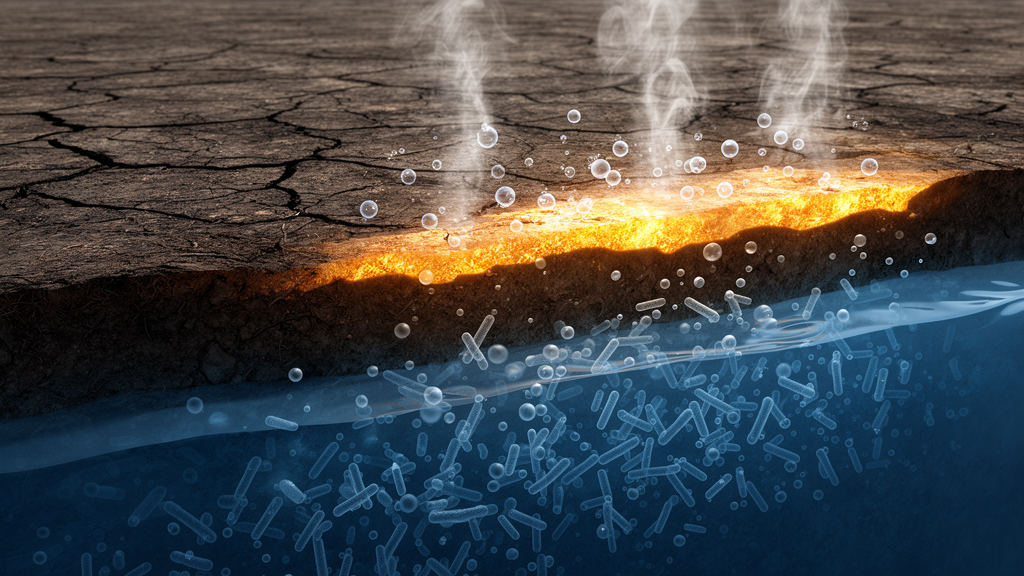
Peatlands punch far above their weight in the planetary carbon budget. Although they blanket only about three percent of Earth’s land surface, these waterlogged ecosystems hold roughly one-third of all the carbon stored in global soils, accumulated over millennia as dead plant material that resists decay in cold, oxygen-starved conditions. The reason peat accumulates at all is deceptively simple: when soils stay saturated, oxygen cannot penetrate deeply, and the microbes that normally dismantle organic matter are starved of the electron acceptor they need to do their work. But what happens when humans drain, graze, or burn these landscapes? A new study published in the journal Microbial Ecology suggests the answer lies in a subtle three-way conversation between microbes, the chemistry of peat organic matter, and the position of the water table — a conversation that degradation appears to silence in troubling ways.
The research, led by Anne Y. Yusuf of RMIT University in Melbourne together with colleagues from RMIT, the University of Southern Queensland, Griffith University, and the University of Melbourne, focused on peatlands in the Bogong High Plains of the Australian Alps. The team compared three sites: one degraded peatland and two intact ones, all located within Victoria’s Alpine National Park, where soils were collected under a research permit issued by the Victorian Department of Environment, Land, Water and Planning. Alpine peatlands are rare and ecologically precious in Australia, and they face mounting pressure from historical drainage, livestock grazing, and fire — the same disturbance trifecta that threatens peatlands worldwide.
To understand how degradation reshapes the underground world, the researchers profiled the microbial communities living at different depths in the peat profile and related them to two critical environmental variables: the position of the water table and the chemical composition of the peat’s organic carbon. The carbon chemistry was characterized in terms of functional groups — the molecular building blocks such as alkyl, N-alkyl, O-alkyl, di-O-alkyl, aryl, O-aryl, and ketone structures — which together describe how labile, or easily decomposed, versus recalcitrant, or chemically stubborn, the peat’s carbon reservoir really is. This combination of microbiology and organic geochemistry allowed the team to ask not just who lives where, but why.
The results revealed a striking pattern. In the intact peatlands, microbial communities were strongly stratified: fungal and prokaryotic — bacterial and archaeal — communities differed markedly depending on depth in the profile and on their position relative to the water table. This vertical heterogeneity is exactly what one would expect in a healthy peatland, where the upper, aerated layer hosts a very different cast of organisms than the saturated, anoxic depths. The intact peats also showed strong associations between community structure and bulk indicators of carbon quality, particularly the total carbon concentration and the carbon-to-nitrogen ratio, suggesting that the microbial residents there are organized around the overall nutritional landscape of the peat.
In the degraded peatland, that orderly structure largely fell apart. The strong depth-dependent and water-table-dependent patterns in fungal and prokaryotic communities were markedly weaker or absent altogether. Instead of being arranged in coherent layers tied to oxygen availability, the microbial communities of the degraded site appeared shuffled, their organization decoupled from the hydrological architecture that normally governs it. At the same time, the chemistry signal changed: variation in the degraded peat’s microbial communities was linked more to specific carbon functional groups — the labile and recalcitrant molecular fractions — than to the bulk carbon and nitrogen measures that mattered in intact peats. In other words, degradation seems to rewrite both the physical structure of the microbial habitat and the chemical language through which microbes and organic matter interact.
Diversity itself told a story as well. The intact peats supported higher prokaryotic diversity and evenness, meaning more distinct microbial types present in more balanced proportions. Degradation, by contrast, was associated with a less diverse and less even prokaryotic community — a signature familiar from many disturbed ecosystems, where a handful of tolerant or opportunistic taxa come to dominate while specialists disappear. Because microbial diversity underpins the full suite of decomposition pathways, from slow anaerobic fermentation to methane production, losses of this kind can ripple through the entire carbon cycle of a peatland.
Why does this matter for the climate? The mechanism is rooted in redox chemistry. When a peatland’s water table is high, the deep peat stays anoxic, and decomposition proceeds slowly through anaerobic pathways, allowing carbon to accumulate faster than it is released. When drainage or degradation lowers the water table, oxygen floods into previously sealed layers, aerobic microbes switch on, and ancient carbon begins to oxidize into carbon dioxide. The new findings suggest that degradation does not merely flip this switch; it dismantles the entire regulatory apparatus. If the tight coupling between water table position and microbial community structure is lost, the ecosystem may lose a key buffer that would otherwise restrain decomposition when conditions fluctuate. A degraded peatland, in effect, may have fewer microbial safeguards standing between its carbon store and the atmosphere.
The shift in which chemical variables best explain microbial community structure is equally significant. Bulk carbon concentration and carbon-to-nitrogen ratio are coarse-grained descriptors; carbon functional groups are fine-grained ones. A community whose composition tracks specific functional groups such as O-alkyl carbohydrates or aryl aromatic structures is one that is responding to the molecular availability of its substrate — potentially indicating that decomposition in the degraded peat is being driven by which compounds are chemically accessible rather than by the broad nutritional context. Such a regime could favor the rapid consumption of labile carbon pools while leaving recalcitrant fractions exposed to slower attack, a dynamic that would progressively erode the peat’s capacity to hold carbon over centuries.
The study also carries a geographic wake-up call. Much of what the world knows about peat microbiology comes from the vast boreal and tropical peat domes of the Northern Hemisphere and Southeast Asia. Alpine peatlands in Australia are small by comparison, but they perform outsized functions: they act as alpine sponges, regulating water flow into major river systems, and they harbor distinctive Sphagnum-associated microbiomes. The Bogong High Plains sites, sampled with support from Australian Government and Parks Victoria scholarships, show that the microbial signatures of degradation are not unique to any one continent. Wherever drainage, grazing, and fire intersect with peat, the same architectural collapse of the microbial–carbon–water table relationship appears to follow.
For conservationists and land managers, the implications point toward restoration with a microbial lens. Rewetting drained peatlands is the flagship intervention, and this study adds a mechanistic rationale: restoring the water table may do more than slow aerobic decay — it may allow the depth-stratified microbial communities that regulate carbon storage to reassemble. Whether that reassembly is possible after severe degradation, and how long it takes, remains an open question that the authors’ framework is well suited to test. What is already clear is that peatland carbon storage is not a passive geological accident but an actively maintained biological system, one that depends on an intricate interplay of water, chemistry, and life. Degrade that interplay, and the planet’s most carbon-rich soils begin, microbe by microbe, to give back what they have spent thousands of years keeping out of the air.
Subject of Research: The effects of peatland degradation on microbial community composition, carbon chemistry, and water table interactions regulating soil carbon storage in alpine peatlands
Article Title: Peatland Degradation Alters the Microbial–carbon–water Table Interactions that Regulate Carbon Storage
Article References: Yusuf, A. Y., Krohn, C., Birnbaum, C., Hearn, K., Treby, S., Ball, A. S., Chapman, J., & Grover, S. (2026). Peatland Degradation Alters the Microbial–carbon–water Table Interactions that Regulate Carbon Storage. Microbial Ecology. https://doi.org/10.1007/s00248-026-02891-3
Image Credits: AI Generated
DOI: 10.1007/s00248-026-02891-3
Keywords: peatlands, microbial ecology, carbon storage, water table, soil carbon, fungal communities, prokaryotes, carbon functional groups, Australian Alps, peatland degradation, Sphagnum, climate
Cite Scienmag News
Morgan Morrow. (October 9, 2026). Drained and Damaged Peatlands Lose the Microbial Order That Keeps Carbon Locked Away. Scienmag. https://scienmag.com/drained-and-damaged-peatlands-lose-the-microbial-order-that-keeps-carbon-locked-away/
Morgan Morrow. "Drained and Damaged Peatlands Lose the Microbial Order That Keeps Carbon Locked Away." Scienmag, 9 October 2026, https://scienmag.com/drained-and-damaged-peatlands-lose-the-microbial-order-that-keeps-carbon-locked-away/. Accessed 9 October 2026.
Morgan Morrow. "Drained and Damaged Peatlands Lose the Microbial Order That Keeps Carbon Locked Away." Scienmag. October 9, 2026. https://scienmag.com/drained-and-damaged-peatlands-lose-the-microbial-order-that-keeps-carbon-locked-away/


