


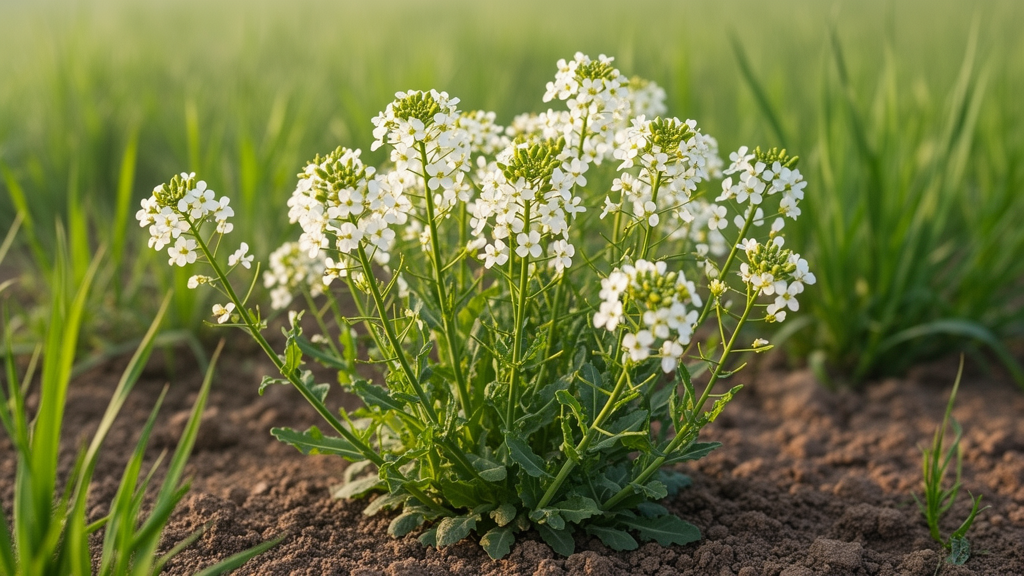
In the semi-arid grasslands of central Spain, a small yellow-flowered crucifer is quietly rewriting what ecologists thought they knew about plant reproduction. A team of Spanish researchers spent two field seasons mapping, genotyping and tracking every individual of Moricandia moricandioides in a 15 by 15 metre plot, and their results reveal something striking: whether a plant succeeds as a mother, as a father, or as both depends not just on its own flowers, but on who its neighbours are and how closely related those neighbours happen to be. The study, published in the journal Web Ecology, is among the first to disentangle the effects of neighbourhood density and neighbourhood genetics on both male and female components of fitness in a natural population.
The species is an ideal subject for this kind of detective work. Moricandia moricandioides is a predominantly annual herb that grows on gypsum-rich and limestone soils in southeastern and central Spain. It is hermaphroditic, meaning each flower carries both male and female organs, but it is also self-incompatible, so a plant cannot fertilise itself and must rely on insect visitors, mainly long-tongued bees of the genera Anthophora and Eucera, to carry pollen between genetically compatible individuals. Its dry fruits split open and drop seeds close to the parent, which means offspring tend to cluster around their mothers. Over generations, that limited seed dispersal produces a subtle but measurable genetic architecture: plants growing within half a metre of each other are significantly more related than chance would predict, a classic pattern known as isolation by distance.
To capture that architecture, the researchers, led by Camilo Ferrón of Universidad Rey Juan Carlos, mapped all 179 plants in their study plot with a differential GPS and sequenced the genome of every single one. Using low-coverage Illumina sequencing aligned to a published reference genome, and filtering rigorously for quality and linkage disequilibrium, they recovered more than 90,000 single nucleotide polymorphisms. An autocorrelation analysis of pairwise kinship coefficients confirmed the expected decline of relatedness with distance, with only plants closer than about half a metre showing kinship above the random baseline. The team also used spatial point-pattern analysis to estimate that the average radius of natural plant aggregations was roughly 0.35 metres, and they adopted that radius as the definition of a local neighbourhood in all subsequent models.
Female fitness was assessed through three classical proxies: fruit set, the proportion of flowers that developed into fruits; total fruit number; and total seed number, estimated by multiplying mean seeds per fruit by fruit count. Male fitness required a more elaborate approach. Seeds collected from 50 tagged plants were germinated, and 315 seedlings were genotyped so that paternity could be assigned with the Sequoia pedigree-reconstruction package. Around 86 percent of seedlings were confidently assigned to a most-likely father within the plot, allowing the researchers to compute siring success, the share of all genotyped offspring fathered by each plant. This proportional metric standardises male reproductive success even though not every seed in the population could be counted or genotyped.
The female results were unambiguous and, in one respect, counterintuitive. The mere presence of conspecific neighbours within that 0.35 metre radius was associated with reduced fruit production, and marginally with lower fruit set and fewer seeds, a pattern the authors attribute to competitive interference for local resources. Meanwhile, floral display traits mattered everywhere: plants with larger corollas produced more fruits and seeds and achieved higher fruit set, and plants with more flowers produced more fruits and seeds overall, although a higher flower count actually reduced the probability that any given flower set fruit. Crucially, the interaction between neighbourhood presence and floral traits had no significant effect on any component of female success. For the maternal function, a plant’s own display ruled, regardless of the company it kept.
Male success told a completely different and more intriguing story. Siring success depended on the interaction between floral traits and neighbourhood context. For solitary plants, larger corollas translated into greater siring success, while flower number was slightly negative. For plants surrounded by conspecifics, the pattern flipped: more flowers boosted male success, whereas larger corollas worked against it. This reversal contradicts a long-standing theoretical expectation, articulated by Cohen and Shmida in 1993, that big floral advertising should pay off best in sparse settings where pollinators are scarce, while fine-grained choice traits like corolla size should win in dense patches. The authors suggest several possible explanations, including the attractiveness dilemma, in which long pollinator bouts on large displays of isolated plants waste pollen, and pollen discounting through self-pollination attempts in a self-incompatible species. They also note that dense clusters may simply attract more insects to the group as a whole, lifting every well-advertised member, rather than changing per-flower visitation rates.
The genetic composition of the neighbourhood added a second layer of complexity. Among plants with at least one neighbour, the number of conspecifics within the local radius significantly reduced fruit set, and the average genetic relatedness of those neighbours significantly reduced siring success. Yet related neighbourhoods were not purely bad news: plants surrounded by close kin tended to mate with pollen donors located farther away, increasing the mean genetic distance to the fathers of their seeds. The most plausible mechanism, the researchers propose, is that in a self-incompatible species, closely related neighbours act as a compatibility filter. Pollen arriving from kin fails to fertilise, while compatible pollen from genetically distant individuals succeeds, effectively pushing mating events beyond the local genetic cluster. Notably, neither neighbour number nor relatedness depressed fruit or seed counts, hinting that M. moricandioides possesses mechanisms that buffer the maternal function against the costs of local inbreeding risk.
The mating-distance analysis reinforced this picture. The mean distance between maternal plants and their assigned fathers was just under seven metres, and the overall distribution of mating distances did not differ from a randomised null expectation, meaning pollinators were not preferentially shuttling pollen to the nearest neighbours. But when the researchers modelled mating distance as a function of neighbourhood attributes, average relatedness among neighbours emerged as a significant positive predictor of the distance to pollen donors. This echoes findings in other annual, self-incompatible species such as wild radish and partridge pea, where relatedness among neighbours reduced fitness components or offspring performance, and it aligns with theory predicting that fine-scale genetic structure combined with self-incompatibility should suppress matings among relatives.
The study also delivers a nuanced verdict on a provocative hypothesis from earlier work by the same group: that kin-selected investment in shared floral advertising, a kind of cooperative billboard among relatives, could enhance collective male reproductive success. The new data offer only partial support. Plants with more flowers did gain male success when surrounded by conspecifics, consistent with the cooperative idea, but higher relatedness among neighbours actually reduced siring success rather than enhancing it, the opposite of what kin selection would predict through indirect fitness benefits. The authors are careful to acknowledge the limits of their design: they measured the traits of focal plants but not those of their neighbours, and they did not directly observe pollinator behaviour, so the precise behavioural mechanisms behind the patterns remain open questions for future work.
What the study establishes firmly is that spatial context is not background noise in plant ecology; it is a selective force in its own right. The same trait can be an asset for one fitness component and a liability for another depending on whether a plant stands alone or in a crowd, and whether that crowd is a family reunion or a gathering of strangers. For a self-incompatible, insect-pollinated annual whose seeds rarely travel far, the genetic neighbourhood is effectively part of the mating environment, filtering pollen and reshuffling paternity. As habitat fragmentation and climate change alter the density and spatial arrangement of plant populations worldwide, understanding these fine-scale neighbourhood effects, the authors conclude, will be essential for predicting how plant reproductive strategies, and the evolutionary trajectories they underwrite, will respond.
Subject of Research: Effects of neighbourhood density and genetic relatedness on male and female fitness in the self-incompatible plant Moricandia moricandioides
Article Title: Intraspecific neighbourhood effects on male and female fitness in Moricandia moricandioides
Article References: Intraspecific neighbourhood effects on male and female fitness in Moricandia moricandioides. (n.d.). https://doi.org/10.5194/we-26-71-2026
Image Credits: AI Generated
Keywords: plant reproduction, fine-scale genetic structure, isolation by distance, floral display, siring success, paternity analysis, self-incompatibility, pollinator behaviour, kin selection, Moricandia moricandioides, neighbourhood effects, plant fitness
Cite Scienmag News
Juliet Wilcox. (October 9, 2026). Neighbours Make or Break Plant Fitness: Genes and Spacing Shape Reproduction in a Wild Crucifer. Scienmag. https://scienmag.com/neighbours-make-or-break-plant-fitness-genes-and-spacing-shape-reproduction-in-a-wild-crucifer/
Juliet Wilcox. "Neighbours Make or Break Plant Fitness: Genes and Spacing Shape Reproduction in a Wild Crucifer." Scienmag, 9 October 2026, https://scienmag.com/neighbours-make-or-break-plant-fitness-genes-and-spacing-shape-reproduction-in-a-wild-crucifer/. Accessed 9 October 2026.
Juliet Wilcox. "Neighbours Make or Break Plant Fitness: Genes and Spacing Shape Reproduction in a Wild Crucifer." Scienmag. October 9, 2026. https://scienmag.com/neighbours-make-or-break-plant-fitness-genes-and-spacing-shape-reproduction-in-a-wild-crucifer/


