


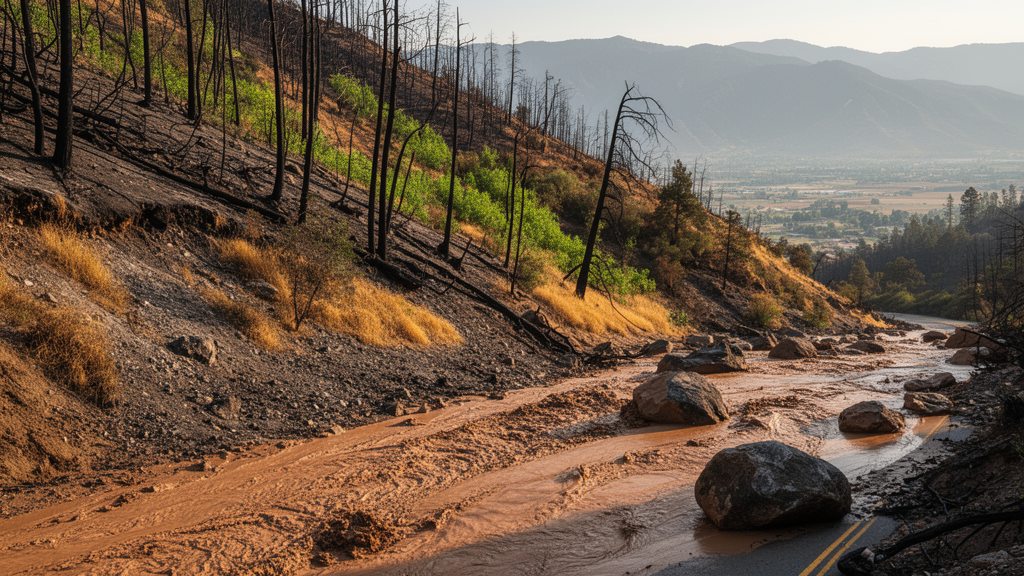
When a wildfire strips vegetation from steep hillsides, the danger does not end when the flames go out. Intense rain falling on freshly burned slopes can mobilize sediment into fast-moving post-fire debris flows, or mudflows, that surge down canyons with little warning. Scientists have long assumed that this hazard peaks in the first year after a fire and then steadily fades as plants regrow and soils recover. A new study of the 2020 Lake Fire in Southern California challenges that simple picture, showing that even four years after the blaze, the risk of a debris flow can swing dramatically between the wet winter months and the dry summer season.
The research, published in the journal Natural Hazards and Earth System Sciences, was led by Jeng-Hann Chong of the University of New Mexico and California State University Northridge, together with colleagues at several institutions. The team combined three field campaigns with high-resolution satellite imagery and numerical modeling to track how the likelihood of debris flows changed over four years in five steep, severely burned basins in the Angeles National Forest. Their central finding is striking: unsaturated soil hydraulic conductivity, a measure of how quickly water can soak into the ground, was roughly an order of magnitude higher during the dry season than during the wet season, sharply reducing the modeled probability of debris flows in summer even years after the fire.
The 2020 Lake Fire burned approximately 125 square kilometers of Los Angeles County, making it the second-largest fire in the county that year. According to Burned Area Emergency Response assessments, about 18 percent of the burn area experienced high burn severity. The researchers focused on five northwest-facing basins underlain by Late Cretaceous quartz diorite, with mean slopes of about 34 degrees. The United States Geological Survey had assigned these basins a debris-flow likelihood of 80 to 100 percent at a peak 15-minute rainfall intensity of 24 millimeters per hour, making them ideal natural laboratories for studying how hazard evolves over time.
Field work took place at three key moments: three months after the fire in December 2020, 45 months after the fire in April 2024 during the wet season, and 50 months after the fire in September 2024 during the dry season. At basin outlets, the team collected sediment samples for grain-size analysis and used a mini disk infiltrometer to measure how fast water penetrated the soil surface without disturbing it. During the first survey, a water droplet penetration test revealed strong soil water repellency, a hallmark of freshly burned ground. Because access to the basins was difficult early on, the team assumed a conservative hydraulic conductivity of 10 millimeters per hour for the initial period, based on measurements from the nearby 2016 Fish Fire in the San Gabriel Mountains, which shares similar bedrock, slopes, and vegetation.
To track vegetation recovery, the researchers processed 61 monthly PlanetScope satellite images at 3-meter resolution, spanning from before the fire through September 2024. They computed the differenced Normalized Difference Vegetation Index, or dNDVI, which highlights where vegetation was lost or gained between two dates. Negative dNDVI values traced the burn perimeter immediately after the fire and matched the areas flagged as high severity by emergency response teams. In later years, positive values along the channels and within the basins signaled the rapid growth of grasses and shrubs, while negative values along the river suggested sediment deposition or erosion during storm events. A ground-based point-intercept survey along a riverbank measured roughly 81 percent vegetation cover, in reasonable agreement with the satellite-derived estimate of about 70 percent.
The rainfall record added crucial context. Peak 15-minute rainfall intensity reached only about 13 millimeters per hour in the first year, well below the modeled debris-flow threshold. Over the full study period, twelve events exceeded 15 millimeters per hour, four exceeded 20 millimeters per hour, and none exceeded 25. Cumulative annual rainfall varied enormously, from 127.5 millimeters in the first year to 1329 millimeters in the third, reflecting the whiplash between drought and atmospheric-river-driven wet years that characterizes Southern California’s climate. This variability matters, because soil moisture left behind by preceding storms shapes how the next storm behaves.
The modeling itself relied on the KWAVE numerical model, which routes overland flow using the kinematic wave approximation, computes infiltration with the Green-Ampt equation, and accounts for canopy interception with the Rutter model. The simulated runoff then fed into a slope-dependent dimensionless-discharge model that estimates the rainfall intensity-duration threshold needed to trigger a runoff-generated debris flow. Immediately after the fire, the simulations showed that most basins required a peak 15-minute intensity of 30 millimeters per hour to initiate debris flows. By the wet season of year four, the picture had changed in a counterintuitive way: despite substantial vegetation regrowth, all basins could still generate debris flows at 30 millimeters per hour, and one basin could be triggered at just 20 millimeters per hour, an intensity that was actually recorded twice in February 2024.
The dry season told a very different story. With hydraulic conductivity roughly ten times higher than in spring, the soils acted like a sponge, absorbing rainfall and suppressing runoff. Three of the four studied basins showed little to no surface runoff even at 30 millimeters per hour, and the simulations indicated that triggering a debris flow would require intensities of about 80 millimeters per hour, corresponding to a 100- to 200-year recurrence interval storm. The researchers attribute this seasonal shift partly to the opening of macropore fractures in dried soils, which lets water drain rapidly, and partly to grasses and shrubs drawing moisture out of the top half-meter of soil through evapotranspiration. A related study after Arizona’s Contreras Fire found a roughly fivefold seasonal increase in hydraulic conductivity; the Lake Fire measurements showed even larger swings.
Perhaps the most surprising result came from the sensitivity analysis, in which the team varied hydraulic conductivity, grain size, and vegetation cover one at a time. Vegetation cover turned out to have remarkably little influence on debris-flow likelihood: a basin with full vegetation cover behaved almost identically to a bare one when other soil properties were held constant, likely because canopy storage saturates quickly during intense rain. Grain size mattered more, with halving the median grain size substantially increasing the number of slopes that could trigger flows in some basins. But hydraulic conductivity dominated, and because it can change by an order of magnitude within a single season, the authors argue that it exerts stronger control on hazard than any slowly evolving property of the landscape. This contrasts with findings from the 2016 Fish Fire, where vegetation recovery played a larger role in raising triggering thresholds.
The implications reach well beyond one burn scar. Hazard assessments that treat post-fire debris-flow risk as a smooth function of time since burning may badly misjudge the danger in any given month, particularly in Mediterranean climates with strong wet-dry contrasts. The study also suggests that recovery is not a one-way street: hydraulic conductivity may follow a non-monotonic, seasonally oscillating path rather than steadily returning to pre-fire levels. The authors caution that their measurements were limited to basin outlets and single visits per season, and that future work should sample within basin interiors, integrate lidar to quantify erosion, and characterize vegetation type and density more precisely. But the core message is clear: to know when a burned mountainside will let go, forecasters must ask not only how long ago the fire burned, but what season it is, and how wet the soil has become.
Subject of Research: Seasonal controls on post-fire debris flow likelihood following the 2020 Lake Fire in Southern California
Article Title: Seasonal influence on post-fire debris flow likelihood after the 2020 Lake Fire
Article References: Chong, J.-H., Ghosh, A., Page, B. T., Jesmok, G., Berg, D. V., Lopez, M., Upadhyay, D., Stone, D. J., Hauswirth, S. C., Lindsey, E. O., & Scuderi, L. A. (2026). Seasonal influence on post-fire debris flow likelihood after the 2020 Lake Fire. Natural Hazards and Earth System Sciences, 26(10), 4723-4740. https://doi.org/10.5194/nhess-26-4723-2026
Image Credits: AI Generated
DOI: 10.5194/nhess-26-4723-2026
Keywords: post-fire debris flows, wildfire, hydraulic conductivity, Lake Fire, soil hydrology, vegetation recovery, rainfall thresholds, remote sensing, NDVI, Angeles National Forest, debris flow modeling, seasonality
Cite Scienmag News
Violet Maxwell. (October 9, 2026). Seasons, Not Just Recovery, Control Mudslide Risk Years After California’s Lake Fire. Scienmag. https://scienmag.com/seasons-not-just-recovery-control-mudslide-risk-years-after-californias-lake-fire/
Violet Maxwell. "Seasons, Not Just Recovery, Control Mudslide Risk Years After California’s Lake Fire." Scienmag, 9 October 2026, https://scienmag.com/seasons-not-just-recovery-control-mudslide-risk-years-after-californias-lake-fire/. Accessed 9 October 2026.
Violet Maxwell. "Seasons, Not Just Recovery, Control Mudslide Risk Years After California’s Lake Fire." Scienmag. October 9, 2026. https://scienmag.com/seasons-not-just-recovery-control-mudslide-risk-years-after-californias-lake-fire/


