


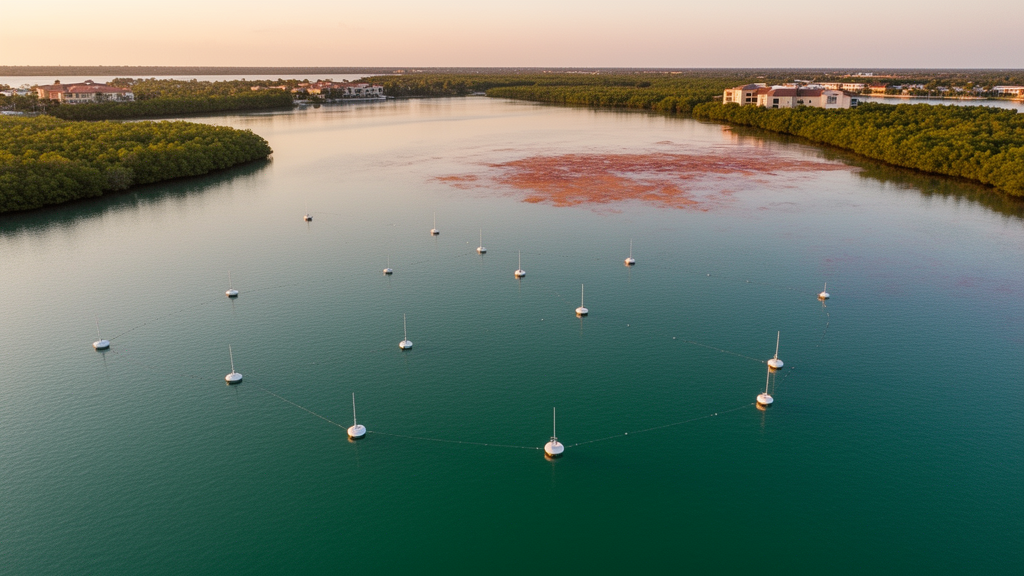
Tampa Bay, the largest open-water estuary in Florida and one of the most economically important coastal ecosystems in the United States, has long been monitored the way a doctor might monitor a critically ill patient with a single annual checkup. Monthly field sampling at fixed stations has produced an invaluable fifty-year record of water quality, but it has also left scientists and managers effectively blind between visits. Now a team led by researchers at the University of South Florida’s College of Marine Science has unveiled the Tampa Bay Observing Network, or TBON, an autonomous system of sensor-equipped stations that streams environmental data from the bay around the clock, every fifteen minutes, in real time. The network, described in the journal Environmental Monitoring and Assessment, was built as a direct response to one of the most alarming environmental incidents in the bay’s recent history.
That incident came in March 2021, when a structural failure at the former Piney Point phosphate processing facility released roughly 215 million gallons of nutrient-rich wastewater into the bay. The discharge delivered a massive pulse of inorganic nitrogen and other contaminants into shallow, well-mixed waters, and it was strongly implicated in sustaining an intense Karenia brevis red tide bloom that caused widespread fish kills. In the aftermath, researchers confronted an uncomfortable truth: no continuous monitoring infrastructure existed to track nutrient dynamics before, during, and after the crisis. Monthly sampling and emergency boat surveys simply could not resolve the fast-moving biogeochemical changes that determined how the bay absorbed, distributed, and recovered from the insult. TBON was conceived to ensure that the next such event would be watched in real time rather than reconstructed afterward.
The technical design of the network reflects both engineering pragmatism and scientific ambition. Since 2023, eight stations have been established across the estuary, with one in Hillsborough Bay, three in middle Tampa Bay, and four in lower Tampa Bay, and a ninth planned for Old Tampa Bay in 2026. Most stations mount their instruments on existing US Coast Guard navigational range towers, an approach that slashes construction costs and sidesteps the hazards of placing new structures in busy shipping channels. Each tower carries a weather station on top, a water quality sensor submerged one to two meters below the surface, and an acoustic Doppler current profiler on the adjacent seafloor. The result is a co-located suite of meteorological, water quality, and physical oceanographic measurements transmitted over cellular networks, a combination the authors note is rarely offered by other estuarine observing systems.
The sensor package itself reads like a compact laboratory suspended in the water column. A YSI EXO2 multiparameter sonde measures temperature, conductivity, salinity, depth, dissolved oxygen, pH, turbidity, and chlorophyll-a every fifteen minutes, with fluorescent dissolved organic matter sensors added in 2024 as proxies for dissolved organic carbon. Above the waterline, a Gill GMX500 weather station logs wind speed and direction, air temperature, humidity, pressure, and precipitation at thirty-minute intervals. Real-time data pass through automated quality control tests for gross range, spikes, and rate of change, following guidelines from the NOAA Integrated Ocean Observing System’s QARTOD program, with quality flags assigned to every data point. A public web portal displays interactive time series and allows users to download data in formats ranging from CSV to JSON, making the system as accessible to a curious student as to an emergency responder.
One of the network’s most striking demonstrations involves a comparison with the very monthly sampling program it is designed to complement. At a location where a TBON station sits alongside a Hillsborough County Environmental Protection Commission sampling site, the team compared nine months of continuous salinity measurements with the discrete monthly values. The results were sobering for anyone who has relied on low-frequency data in a dynamic estuary. The monthly samples frequently landed at the edge of the observed range, sometimes fell entirely outside the typical spread, and on one occasion represented a statistical outlier. Agreement between the two datasets occurred only when field collection happened to coincide with the daily average, and deviations revealed the bias introduced by sampling during diurnal salinity minima.
The second case study tackled a persistent problem in coastal remote sensing: chlorophyll-a monitoring in optically complex estuarine waters. Chlorophyll-a serves as a critical proxy for phytoplankton biomass, eutrophication, and the onset of harmful algal blooms, but satellite products such as NASA’s MODIS 8-day dataset struggle in Tampa Bay because of the optical complexity of the water and bottom reflectance from shallow depths. When the team compared monthly field samples, satellite estimates, and TBON sensor data from January to September 2024, the satellite product failed to reproduce either the magnitude or the temporal trend of the chlorophyll-a signal, which climbed from below 2 micrograms per liter in spring to a peak of 20.5 micrograms per liter in August. The autonomous sensor data, by contrast, tracked the field samples closely while resolving the bloom’s development at daily resolution, effectively filling the gap between shipboard sampling and space-based observation.
Perhaps the most dramatic evidence of the network’s value came in August 2024, when Hurricane Debby swept past Tampa Bay. As the storm’s center approached to within about 100 miles of the bay, the Bayboro Harbor station recorded air pressure dropping to roughly 1004 millibars and wind speeds peaking near 12.7 meters per second. The high-frequency record captured the full cascade of physical and biogeochemical responses: air temperature fluctuating with each precipitation pulse, water temperature declining more gradually due to its greater heat capacity, salinity plunging to 28 under a deluge of rain before rebounding to about 32 with tidal ingress, and turbidity spiking as winds resuspended sediments and runoff carried particulates into the harbor.
The storm record also revealed the intricate interplay of processes governing dissolved oxygen and pH. Before the storm’s closest passage, dissolved oxygen and chlorophyll-a moved in lockstep, implicating phytoplankton metabolism as the dominant control. As winds intensified, oxygen dynamics shifted toward physical forcing, with wind-induced vertical mixing and air bubble injection producing pronounced fluctuations that decoupled oxygen from the biological signal. Chlorophyll-a itself dropped during the storm, likely because enhanced mixing redistributed algae through the full water column while reduced light and increased particulates suppressed primary production. pH followed a similar choreography, mirroring biological activity early on, then tracking vertical mixing, then dipping as low-pH freshwater from precipitation and runoff entered the system before gradually recovering after the storm passed.
Beyond its role as a sentinel, TBON is designed to feed directly into the operational Tampa Bay Coastal Ocean Model, a high-resolution numerical system that produces daily nowcasts and forecasts of sea level, currents, salinity, and temperature for the bay and adjacent waters. The model has already been applied to storm surge forecasting during hurricanes, tracking harmful algal blooms, and evaluating engineering projects, and future work will integrate biogeochemical modules for productivity, inorganic carbon cycling, and organic carbon export. The continuous streams of chlorophyll-a, pH, and dissolved organic matter data from TBON will serve as vital resources for developing and validating these new capabilities, in much the same way that sustained observations underpin the Chesapeake Bay Environmental Forecast System.
The researchers are candid about the system’s limitations. Biofouling remains the chief operational challenge in a subtropical estuary, particularly in summer, requiring maintenance trips that range from weekly to monthly depending on conditions. Data gaps occasionally arise from connector issues or power outages when solar panels are blocked. Most significantly, current sensors cannot directly measure nutrients such as nitrogen species, which are the key water quality indicators for Tampa Bay, though a companion machine learning model for real-time total nitrogen monitoring is under development to serve the Tampa Bay Nitrogen Management Consortium. Spatial coverage also remains limited, and expanding the network is a primary goal. Even so, the case studies make a compelling argument that TBON has closed a critical information gap for an estuary that, unlike Chesapeake Bay and other nationally significant systems, historically lacked any continuous data acquisition capability. For resource managers, emergency responders, and the public, the bay now has a functioning nervous system, one that watches every tide, every storm, and every crisis as it unfolds.
Subject of Research: Autonomous real-time environmental monitoring of the Tampa Bay estuary using a network of sensor-equipped observing stations
Article Title: Tampa Bay observing network: a continuous data acquisition system in support of science and environmental management
Article References: Yang, B., Liu, Y., Law, J. A., Weisberg, R. H., D’Angelo, S. E., Qiao, K., Beck, M. W., Sherwood, E. T., & Frazer, T. K. (2026). Tampa Bay observing network: a continuous data acquisition system in support of science and environmental management. Environmental Monitoring and Assessment, 198(11), Article 1149. https://doi.org/10.1007/s10661-026-16007-4
Image Credits: AI Generated
DOI: 10.1007/s10661-026-16007-4
Keywords: Tampa Bay, environmental monitoring, autonomous sensors, water quality, estuary, harmful algal blooms, Hurricane Debby, Piney Point, chlorophyll-a, real-time data, coastal ocean model, University of South Florida
Cite Scienmag News
Violet Maxwell. (October 9, 2026). Florida’s Largest Estuary Gets a 24/7 Nervous System to Track Hurricanes and Red Tide. Scienmag. https://scienmag.com/floridas-largest-estuary-gets-a-24-7-nervous-system-to-track-hurricanes-and-red-tide/
Violet Maxwell. "Florida’s Largest Estuary Gets a 24/7 Nervous System to Track Hurricanes and Red Tide." Scienmag, 9 October 2026, https://scienmag.com/floridas-largest-estuary-gets-a-24-7-nervous-system-to-track-hurricanes-and-red-tide/. Accessed 9 October 2026.
Violet Maxwell. "Florida’s Largest Estuary Gets a 24/7 Nervous System to Track Hurricanes and Red Tide." Scienmag. October 9, 2026. https://scienmag.com/floridas-largest-estuary-gets-a-24-7-nervous-system-to-track-hurricanes-and-red-tide/


