


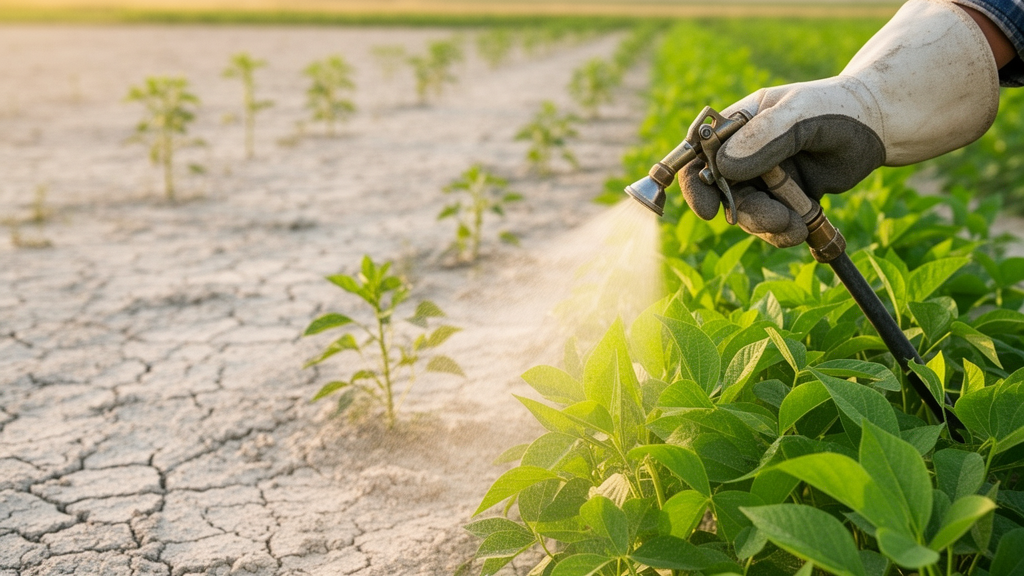
Phosphorus is the quiet bottleneck of global agriculture. In vast stretches of farmland across Asia and Africa, soils simply do not release enough of this essential element for crops to build the ATP molecules, nucleic acids, and phospholipids that cell life depends on. For legumes such as mung bean (Vigna radiata L.), a protein-rich staple for millions of people, phosphorus deficiency translates directly into stunted photosynthesis, poor seed filling, and diminished nutritional quality. Now, a two-year field study published in Plant and Soil offers an unexpectedly simple countermeasure: spraying the plants with a dilute solution of lanthanum, one of the lightest rare earth elements, appears to partially rescue the crop from the biochemical consequences of phosphorus starvation.
The research, led by Huida Lian and Cheng Qin with colleagues at the University of Changzhi, Northwest A&F University, Shanxi Normal University, and Shanxi Agricultural University in China, set out to answer a question that has lingered in plant physiology for decades: can foliar-applied rare earth elements meaningfully interact with soil phosphorus supply to shape crop performance from the leaf to the seed? Earlier work by some of the same team had shown that lanthanum chloride could boost growth and phosphorus acquisition in phosphorus-limited adzuki bean seedlings, but the mechanism remained murky, and field-scale evidence was thin. The new study moves the question from the greenhouse into real agronomic conditions.
The experimental design was deliberately straightforward. Over two growing seasons, 2023 and 2024, the researchers grew mung bean under six treatment combinations: two soil phosphorus regimes, one deficient and one sufficient with 80 kilograms per hectare of superphosphate, crossed with three foliar lanthanum concentrations of zero, 50, and 100 millimolar. Across the treatments they tracked a chain of measurements that reads like a tour of plant metabolism: leaf chlorophyll content measured as SPAD values, gas exchange parameters including net photosynthetic rate, stomatal conductance, intercellular carbon dioxide concentration, and transpiration rate, the activities of key enzymes in nitrogen and carbohydrate metabolism, the expression of photosynthesis- and sugar-related genes, and finally the accumulation of phosphorus, nitrogen, and other minerals in the harvested seeds.
The damage inflicted by phosphorus deficiency alone was severe and quantifiable. Compared with phosphorus-sufficient plants, deficient plants lost 20.95 percent of their leaf chlorophyll as measured by SPAD values and suffered a 31.62 percent drop in net photosynthetic rate. The consequences rippled all the way to the grain: seed phosphorus content fell by 45.9 percent and seed nitrogen content by 21.9 percent. These numbers capture a familiar cascade. When phosphorus is scarce, the light reactions of photosynthesis falter because ATP synthesis and the regeneration of phosphorylated intermediates in the Calvin-Benson cycle depend on a steady phosphorus supply. Less carbon fixed means less sugar exported to developing seeds, and the seeds themselves, which require phosphorus for phytate storage compounds and nitrogen for storage proteins, end up nutritionally impoverished.
The lanthanum sprays changed that picture in a striking way. Under phosphorus deficiency, the 100 millimolar foliar treatment partially restored photosynthetic efficiency, reactivated a suite of key metabolic enzymes, and enhanced both carbohydrate synthesis and the translocation of nutrients into the seeds. Among the enzymes that responded were nitrate reductase and glutamine synthetase, the two gatekeepers of nitrogen assimilation, and sucrose phosphate synthase and sucrose synthase, which together govern how efficiently photosynthetic carbon is converted into the transport sugar sucrose and then metabolized in sink tissues. In other words, lanthanum did not merely green the leaves; it appeared to re-tune the entire source-to-sink pipeline that carries carbon and nitrogen from the canopy into the grain.
The molecular data gave that physiological story a concrete genetic footing. Gene expression analysis revealed that lanthanum upregulated a cluster of photosynthesis-related genes encoding extrinsic proteins of photosystem II, including PsbO, PsbP, PsbQ, PsbY, and Psb28. These proteins stabilize the oxygen-evolving complex of photosystem II, the molecular machine that splits water and drives the electron transport chain at the heart of the light reactions. Their upregulation suggests that lanthanum helps maintain the structural and functional integrity of the photosynthetic apparatus precisely where phosphorus stress would be expected to degrade it. Earlier biochemical studies had reported that rare earth ions such as lanthanum and cerium can promote the formation of functional complexes between rubisco and rubisco activase in spinach, providing a plausible additional route by which the element could enhance carbon fixation.
Even more dramatic was the response of the carbohydrate metabolism genes. Expression of SuSy1, one of the genes encoding sucrose synthase, increased up to 20.11-fold under the combined treatment of optimal phosphorus and lanthanum, with SuSy2 and SS1 also upregulated. Sucrose synthase is central to seed development because it cleaves incoming sucrose into uridine diphosphate glucose and fructose, feeding starch biosynthesis and cell wall construction in the filling grain. A twentyfold increase in the transcript abundance of this gene under combined optimal phosphorus and lanthanum points to a coordinated transcriptional program that prioritizes carbon allocation to the seed. The path analysis presented by the authors, with standardized coefficients linking photosynthetic parameters, enzyme activities, and seed mineral contents, supports the idea that these effects are mechanistically interconnected rather than isolated correlations.
Why would a rare earth element exert this kind of influence? Lanthanum is not a plant nutrient in the classical sense, and its chemistry is dominated by the trivalent lanthanum ion, which mimics calcium in many biological contexts. Research over the past two decades has shown that rare earth elements can activate endocytosis in plant cells, trigger calcium-dependent signaling pathways, and modulate the activity of calcium-binding proteins involved in photosynthesis. There is also a practical advantage to applying lanthanum as a foliar spray: it bypasses the soil entirely, avoiding the notorious tendency of lanthanide ions to precipitate with phosphates and become immobilized in soil particles. Foliar delivery places the element directly on the leaf surface, where it can be absorbed and act on photosynthetic tissue without ever encountering the soil chemistry that would otherwise neutralize it.
The study is not without caveats that any careful reader should weigh. The concentrations tested, 50 and 100 millimolar, are high relative to typical micronutrient sprays, and the long-term environmental behavior of rare earth elements in agricultural systems, including their accumulation in soils and food chains, remains an active area of research. Rare earth elements have documented effects on soil microbial communities, and excessive exposure can be toxic to plants, as studies on rice seedlings have shown. The authors report that lanthanum application independently improves photosynthetic performance, carbohydrate metabolism, and nutrient translocation, thereby alleviating phosphorus-deficiency stress and enhancing mung bean productivity and seed nutritional quality in phosphorus-limited agricultural systems, but translating a two-year field result into agronomic practice will require attention to dose, formulation, residue dynamics, and regulatory frameworks that currently treat rare earth elements with caution.
Nevertheless, the findings land at a consequential moment. Global phosphorus rock reserves are finite and unevenly distributed, fertilizer prices are volatile, and phosphorus-use efficiency in most cropping systems remains low, with a large fraction of applied phosphate locked into unavailable soil pools within weeks. Strategies that allow crops to maintain yield and seed quality under reduced phosphorus inputs are therefore valuable on multiple fronts. If the lanthanum effect documented here can be reproduced across seasons, soil types, and crop species at lower effective doses, foliar rare earth application could become a targeted tool in the broader toolkit of phosphorus-efficient agriculture, sitting alongside phosphorus-solubilizing microbes, root architectural breeding, and precision fertilization. For a crop as nutritionally and culturally important as mung bean, a single foliar spray that lifts photosynthesis, reprograms sugar metabolism, and enriches the grain offers a glimpse of how trace chemistry might help close the yield gap on the world’s phosphorus-poor soils.
Subject of Research: Interactive effects of soil phosphorus levels and foliar lanthanum application on photosynthesis, carbohydrate metabolism, gene expression, and seed mineral accumulation in mung bean
Article Title: From photosynthesis to grain formation: a comprehensive evaluation of phosphorus – lanthanum combined effects on mung bean (Vigna radiata L.) cultivation
Article References: Lian, H., Zhang, X., Shi, C., Shen, J., Li, L., Wu, S., Dong, J., Zhang, Z., He, Z., Qin, C., & Zhang, S. (2026). From photosynthesis to grain formation: a comprehensive evaluation of phosphorus – lanthanum combined effects on mung bean (Vigna radiata L.) cultivation. Plant and Soil. https://doi.org/10.1007/s11104-026-09088-0
Image Credits: AI Generated
DOI: 10.1007/s11104-026-09088-0
Keywords: mung bean, phosphorus deficiency, lanthanum, rare earth elements, photosynthesis, carbohydrate metabolism, sucrose synthase, photosystem II, seed quality, foliar application, plant nutrition, Vigna radiata
Cite Scienmag News
Alan Morgan. (October 9, 2026). Rare Earth Spray Helps Mung Bean Survive Phosphorus-Starved Soils. Scienmag. https://scienmag.com/rare-earth-spray-helps-mung-bean-survive-phosphorus-starved-soils/
Alan Morgan. "Rare Earth Spray Helps Mung Bean Survive Phosphorus-Starved Soils." Scienmag, 9 October 2026, https://scienmag.com/rare-earth-spray-helps-mung-bean-survive-phosphorus-starved-soils/. Accessed 9 October 2026.
Alan Morgan. "Rare Earth Spray Helps Mung Bean Survive Phosphorus-Starved Soils." Scienmag. October 9, 2026. https://scienmag.com/rare-earth-spray-helps-mung-bean-survive-phosphorus-starved-soils/


