


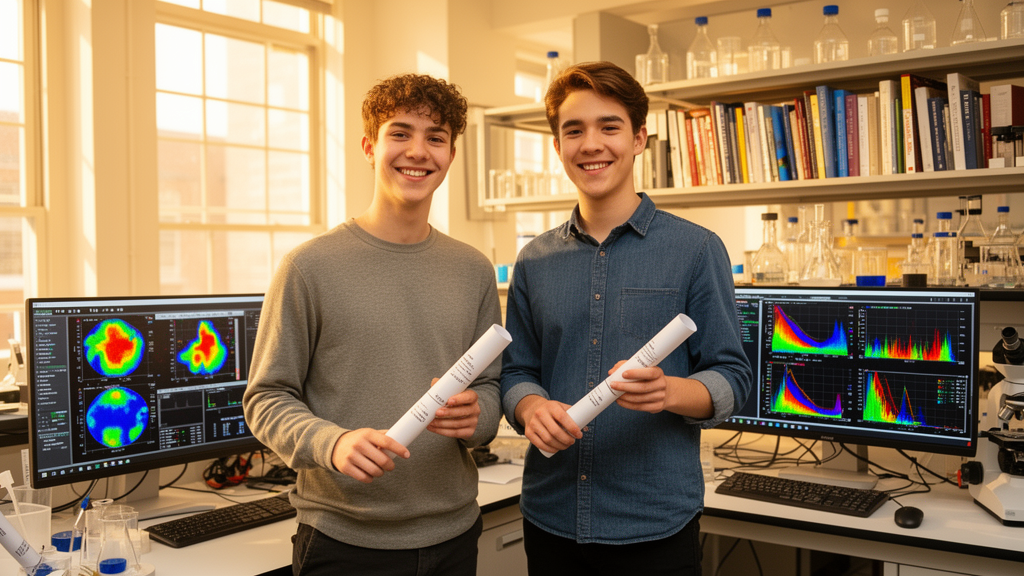
Two graduate students at Georgia State University have been named recipients of the 2026 Graduate Awards from the Southeastern Universities Research Association, a distinction that placed them among only four students selected this year from across the consortium’s member institutions. Ahanab Hafiz Anab, who completed his master’s degree in computer science in 2025 and is now pursuing a doctorate in the same field, and Haobo Cui, who finished a master’s degree in 2026 and is continuing doctoral work in mathematics and statistics, were honored for their academic achievement, demonstrated research potential and commitment to advancing science and technology. The award recognizes incoming doctoral students in science, technology, engineering and mathematics fields who have shown exceptional academic and research talent early in their graduate careers.
The Southeastern Universities Research Association is a consortium of research universities that works to advance collaborative research and education across the region and to strengthen the scientific enterprise of the United States more broadly. The organization supports research operations and workforce development in partnership with member universities, government agencies and national laboratories. Its Graduate Awards program is designed to identify and support emerging STEM talent at a pivotal moment, when students are transitioning from master’s-level training into the sustained, independent inquiry that defines doctoral research. Each recipient receives 5,000 dollars to support professional development and to help reduce the financial barriers that often accompany the start of doctoral study, a stage at which promising researchers can otherwise be forced to divide their attention between scholarship and outside employment.
Anab’s research trajectory illustrates the increasingly practical orientation of modern computer science graduate training. During his master’s studies at Georgia State, he applied data science and artificial intelligence techniques to real-world datasets, developing webcam-based systems capable of stress signal detection, emotion recognition and real-time sign language translation. These projects sit at the intersection of computer vision, machine learning and human-computer interaction, requiring models that can interpret subtle visual cues from video streams in real time rather than analyzing static images after the fact. Webcam-based sensing is an area of growing interest in digital health because it turns an ordinary camera already present in most laptops and phones into a passive monitoring instrument, avoiding the cost and friction of dedicated wearable sensors while raising important questions about accuracy, robustness and privacy that researchers in this field must confront directly.
As a doctoral researcher, Anab plans to build on that foundation by developing AI-enabled digital health technologies. The ambition is to move from laboratory demonstrations toward practical tools that can improve how human well-being is monitored and understood, combining advances in artificial intelligence, sensing and digital health into systems that are reliable enough for everyday use. In his own words, receiving the SURA Graduate Award is a meaningful recognition of his research journey and a motivation to continue developing technologies that can have a real impact on human health, with support that will help him advance doctoral research aimed at creating practical tools for monitoring well-being. The transition from detecting stress signals in controlled settings to deploying dependable health technologies is a demanding one, and sustained fellowship support of the kind the SURA award provides is often what allows doctoral students to pursue it rigorously.
Cui’s work addresses a different but equally consequential frontier: the statistical theory that underpins machine learning and data science. During his master’s research in Georgia State’s Department of Mathematics and Statistics, he developed new multivariate modeling approaches for high-dimensional datasets, work that has produced a first-author paper currently under review. High-dimensional data, in which the number of variables approaches or exceeds the number of observations, is now the norm in fields ranging from genomics to finance to large-scale behavioral studies, and it poses a fundamental challenge to classical statistical methods that were designed for settings with many more data points than parameters. Cui has described what excites him most as building statistical methods that stay reliable when data are high-dimensional and messy, which is precisely the regime in which machine learning tools are hardest to trust. His selection as one of two students chosen for the department’s machine learning concentration reflects the growing recognition within mathematics departments that rigorous statistical theory is essential to the credibility of modern artificial intelligence.
The distinction between Cui’s theoretical orientation and Anab’s applied systems work captures two complementary halves of the contemporary data science enterprise. Applied AI systems such as webcam-based health monitors depend on statistical guarantees to behave predictably when confronted with noisy, shifting, real-world inputs, while theoretical advances in multivariate modeling gain relevance when they inform the design of learning algorithms that must operate on imperfect data at scale. That both researchers emerged from the same college at the same university, and were recognized in the same year by the same consortium, suggests how deeply data-driven methods now permeate disciplines that were once sharply separated, from computer science departments focused on engineering working systems to statistics departments focused on inference and uncertainty.
Both students are based in Georgia State’s College of Arts & Sciences, and their recognition carries institutional weight beyond the individual honor. Donald Hamelberg, the university’s Vice President for Research and Economic Development and himself a Georgia State doctoral alumnus, attended the ceremony honoring this year’s awardees at the SURA Annual Members Meeting and accepted Cui’s award on his behalf. Having two Georgia State students among the four awardees, he noted, speaks to the strength of the university’s graduate research community, and he expressed pride in seeing the two students’ efforts recognized as a reflection of the talented researchers advancing discovery at the institution. For a university that has invested heavily in building research capacity across the computational and quantitative sciences, the concentration of awards in artificial intelligence and statistics is a visible signal of where that investment is bearing fruit.
The selection process itself was led by M. Omar Faison, chair of the SURA Committee for Collaborative Capacity Building, who oversaw the evaluation of candidates from member universities. He described the students as selected for their academic excellence and dedication to advancing research as outstanding members of the next generation of STEM talent, and emphasized that the SURA Graduate Award offers awardees an added measure of support during a key moment in their research journeys. The framing matters: early-career awards of this kind do more than provide money. They signal to doctoral advisors, hiring committees and funding agencies that a researcher has been independently vetted by a multi-institutional body, and they give recipients the freedom to take intellectual risks in the first years of a doctorate, when the direction of a research career is often set.
The setting of the recognition added its own symbolic resonance. Anab and Cui were honored at the 2026 SURA Annual Members Meeting held at the Thomas Jefferson National Accelerator Facility, a U.S. Department of Energy national laboratory in Newport News, Virginia, known widely as Jefferson Lab. The facility, which probes the fundamental structure of matter using high-energy electron beams, represents the kind of large-scale, collaborative scientific infrastructure that consortia like SURA exist to connect with university research programs. Honoring emerging researchers in artificial intelligence and statistics at a national laboratory dedicated to experimental physics underscores how the boundaries of STEM research continue to blur, with computational and statistical expertise now indispensable to nearly every scientific domain, from particle physics to digital health.
For the two awardees, the award arrives as they begin doctoral work that will unfold over the coming years, in fields that are evolving almost faster than curricula can be updated. Anab’s plan to develop AI-enabled digital health technologies places him in one of the most competitive and fastest-growing areas of computer science, where the difference between a compelling prototype and a deployable clinical tool often comes down to years of careful validation. Cui’s focus on statistical theory for high-dimensional machine learning addresses a foundational vulnerability of the AI systems now reshaping science and society, since methods that cannot be trusted on messy data cannot be trusted at all. The SURA recognition, and the financial support that accompanies it, gives both researchers a measure of runway at exactly the stage when sustained focus matters most, and it offers an early, externally validated vote of confidence in the directions they have chosen to pursue.
Subject of Research: SURA 2026 Graduate Awards recognizing two Georgia State doctoral students in artificial intelligence and statistical modeling
Article Title: Two Georgia State students recognized among emerging STEM leaders
Article References: Two Georgia State students recognized among emerging STEM leaders. (n.d.). Original publication
Image Credits: AI Generated
DOI: Not provided
Keywords: SURA, Georgia State University, graduate awards, STEM, artificial intelligence, digital health, computer vision, statistics, machine learning, high-dimensional data, doctoral research, Jefferson Lab
Cite Scienmag News
Blake Davidson. (October 9, 2026). Two Georgia State Doctoral Students Win SURA Graduate Awards for AI and Statistics Research. Scienmag. https://scienmag.com/two-georgia-state-doctoral-students-win-sura-graduate-awards-for-ai-and-statistics-research/
Blake Davidson. "Two Georgia State Doctoral Students Win SURA Graduate Awards for AI and Statistics Research." Scienmag, 9 October 2026, https://scienmag.com/two-georgia-state-doctoral-students-win-sura-graduate-awards-for-ai-and-statistics-research/. Accessed 9 October 2026.
Blake Davidson. "Two Georgia State Doctoral Students Win SURA Graduate Awards for AI and Statistics Research." Scienmag. October 9, 2026. https://scienmag.com/two-georgia-state-doctoral-students-win-sura-graduate-awards-for-ai-and-statistics-research/


