


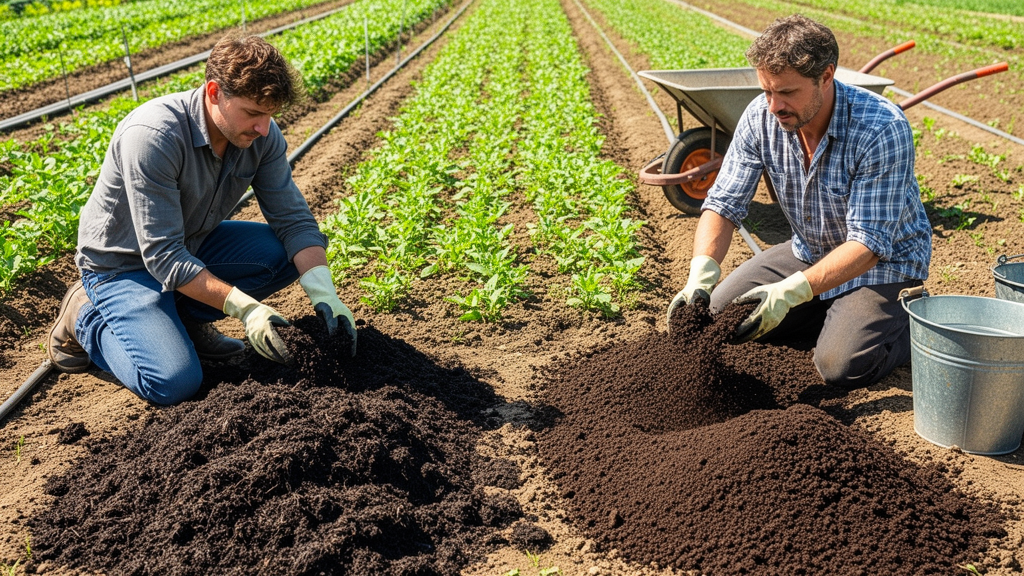
Cadmium is one of the most stubborn contaminants in the world’s farmland. The toxic heavy metal accumulates silently in soils, slips into crops, and eventually enters the human food chain, where it damages kidneys and bones. Cleaning it up is notoriously difficult: conventional engineering fixes such as soil excavation or chemical washing are expensive, disruptive, and impractical across the vast agricultural landscapes where the problem is worst. Phytoremediation, the use of plants to extract pollutants from the ground, offers an elegant alternative, but it has long been hampered by a frustrating bottleneck. Most metal-accumulating plants grow slowly and capture only modest amounts of metal per harvest, meaning remediation can drag on for decades. Now a team of Chinese researchers has shown that a humble, widely available input, livestock manure, can dramatically boost the cleanup power of an ornamental flower, and that two common manures achieve this feat through completely different biological routes.
The study, published in the journal Environmental Geochemistry and Health, was led by Luqi Mi and colleagues at the Agro-Environmental Protection Institute of the Ministry of Agriculture and Rural Affairs in Tianjin, together with Northeast Agricultural University in Harbin. The researchers set out to tackle a specific and under-studied challenge: alkaline soils contaminated with cadmium. Alkaline conditions, which prevail across large tracts of northern China and many other agricultural regions, actually work against remediation efforts, because cadmium becomes less soluble and less available to plant roots as pH rises. In acidic soils, mobilizing cadmium is relatively straightforward; in alkaline soils, the metal is chemically locked away, making the phytoremediation problem far harder. Any strategy that hopes to accelerate cleanup in these soils must either unlock the metal or grow much more plant material to soak it up.
The plant at the center of the experiment was the French marigold, Tagetes patula, a cheerful garden annual that has attracted serious scientific attention for its ability to accumulate cadmium. Previous work had already shown that different cultivars of French marigold vary widely in their cadmium uptake and rhizosphere characteristics, making the species a promising candidate for phytoremediation in contaminated fields. What remained unclear was whether and how organic amendments could push its performance further, and whether the choice of amendment mattered. To find out, the team grew marigolds in cadmium-contaminated alkaline soil treated with either chicken manure or cow manure, then measured a comprehensive suite of responses: soil pH, cadmium availability, plant biomass, physiological health, root metabolite profiles, soil microbial communities, and enzyme activity.
The results revealed a striking divergence. Chicken manure significantly increased the amount of plant-available cadmium in the soil, and it did so by lowering soil pH. This is a chemically meaningful effect: as pH drops, cadmium ions that were previously adsorbed onto mineral surfaces and bound in carbonate complexes are released into the soil solution, where roots can absorb them. With more cadmium in circulation, the marigolds accumulated substantially higher concentrations of the metal in their tissues. In effect, chicken manure acted as a mobilizing agent, converting a locked-up pollutant into a form the plant could extract. The researchers describe this as a mobilization-and-uptake mechanism, and it is precisely the kind of intervention that alkaline soils demand, since the usual problem there is too little soluble cadmium rather than too much.
Cow manure told a completely different story. It did not alter soil pH and did not increase the pool of available cadmium. Yet the marigolds grown with cow manure still removed more total cadmium from the soil. The explanation lay in the plants themselves: cow manure substantially promoted biomass, producing bigger, more vigorous plants with more root and shoot tissue. Even though the concentration of cadmium per gram of tissue did not rise, the sheer increase in plant mass meant that the total quantity of cadmium harvested per plot climbed. The researchers call this a biomass-amplification mechanism, and it represents the second great lever of phytoremediation engineering. Where chicken manure changes the chemistry of the soil, cow manure changes the economics of the plant, trading concentration for volume.
Beneath these headline outcomes, both manures triggered a cascade of deeper biological changes. The plants treated with either amendment showed improved physiological status, suggesting that the organic matter and nutrients in manure helped the marigolds withstand the oxidative and metabolic stress that cadmium normally imposes. More intriguingly, metabolomic profiling of the roots revealed that both manures altered the suite of metabolites the plants released into the rhizosphere, the narrow zone of soil immediately surrounding the roots. Several pathways related to cadmium defense were upregulated, indicating that the manures did not merely feed the plants but actively reprogrammed their chemical conversation with the soil. Root exudates are known to include low-molecular-weight organic acids and other compounds that can chelate metals, modulate their speciation, and recruit beneficial microbes, so shifting this exudate profile is a powerful way to influence metal uptake.
The soil itself responded in kind. Both manures enriched beneficial microbial taxa, including the bacterial phyla Bacteroidota and Patescibacteria, and enhanced the activity of soil enzymes. This matters because plant-microbe partnerships are increasingly recognized as central to phytoremediation success. Microbes can solubilize nutrients, produce plant growth-promoting compounds, and alter metal speciation in the rhizosphere, effectively extending the plant’s physiological reach into the soil. Long-term studies of manure fertilization have repeatedly shown that organic amendments restructure soil microbial communities and improve soil health more broadly, and the new findings suggest that these community shifts are not incidental but functionally linked to enhanced metal extraction. The enzyme activity increases point in the same direction, indicating a more biochemically active soil environment capable of supporting both plant growth and metal cycling.
The practical implications are considerable, because the two manures turn out to be suited to different remediation scenarios. Chicken manure, with its pH-lowering, cadmium-mobilizing action, is best deployed where rapid removal is the priority, for example in fields where contamination levels pose an acute risk to food safety and a fast reduction in the available cadmium pool is needed. Cow manure, which builds biomass and improves plant tolerance without mobilizing the metal, is better matched to long-term remediation programs that can be combined with sustainable agricultural practices, since it simultaneously improves soil fertility, structure, and microbial life while steadily drawing down cadmium through repeated harvests of larger plants. In other words, the choice of manure becomes a strategic decision, matching the amendment to the timeline and goals of the cleanup.
The study also carries a cautionary note that the authors and other researchers in the field have emphasized: livestock manures can act as either a source or a sink of soluble heavy metals in soil, depending on their composition and the geochemical context. Manure itself contains trace metals, and geochemical modeling work has shown that whether fertilization increases or decreases metal mobility depends on the balance of organic binding sites, pH effects, and background contamination. This underscores the value of the new study’s mechanistic approach. Rather than treating all organic amendments as interchangeable green inputs, the researchers disentangled the specific chemical and biological pathways through which each manure operates, providing a theoretical basis for optimizing manure-assisted phytoremediation rather than applying it blindly.
For a technology often dismissed as too slow to matter, phytoremediation is quietly accumulating a toolkit of accelerators: chelating agents, microbial inoculants, biochar, humic substances, and now carefully selected manures. What distinguishes the latest work is its systems-level view, connecting soil chemistry, plant metabolism, root exudation, microbial ecology, and enzyme activity into a single explanatory framework. The image that emerges is of the rhizosphere as a managed ecosystem, one that farmers and remediators can tune with ordinary agricultural inputs. If a garden flower fed with barnyard manure can pull a toxic metal out of locked-up alkaline ground, the future of contaminated-soil cleanup may look less like heavy industry and more like very clever farming, guided by a precise understanding of which lever, chemistry or biomass, needs pulling in each field.
Subject of Research: Manure-enhanced phytoremediation of cadmium-contaminated alkaline soils using French marigold
Article Title: Chicken manure and cow manure regulate phytoremediation of cadmium-contaminated alkaline soils through distinct mechanisms
Article References: Mi, L., Qin, X., Huang, Q., Zhao, L., & Sun, Y. (2026). Chicken manure and cow manure regulate phytoremediation of cadmium-contaminated alkaline soils through distinct mechanisms. Environmental Geochemistry and Health, 48(16), Article 629. https://doi.org/10.1007/s10653-026-03519-8
Image Credits: AI Generated
DOI: 10.1007/s10653-026-03519-8
Keywords: phytoremediation, cadmium, chicken manure, cow manure, alkaline soil, Tagetes patula, soil microbiome, rhizosphere metabolomics, soil enzymes, heavy metal contamination, biomass amplification, sustainable agriculture
Cite Scienmag News
Sloane Callahan. (October 9, 2026). Two Manures, Two Strategies: How Farmyard Fertilizers Supercharge Cadmium Cleanup. Scienmag. https://scienmag.com/two-manures-two-strategies-how-farmyard-fertilizers-supercharge-cadmium-cleanup/
Sloane Callahan. "Two Manures, Two Strategies: How Farmyard Fertilizers Supercharge Cadmium Cleanup." Scienmag, 9 October 2026, https://scienmag.com/two-manures-two-strategies-how-farmyard-fertilizers-supercharge-cadmium-cleanup/. Accessed 9 October 2026.
Sloane Callahan. "Two Manures, Two Strategies: How Farmyard Fertilizers Supercharge Cadmium Cleanup." Scienmag. October 9, 2026. https://scienmag.com/two-manures-two-strategies-how-farmyard-fertilizers-supercharge-cadmium-cleanup/


