


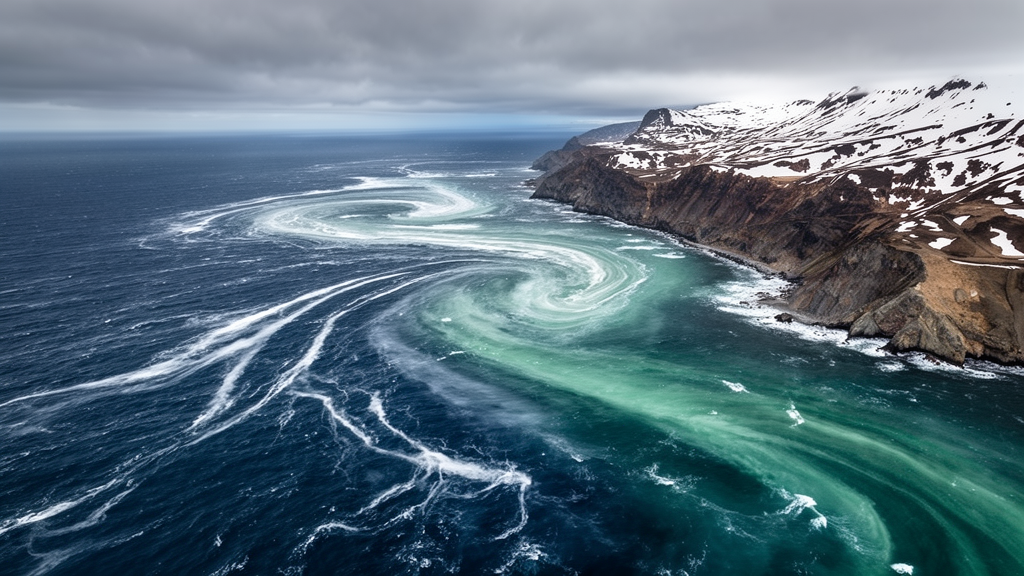
Off the southern tip of South America, two of the world’s most productive continental shelves sit back to back, separated by a narrow isthmus and connected by some of the most intricate ocean pathways on Earth. A new study published in Ocean Science shows that the winds sweeping across this remote region act like a master switch, simultaneously reorganizing sea surface temperature, salinity, and sea level on both the Pacific and Atlantic sides of the continent. The research, led by M. Milagro Urricariet of the Centro de Investigaciones del Mar y la Atmósfera in Buenos Aires, together with Laura Ruiz-Etcheverry and Alberto R. Piola, reveals that shifts in the north-south component of the wind can cool or warm surface waters, freshen or salt them, and speed up or slow down the currents that carry water between the two great ocean basins.
The team focused on the Patagonian Continental Shelves, the vast expanse of shallow ocean south of 40 degrees South that fringes both Chile and Argentina. On the Pacific side, the shelf is narrow, averaging roughly 40 kilometers in width, and carved into a labyrinth of fjords, channels, and islands that receive enormous inputs of freshwater from rivers and melting glaciers. On the Atlantic side, the shelf broadens dramatically, from about 450 kilometers wide near 40 degrees South to roughly 850 kilometers at 51 degrees South, with a smooth coastline of wide bays and gulfs. Despite their differences, the two shelves are dynamically coupled: the southward-flowing Cape Horn Current delivers relatively fresh Subantarctic Surface Water toward the Atlantic through the Le Maire Strait and the gap between Estados Island and Burdwood Bank, while the cold, salty Malvinas Current pushes northward along the Atlantic slope.
To untangle how winds shape this system, the researchers combined satellite observations of sea surface temperature, sea surface salinity, and sea level anomaly with wind data from the ERA5 atmospheric reanalysis produced by the European Centre for Medium-Range Weather Forecasts. The temperature record came from a merged microwave and infrared product that pierces the region’s notoriously persistent cloud cover, which blankets more than half of the sky on average. Salinity measurements were drawn from the European Space Agency’s Climate Change Initiative, which blends data from the SMOS, Aquarius, and SMAP satellite missions. Sea level was tracked with multi-satellite altimetry distributed by the Copernicus Climate Change Service, covering the period from 1993 onward.
The methodological core of the study is Empirical Orthogonal Function analysis, a statistical technique that decomposes sprawling space-time datasets into their dominant spatial patterns, called EOFs, and their accompanying time series, called principal components. Before applying it, the team carefully preprocessed every variable: they removed long-term trends to eliminate the influence of warming and sea level rise, applied a second-order Butterworth low-pass filter with a 20-day cutoff to strip out synoptic weather noise, and used a fourth-order band-stop filter to excise the seasonal cycle between 150 and 400 days. Sensitivity tests with alternative filtering schemes confirmed that the main patterns survived all reasonable preprocessing choices.
The results were striking. The leading mode of meridional wind variability, a monopole centered over South America, explained about 62 percent of the variance in north-south wind fluctuations and was significantly correlated with the dominant modes of temperature, salinity, and sea level variability across both shelves. When the principal component of this wind mode exceeded one standard deviation for at least five consecutive days, the researchers built composite maps of the ocean response. During the positive phase, when southerly winds prevail, surface waters cooled across both shelves by roughly 0.2 degrees Celsius, with the strongest cooling over the outer Atlantic shelf north of 50 degrees South. During the negative phase, when northerly winds dominate, the pattern reversed and waters warmed, though the warming signal was somewhat weaker than the cooling.
The salinity response was most dramatic over the Pacific slope south of 47.5 degrees South, where southerly winds produced low-salinity anomalies exceeding 0.1 units. The mechanism is classic Ekman dynamics: southerly winds blowing along the coast drive offshore transport of surface water in the Southern Hemisphere, sweeping the low-salinity water exported from the Patagonian fjords away from the coast and onto the continental slope. Northerly winds reverse this transport, piling fresher water against the shore. On the Atlantic side, the salinity anomalies were smaller, generally below 0.05 units, but their sign was consistent with a shift in the balance between fresh Pacific inflow and salty subantarctic water.
Sea level told perhaps the most compelling story. Under southerly winds, sea level rose by more than 3 centimeters over the mid-shelf of the northern Atlantic, setting up a zonal pressure gradient that drove northeastward geostrophic current anomalies of up to 2 centimeters per second. Meanwhile, over the Pacific, sea level fell in the region of the Cape Horn Current, and the associated geostrophic velocity anomalies reached about 5 centimeters per second along the slope, indicating a slowdown of the southward mean flow. When northerly winds took over, the entire pattern flipped: the Cape Horn Current strengthened, and the northward transport over the Atlantic shelf weakened. The correlation between the leading meridional wind mode and the second sea level mode was particularly strong, at minus 0.74, one of the most robust statistical relationships in the study.
Put together, these findings paint a coherent physical picture. Southerly winds enhance coastal upwelling on the Pacific side, export fresh fjord water offshore, weaken the Cape Horn Current, and simultaneously strengthen the northward transport of cold, salty subantarctic water over the Atlantic shelf. Northerly winds do the opposite, boosting the Pacific-to-Atlantic connection and damping the Atlantic flow. Because the mean flow is southward in the Pacific and northward in the Atlantic, a spatially uniform meridional wind anomaly acts asymmetrically on the two margins, always favoring one while suppressing the other. This wind-driven seesaw effectively modulates the interocean exchange that supplies the Atlantic shelf with either fresh Pacific water or salty subantarctic water, reshaping the hydrographic balance of the entire region.
The zonal, east-west wind component also left its fingerprint, though the picture was more complicated. The leading mode of zonal wind variability, which represents the strengthening or weakening of the prevailing westerlies, explained about 50 percent of the variance and correlated significantly with the first sea level mode, with a correlation coefficient of 0.41. Intensified westerlies raised sea level over the Atlantic shelf and the Cape Horn region while lowering it slightly over the Pacific shelf north of 53 degrees South, driving geostrophic anomalies of about 1 centimeter per second along the outer Atlantic shelf. The authors note that the mechanisms behind the zonal wind response remain unclear and merit further investigation with high-resolution models.
The study also confronted the hard limits of observing such a remote and dynamic region. Satellite salinity retrievals degrade in cold water and near land, and the researchers caution that their Pacific shelf results should be interpreted carefully. Altimetry loses accuracy close to the coast, where waveform contamination, tidal corrections, and the macrotidal environment of Tierra del Fuego, where tides exceed 10 meters, complicate the retrieval of sea level. The filtering that removes synoptic variability may also underestimate the full oceanic response, since meridional wind fluctuations at daily timescales are as energetic as the zonal ones over much of the Atlantic shelf. Even so, the consistency between correlation maps, composite analyses, and previous numerical simulations, including work linking the Southern Annular Mode to shelf circulation, gives the team confidence that the wind-driven coupling they document is real and robust.
Why does this matter beyond the physics? The Patagonian shelves host some of the Southern Hemisphere’s richest fisheries and marine ecosystems, and the wind-driven modulation of temperature, salinity, and circulation directly shapes nutrient supply, water mass distribution, and species habitats. As climate change alters the westerly winds and the Southern Annular Mode shifts poleward, the delicate balance of interocean exchange documented here may itself change, with consequences for the salinity budget of the South Atlantic and the ecosystems that depend on it. The authors argue that anticipating these changes will require high-resolution regional models capable of resolving narrow straits and steep slopes, together with an expanded network of sustained in-situ observations in one of the least monitored ocean regions on the planet. For now, the study stands as a vivid demonstration that a single atmospheric variable, the meridional wind, can orchestrate a basin-spanning symphony of ocean change around the southern tip of a continent.
Subject of Research: Wind-driven variability of sea surface temperature, salinity, and sea level over the Patagonian continental shelves and its role in Pacific-Atlantic ocean exchange
Article Title: Impact of wind variations on surface variability over the Patagonian Continental Shelves
Article References: Urricariet, M. M., Ruiz-Etcheverry, L., & Piola, A. R. (2026). Impact of wind variations on surface variability over the Patagonian Continental Shelves. Ocean Science, 22(5), 2993-3015. https://doi.org/10.5194/os-22-2993-2026
Image Credits: AI Generated
Keywords: Patagonian shelf, wind variability, sea surface temperature, sea surface salinity, sea level anomaly, Cape Horn Current, Ekman transport, continental shelf circulation, interocean exchange, satellite oceanography, ERA5 reanalysis, Southern Annular Mode
Cite Scienmag News
Violet Maxwell. (October 9, 2026). Winds Flip the Ocean Around Patagonia, Reshaping Pacific-Atlantic Water Exchange. Scienmag. https://scienmag.com/winds-flip-the-ocean-around-patagonia-reshaping-pacific-atlantic-water-exchange/
Violet Maxwell. "Winds Flip the Ocean Around Patagonia, Reshaping Pacific-Atlantic Water Exchange." Scienmag, 9 October 2026, https://scienmag.com/winds-flip-the-ocean-around-patagonia-reshaping-pacific-atlantic-water-exchange/. Accessed 9 October 2026.
Violet Maxwell. "Winds Flip the Ocean Around Patagonia, Reshaping Pacific-Atlantic Water Exchange." Scienmag. October 9, 2026. https://scienmag.com/winds-flip-the-ocean-around-patagonia-reshaping-pacific-atlantic-water-exchange/


