


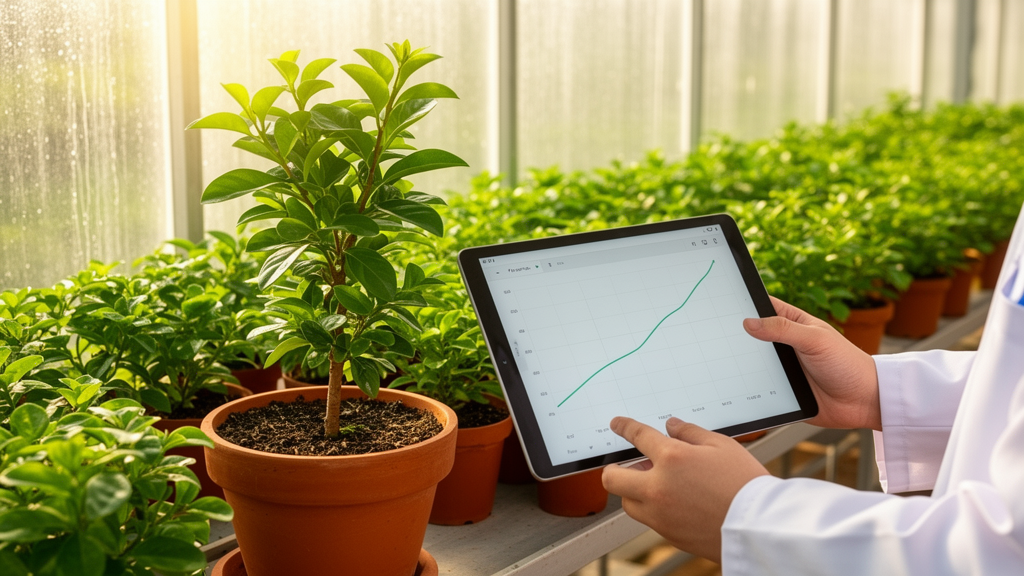
A humble herb that grows across the hillsides and home gardens of Vietnam has become the unlikely star of a study that blends old-fashioned plant physiology with cutting-edge artificial intelligence. Vietnamese balm, known scientifically as Elsholtzia ciliata and belonging to the mint family, Lamiaceae, is prized both as a culinary herb and as a source of essential oils with documented antioxidant, antimicrobial, and anti-inflammatory properties. Researchers in Vietnam have now shown that a single synthetic plant hormone, applied at precisely the right moment in the plant’s life, can dramatically increase its vegetative growth, and that machine-learning algorithms can predict exactly which combination of dose and timing delivers the biggest payoff. The work, published in the journal Plant Biosystems, also tackles a question that consumers rarely think about but regulators obsess over: whether the hormone lingers on the leaves at levels that could pose a dietary risk.
The hormone in question is 6-benzyladenine, usually abbreviated 6-BA, a synthetic cytokinin. Cytokinins are the class of plant hormones that govern cell division, shoot branching, leaf expansion, and the delay of senescence, the programmed aging that eventually yellows and kills a leaf. Farmers and horticulturists have long sprayed cytokinins to bulk up leafy crops and keep harvested vegetables fresh, but the results have often been inconsistent, because the same chemical that helps at one stage of development can do little or even harm at another. That stage dependence is precisely what the new study set out to quantify, moving beyond the traditional trial-and-error approach toward a data-driven optimization of growth regulator use.
The research team, led by Luu Tang Phuc Khang of Ho Chi Minh City University of Education and Chiang Mai University together with Nguyen Xuan Tong of the Industrial University of Ho Chi Minh City, monitored the growth of Vietnamese balm plants over eight weeks. Fresh biomass followed a striking trajectory, climbing from a mere 0.7 grams per plant in the first week to 40.2 grams per plant by week eight, a roughly fifty-seven-fold increase that illustrates how explosively this herb accumulates tissue during its vegetative phase. Against this backdrop of rapid natural growth, the researchers sprayed plants with 6-BA at two different developmental stages, week four and week six, and at varying concentrations, then tracked leaf number, leaf area, biomass, and photosynthetic physiology using high-resolution phenotyping and biochemical analyses.
The verdict on timing was unambiguous. The greatest improvements in leaf number, leaf area, and overall biomass came from a concentration of 15 parts per million applied at week four, the early vegetative stage when the plant is actively building its photosynthetic machinery. Spraying later, at week six, produced weaker responses, consistent with the idea that cytokinins exert their strongest influence on sink strength, the capacity of young tissues to attract sugars and nutrients, while leaves are still expanding. This fits with decades of plant science showing that cytokinins regulate source-to-sink carbon partitioning: by stimulating cell division in developing leaves, the hormone effectively enlarges the plant’s demand for photosynthate, which in turn drives further growth. Applying the chemical after that window has largely closed yields diminishing returns.
What makes the study distinctive is its analytical machinery. Rather than relying on simple comparisons of treatment means, the team built four predictive models: XGBoost, random forest, elastic net regression, and ordinary linear regression. These algorithms were trained on the experimental data to forecast growth performance from variables including hormone dose, spraying time, and the duration of growth after treatment. XGBoost, a gradient-boosted decision tree method that has become a workhorse of agricultural prediction, emerged as the most accurate, achieving a coefficient of determination of up to 0.94, meaning it explained roughly ninety-four percent of the variance in the measured outcomes. For a field experiment with biological variability, that level of predictive power is remarkable.
Even more valuable than the raw accuracy is the interpretability layer the researchers added. Using SHAP analysis, a technique borrowed from game theory that assigns each input variable a quantified contribution to every prediction, the team identified application dose, spraying time, and post-treatment duration as the three most influential factors governing growth outcomes. In practical terms, this means a grower or agronomist could use the model to ask a counterfactual question, such as what happens to expected biomass if the spray is moved a week earlier or the concentration is halved, and receive a data-grounded answer. The approach mirrors a broader movement in smart agriculture, where interpretable machine learning is increasingly used to optimize fertilization, irrigation, and yield prediction across crops from cabbage to wheat and maize.
Growth enhancement, however, is only half of the story. Any chemical sprayed on a food plant raises the question of residues, and 6-BA is no exception, even though it is generally regarded as a low-risk plant growth regulator that has been reviewed by the European Food Safety Authority. The researchers performed residue determination on the treated plants and then carried out a dietary exposure assessment, using Monte Carlo simulation to account for variability in consumption patterns. The results were reassuring: 6-BA dissipated rapidly after application, and the estimated chronic dietary exposure across all age groups was negligible, indicating no meaningful long-term health risk under the tested conditions. For an herb that is often eaten fresh or dried in large culinary quantities, that safety margin matters as much as the yield boost itself.
The implications extend beyond one herb in one country. Vietnamese balm is a medicinal and aromatic plant whose essential oil chemistry has attracted growing scientific interest, and previous work by some of the same authors documented the biological activities of its oils and the effects of other hormones such as gibberellic acid on its growth. Cytokinin sprays have been shown to influence essential oil biosynthesis in other Lamiaceae species, including lavender, rosemary, and thyme, raising the possibility that carefully timed 6-BA application could enhance not only biomass but also the production of valuable secondary metabolites. The authors are careful on this point, noting that further metabolomic studies are needed before any claims about phytochemical quality can be made with confidence.
There are also honest caveats about the scope of the machine-learning framework. The models were trained on a single field experiment in a single environment, and the authors themselves emphasize that multi-environment validation is required before the approach can support broader commercial implementation. Plant growth regulator responses are notoriously sensitive to climate, soil, cultivar, and cultivation practice, and a model optimized for Vietnamese growing conditions may not transfer directly to temperate farms. Still, the study offers a template: pair a well-designed, stage-specific field trial with interpretable machine learning, and the result is not just a recommendation for one crop but a transferable method for finding the optimal intervention window in virtually any managed plant system.
For now, the practical takeaway is refreshingly concrete. Vietnamese balm growers who want bigger, leafier plants should consider a single foliar application of 15 ppm 6-BA at around week four of growth, a treatment the data show enhances vegetative performance while leaving residues that dissipate quickly and pose negligible chronic risk to consumers of any age. More broadly, the study signals a shift in how agricultural science is done: the era of guessing the right dose and hoping for the best is giving way to algorithms that can read the plant’s developmental clock and tell farmers exactly when to act. As machine learning continues to seep into greenhouses and field trials, the humble herbs on our plates may be among the first beneficiaries of this quiet revolution in precision crop management.
Subject of Research: Stage-specific application of the cytokinin 6-benzyladenine to enhance growth of Elsholtzia ciliata and assess residue safety using machine learning
Article Title: Growth regulation and residue safety of 6-benzyladenine in Vietnamese Balm (Elsholtzia ciliata, Lamiaceae): a stage-specific and data-driven assessment
Article References: Khang, L. T. P., & Tong, N. X. (2026). Growth regulation and residue safety of 6-benzyladenine in Vietnamese Balm (Elsholtzia ciliata, Lamiaceae): a stage-specific and data-driven assessment. Plant Biosystems, 160(5), Article 286. https://doi.org/10.1007/s44473-026-00289-0
Image Credits: AI Generated
DOI: 10.1007/s44473-026-00289-0
Keywords: 6-benzyladenine, cytokinins, Elsholtzia ciliata, Vietnamese balm, plant growth regulators, machine learning, XGBoost, SHAP analysis, residue risk assessment, photosynthesis, leaf development, food safety
Cite Scienmag News
Blake Davidson. (October 9, 2026). Machine Learning Pinpoints the Perfect Timing to Boost Vietnamese Balm Growth. Scienmag. https://scienmag.com/machine-learning-pinpoints-the-perfect-timing-to-boost-vietnamese-balm-growth/
Blake Davidson. "Machine Learning Pinpoints the Perfect Timing to Boost Vietnamese Balm Growth." Scienmag, 9 October 2026, https://scienmag.com/machine-learning-pinpoints-the-perfect-timing-to-boost-vietnamese-balm-growth/. Accessed 9 October 2026.
Blake Davidson. "Machine Learning Pinpoints the Perfect Timing to Boost Vietnamese Balm Growth." Scienmag. October 9, 2026. https://scienmag.com/machine-learning-pinpoints-the-perfect-timing-to-boost-vietnamese-balm-growth/


