


More than a century before space probes returned samples from asteroids and laboratories began dissecting pristine pieces of the early solar system, a Smithsonian scientist working with little more than a petrographic microscope and a cabinet of fallen stones laid the intellectual foundations of modern meteoritics. George Perkins Merrill (1854–1929), the preeminent American meteoriticist of the first quarter of the twentieth century, spent his career at the United States National Museum, now the Smithsonian Institution in Washington, D.C., and produced more than seventy publications on meteorites. A new historical review by Carl N. Drummond of Purdue University Fort Wayne, published as a preprint in the History of Geo- and Space Sciences, examines the origins, arguments, and lasting reception of the two papers that defined Merrill’s legacy: his analyses of the origin of chondrules and of the evidence for metamorphic alteration in chondritic meteorites.
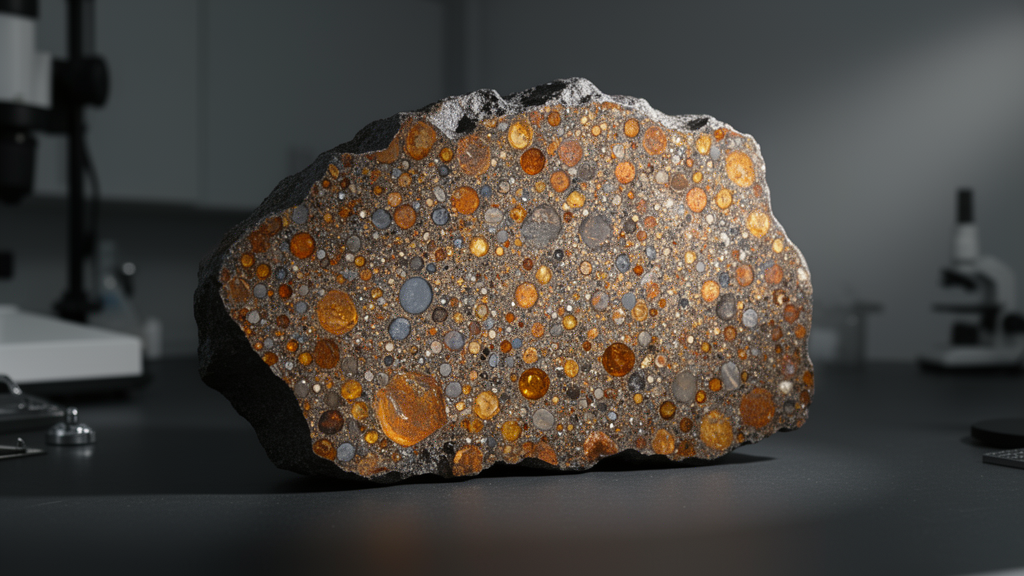
Chondrules are the tiny, once-molten spherical grains that dominate stony meteorites known as chondrites, and they remain among the most enigmatic objects in the solar system. These millimeter-sized droplets of silicate material formed in the solar nebula some 4.56 billion years ago, predating the assembly of the planets themselves, and their textures preserve a record of the extreme, brief heating events that shaped the primordial disk. Merrill recognized early that these small spheres were not incidental curiosities but the building blocks of the most common class of meteorites, and therefore potential witnesses to the earliest moments of planetary formation. His insistence that chondrules deserved rigorous petrographic study helped transform meteoritics from a cataloguing pursuit into an experimental, process-driven science.
Drummond’s review emphasizes that Merrill’s skill lay in the emerging discipline of petrography, the microscopic analysis of rocks in thin section. By grinding meteorite samples to slices thin enough for light to pass through and examining them under polarized light, Merrill could identify the minerals, textures, and intergrowth relationships that record how a rock formed and how it was subsequently modified. He applied this technique systematically to chondritic meteorites at a time when many of his contemporaries still debated whether meteorites were volcanic ejecta, atmospheric condensates, or cosmic debris. His careful descriptions of chondrule textures, including radial and barred varieties now classified as RP, C, and BO textural types, gave later researchers a descriptive vocabulary that persists in modified form today.
The first of Merrill’s landmark papers tackled the question of chondrule origin, a problem that remains only partially resolved even now. Drawing on his petrographic observations, Merrill concluded that chondrules could not be explained by a single formation process. He argued that the diversity of textures and mineral assemblages among chondrules pointed to multiple mechanisms operating in the early solar system, an interpretation that anticipated the modern situation in which researchers have proposed no fewer than eight, and by some counts fourteen, distinct mechanisms for chondrule formation, ranging from nebular shock waves to collisions between molten planetesimals. Merrill’s pluralism, once controversial, now looks strikingly prescient in a field that has yet to converge on a single origin story.
Merrill also documented compound chondrules, pairs or clusters of spheres that appear to have fused together while still plastic, and used them to argue that some chondrules experienced more than one heating episode or collided shortly after forming. Modern researchers continue to study compound chondrules as constraints on chondrule densities in the nebula and on the timing of their formation, though the community today distinguishes carefully between compound chondrules of various textural types and the much more common porphyritic chondrules, most of which are not compound. That Merrill extracted such inferences from optical microscopy alone, without electron microprobes, isotopic analysis, or synchrotron beams, underscores how far careful observation can carry a scientist.
The second landmark paper addressed metamorphism, the alteration of rocks by heat and pressure after their initial formation. Merrill marshaled petrographic evidence that chondritic meteorites had not survived the intervening eons unchanged. Instead, he showed that their minerals and textures record a history of thermal and dynamic metamorphic alteration on their parent bodies. Chondrules in some meteorites appear blurred and recrystallized, their once-sharp boundaries softened by prolonged heating, while others show evidence of deformation and shock. Merrill’s recognition that these stones are altered rocks, not pristine nebular condensates, anticipated the modern petrologic typing scheme, in which chondrites are graded from type 3, relatively unaltered, to types 5 and 6, strongly thermally metamorphosed.
The consequences of that insight for modern planetary science are difficult to overstate. Today’s researchers read chondrites as archives of parent-body evolution: the degree of metamorphism tells them how deeply a meteorite was buried inside its parent asteroid, how large and how hot that body became, and how the decay of short-lived radionuclides drove internal heating in the solar system’s first tens of millions of years. Modern reviewers of Drummond’s paper note refinements Merrill could not have anticipated, such as the fact that essentially no static lithostatic pressure was involved in chondrite formation, so that dynamic shock rather than burial pressure explains most deformation features. Yet the basic framework, that chondrites record both primary nebular processes and secondary parent-body processing, is squarely Merrill’s.
Recognition came late but emphatically. In 1922 the National Academy of Sciences awarded Merrill the J. Lawrence Smith Medal, only its second presentation, for outstanding accomplishments in the study of meteorites, citing in particular the pair of papers on chondrule origin and chondrite metamorphism. By then Merrill had risen to head curator of geology at the National Museum, and his students and successors had carried his methods into a growing American research enterprise. Even his name became embedded in the science itself: the phosphate mineral merrillite, a trace but ubiquitous accessory phase in chondrules, commemorates his contributions every time a researcher logs its presence in a thin section.
Drummond’s historical analysis also traces how Merrill’s hypotheses were received and refined by subsequent generations. The peer discussion accompanying the preprint, including detailed commentary from meteoriticist Alan E. Rubin, situates Merrill’s observations within modern classifications, noting for example that the plagioclase feldspar Merrill found scarce in his samples is essentially absent in petrologic type 3 chondrites and only grows to visible sizes in types 5 and 6, exactly as the metamorphism framework predicts. Reviewers likewise note that while nearly four dozen mineral phases have been identified in chondrules, more than 98 percent of chondrules in ordinary and carbonaceous chondrites are dominated by olivine, low-calcium pyroxene, and silico-feldspathic glass, with minor metal, sulfide, and accessory phases, a simplification that makes Merrill’s optical-era descriptions remarkably durable.
What emerges from Drummond’s review is a portrait of a scientist whose patience with small stones yielded insights of cosmic scale. At a time when the solar system’s origin was a matter of speculation, Merrill treated meteorites as data, read their microtextures as records of process, and concluded that both the formation of chondrules and the alteration of chondrites were complex, multi-stage histories rather than single events. Every laboratory that today heats dust aggregates to simulate chondrule formation, every mission that returns material from a primitive asteroid, and every petrologic type assigned to a newly fallen stone operates within the framework he helped construct. The tiny spheres he studied under the microscope a century ago still carry the oldest story ever told, and George Perkins Merrill taught science how to read them.
Subject of Research: Historical analysis of George Perkins Merrill's petrographic research on chondrules and metamorphism in chondritic meteorites
Article Title: George Perkins Merrill's Analyses of Chondrules and Chondritic Meteorites
Article References: Drummond, C. N. (2026). George Perkins Merrill's Analyses of Chondrules and Chondritic Meteorites. https://doi.org/10.5194/hgss-2026-9
Image Credits: AI Generated
DOI: 10.5194/hgss-2026-9
Keywords: George Perkins Merrill, chondrules, chondritic meteorites, meteoritics, Smithsonian, metamorphism, solar system origin, petrography, J. Lawrence Smith Medal, history of science, chondrites, Carl N. Drummond
Cite Scienmag News
Grant Pearson. (October 9, 2026). How a Smithsonian Scientist’s Century-Old Chondrule Studies Still Shape Solar System Science. Scienmag. https://scienmag.com/how-a-smithsonian-scientists-century-old-chondrule-studies-still-shape-solar-system-science/
Grant Pearson. "How a Smithsonian Scientist’s Century-Old Chondrule Studies Still Shape Solar System Science." Scienmag, 9 October 2026, https://scienmag.com/how-a-smithsonian-scientists-century-old-chondrule-studies-still-shape-solar-system-science/. Accessed 9 October 2026.
Grant Pearson. "How a Smithsonian Scientist’s Century-Old Chondrule Studies Still Shape Solar System Science." Scienmag. October 9, 2026. https://scienmag.com/how-a-smithsonian-scientists-century-old-chondrule-studies-still-shape-solar-system-science/


