


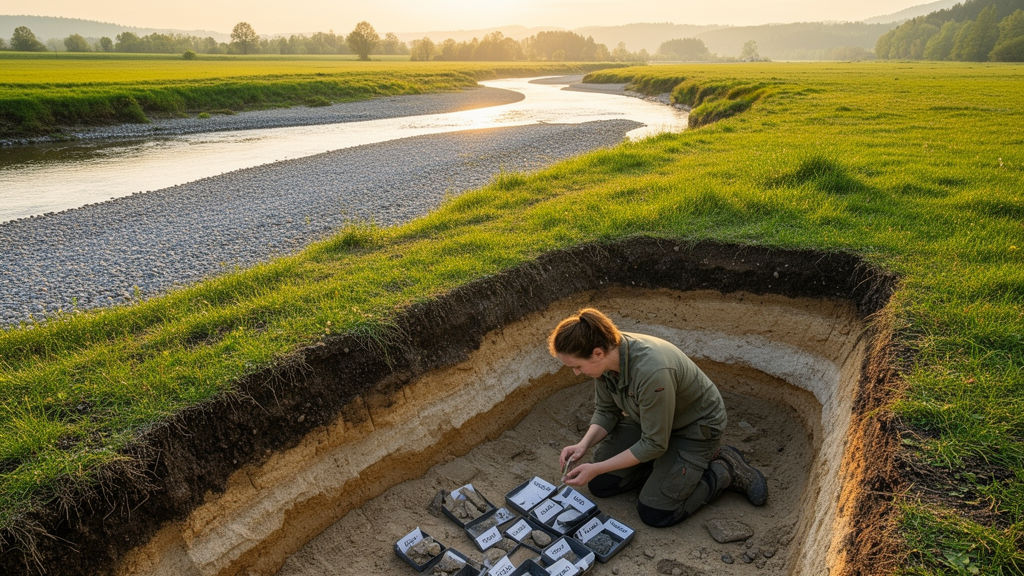
Beneath the quiet meadows of the Wiesent River in northern Bavaria lies a layered record of human history stretching back thousands of years. A new study published in the E&G Quaternary Science Journal shows that this seemingly pastoral valley was once a marshy wetland, and that centuries of farming, deforestation, sheep grazing, and river engineering gradually turned it into the human-shaped landscape visible today. The research, led by Bastian Grimm of Justus Liebig University Giessen together with colleagues from the University of Bamberg, is among the first to apply the concept of the fluvial anthroposphere to a rural low-mountain catchment in Germany, and its findings suggest that people, not climate, have been the dominant force shaping this river system since at least the early Middle Ages.
The idea of the fluvial anthroposphere differs from the better-known Anthropocene. Rather than defining a single stratigraphic moment when humanity began leaving its mark on the geological record, the fluvial anthroposphere describes a long, uneven, and locally variable transition from natural to human-dominated river landscapes. This transition unfolded at different times in different places, shaped by societal responses, technological innovations, and ecological feedbacks. In the humid lowlands of central Europe, the shift began remarkably early, sometimes as far back as the Neolithic period in the sixth millennium BCE, as documented in Belgian catchments such as the Dijle and Gete rivers and in eastern German lowlands. In low-mountain ranges, however, the transformation often came much later, frequently not before the Middle Ages between roughly 500 and 1500 CE.
The Wiesent River catchment offers an ideal natural laboratory for studying this delayed transformation. Covering 1040 square kilometers of the northern Franconian Alb, the catchment has been settled since the Neolithic yet has remained overwhelmingly rural, without major cities, monasteries, or industrial centers. This makes it possible to assess the cumulative effects of ordinary human activities, such as small-scale agriculture and village life, without the overwhelming signal of urbanization. The river itself runs 78 kilometers from its source near Steinfeld to its confluence with the Regnitz near Forchheim, cutting through a karstic plateau of Jurassic limestone and dolomite that rises to around 450 meters above sea level. Deeply incised valleys, typically only 50 to 70 meters wide, confine the floodplains and concentrate the sedimentary record.
To reconstruct the valley’s history, the team combined a comprehensive multidisciplinary review with the first geoscientific field investigations. The review synthesized environmental data, archaeological findings, medieval and early modern documents, administrative records, place-name analysis, and archival maps. The fieldwork included electrical resistivity tomography, a geophysical technique that maps subsurface resistivity variations to reveal buried sediment bodies and ancient channel fills, along with percussion drilling and laboratory analysis of sediment cores. At the Höfen site, roughly two kilometers south of Hollfeld, the researchers extracted cores up to four meters deep and analyzed grain size distributions and organic content using the sieve and pipette method and loss-on-ignition measurements.
The stratigraphy that emerged tells a striking story. At the base of the sequence lie dark, organic-rich silty clays and peat, locally more than 40 centimeters thick, deposited during the Early Holocene when the valley floor was a waterlogged, marsh-like environment with weakly defined, anastomosing channels. Comparable peat sequences in the neighboring Aufsess River catchment have been dated to around 7400 years ago. Above these organic deposits, thin layers of well-rounded limestone and dolomite gravel record short episodes of high-energy flooding during the Middle to Late Holocene. Capping everything is the most dramatic unit: up to three meters of homogeneous, brown-beige silty to loamy overbank deposits with low organic content, laid down by repeated flooding as fine sediment washed off eroding hillslopes.
This three-meter blanket of floodplain loam is the fingerprint of human land use. The review shows that deforestation began in the Neolithic through rotating slash-and-burn cultivation, but intensified dramatically in the Middle Ages, a process preserved in place names bearing the suffix -reuth, which denote large-scale forest clearances. From the eleventh and twelfth centuries onward, village formation, settlement nucleation around churches and manorial centers, and the spread of the open-field system accelerated soil erosion on slopes. Sheep grazing amplified the effect: by the 1850s, manorial sheep farms in the region kept as many as 177,000 animals in total, and their grazing on steep valley slopes stripped vegetation cover and delivered sediment directly to the river system. Previous work in the Aufsess catchment dated the onset of sustained overbank deposition to between 2400 and 3000 years ago, with sedimentation rates eventually reaching up to two millimeters per year.
Human intervention extended beyond the slopes to the river itself. Historical sources document mills with mill races, small weirs, water wheels, and irrigated water meadows throughout the catchment, all of which altered flow conditions, sediment trapping, and channel morphology. The demand for winter fodder for the growing sheep flocks likely drove the construction of water meadows, which in turn reshaped how sediment moved between slopes, floodplains, and channels. Archival records from the sixteenth century onward reveal frequent disputes over water use among farmers, millers, and timber rafters, and nineteenth-century petitions to repair eroded river banks describe the loss of hundreds of square meters of farmland. Even the famous juniper heaths of the Franconian Alb, often mistaken for pristine nature, are revealed as cultural landscapes created by centuries of continuous grazing pressure.
The study also highlights a crucial complication in reading sediment archives: the response of rivers to human pressure is neither immediate nor linear. Eroded soil is often stored temporarily as colluvium on slopes or at foot-slope positions before eventually reaching the floodplain, a phenomenon known as the sediment cascade. This temporal decoupling between erosion and deposition means that layers of floodplain sediment may lag centuries behind the land-use changes that triggered them. In the Wiesent catchment, gullies up to ten meters deep near the confluence of the Aufsess and Wiesent rivers testify to severe historical soil erosion, while the absence of subfossil oak trunks in Main River deposits after around 1200 BCE has been interpreted as evidence of widespread deforestation upstream.
Climate, the researchers emphasize, played a comparatively minor role in this particular story. While events such as the 8.2 ka cooling, the Löbben Oscillation around 1600 BCE, the Medieval Climate Optimum, and the flood-rich phases of the Little Ice Age certainly influenced discharge and flood frequency, the long-term morphology and sediment dynamics of the floodplain appear dominated by anthropogenic disturbance. The close correspondence between the historical review and the empirical field data, the authors argue, confirms the Wiesent floodplain as a high-resolution archive of human-induced fluvial change. With its rural character, well-preserved stratigraphy, and absence of industrial contamination, the catchment is now positioned as a key study area for future work within the German Research Foundation’s priority programme on the fluvial anthroposphere, offering a template for disentangling human impacts from natural background processes in river systems across Europe.
Subject of Research: Human-induced transformation of the Wiesent River floodplain in northern Bavaria from wetland to human-dominated fluvial landscape since the Holocene
Article Title: The fluvial anthroposphere of the Wiesent River catchment, northern Bavaria, Germany: review and first results
Article References: Grimm, B. E. W. W., Voigt, A., Dix, A., Schreg, R., & Fuchs, M. (2026). The fluvial anthroposphere of the Wiesent River catchment, northern Bavaria, Germany: review and first results. E&G Quaternary Science Journal, 75(1), 49-67. https://doi.org/10.5194/egqsj-75-49-2026
Image Credits: AI Generated
Keywords: fluvial anthroposphere, floodplain, Wiesent River, Franconian Alb, sediment cores, electrical resistivity tomography, soil erosion, medieval land use, deforestation, sheep grazing, Holocene, geoarchaeology
Cite Scienmag News
Violet Maxwell. (October 9, 2026). Bavarian River Floodplain Reveals Millennia of Human Transformation Beneath Its Sediments. Scienmag. https://scienmag.com/bavarian-river-floodplain-reveals-millennia-of-human-transformation-beneath-its-sediments/
Violet Maxwell. "Bavarian River Floodplain Reveals Millennia of Human Transformation Beneath Its Sediments." Scienmag, 9 October 2026, https://scienmag.com/bavarian-river-floodplain-reveals-millennia-of-human-transformation-beneath-its-sediments/. Accessed 9 October 2026.
Violet Maxwell. "Bavarian River Floodplain Reveals Millennia of Human Transformation Beneath Its Sediments." Scienmag. October 9, 2026. https://scienmag.com/bavarian-river-floodplain-reveals-millennia-of-human-transformation-beneath-its-sediments/


