


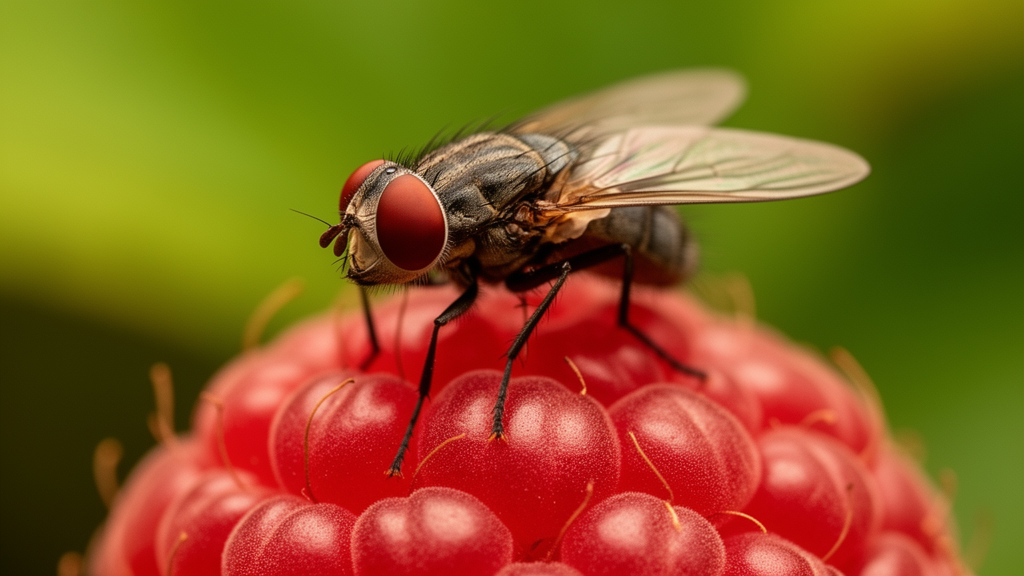
Every animal that navigates the world faces a deceptively simple problem: how to remember where it is going. When a fruit fly catches a whiff of apple cider vinegar, it commits to a heading and keeps walking upwind for several seconds after the odour disappears. That brief sensory encounter must somehow be written into the fly’s brain as a stable memory of a goal, held in place while the animal runs, and then erased the moment the fly turns away. A new study published in Nature reveals, at the level of individual synapses, how a tiny circuit in the fly brain accomplishes this feat, and in doing so offers a fresh answer to one of neuroscience’s oldest puzzles: how recurrent networks can be both rock-steady and instantly switchable.
Recurrent attractor networks have long been the leading theoretical explanation for working memory. In these circuits, neurons excite one another in loops, so that a pattern of activity, once ignited, sustains itself long after the triggering stimulus has vanished. Neurons in the prefrontal cortex of primates show exactly this kind of persistent firing during memory tasks, outlasting the intrinsic time constants of their membranes by orders of magnitude, which argues that the persistence comes from the network rather than from any single cell. But attractor networks carry an inherent trade-off. A circuit tuned to hold activity stably is notoriously hard to switch off, and models have typically solved this by adding abstract gates that control when the attractor is allowed to run. What those gates look like in real biology, synapse by synapse, has remained unclear.
The fan-shaped body of the fruit fly, part of a navigation centre called the central complex, offered the research team led by Aaron Lanz and Katherine Nagel at NYU School of Medicine an unusually tractable place to look. Connectomics has mapped this region with synaptic precision, and genetic tools allow researchers to record from identified cell types in walking flies. Within the fan-shaped body, two local neuron types, called hΔK and PFG, are reciprocally connected in a ring, forming the most numerous recurrent connections of any columnar pair in the central complex. PFG neurons also receive direct inputs from the fly’s internal compass in the ellipsoid body, while both populations get broad input from tangential neurons. The architecture is strikingly reminiscent of classic working memory models: local recurrent excitation, structured input, and global inhibition.
Using two-photon calcium imaging in flies walking on an air-supported ball, the researchers confirmed that both hΔK and PFG neurons show a localized bump of activity that switches on with odour and persists while the fly maintains its heading. When the bump turned off, the fly’s trajectory deviated from its goal, linking the neural persistence directly to navigational behaviour. Whole-cell patch clamp recordings then probed where this persistence comes from. Injecting current into hΔK neurons produced rapid responses with no lingering excitation, ruling out intrinsic membrane properties. Instead, when the team optogenetically activated upstream tangential neurons, hΔK cells responded with slow, persistent excitation that vanished when recurrent signalling from hΔK itself was blocked with tetanus toxin. Persistence, in other words, is a property of the loop, not the neuron.
The synaptic details proved to be the study’s most surprising twist. Excitation arriving at hΔK is slow, likely carried by neuropeptides and modulators, since PFG neurons express no classical fast transmitter at all, only tyramine, myoinhibitory peptide and diuretic hormone 31. Inhibition, by contrast, is fast: two tangential neuron types, FB5V and FB6M, deliver rapid GABAergic inhibition that depresses over time and can be converted to excitation by the blocker picrotoxin. When the researchers built a computational model of the circuit based on real connectome weights, with 30 hΔK neurons, 18 PFG neurons and a global inhibitory unit, this speed asymmetry turned out to be crucial. With fast recurrent excitation, only a narrow band of excitation and inhibition strengths produced stable persistence; small parameter changes flipped the network between transient and non-decaying regimes. With slow excitation, a broad regime of tuneable persistence emerged, allowing the duration of the memory to be graded smoothly by modest changes in synaptic strength, matching the variability seen in the flies.
But a stable memory still needs a switch. Close inspection of the imaging data revealed that hΔK and PFG, despite their tight anatomical coupling, behave alike only during straight goal-directed runs. During turns and rest, the two populations decouple: PFG neurons maintain a low-amplitude bump that slides across the fan-shaped body in register with the fly’s heading, exactly like the compass it receives, while hΔK activity largely disappears and reappears only when the fly settles on a new direction. When the experimenters rotated the wind by 90 degrees mid-trial, low-amplitude PFG bumps followed the heading change faithfully, whereas high-amplitude bumps stayed fixed in place. A single population could thus flip between tracking the compass and holding a goal, depending on its own activity level.
The mechanism the team proposed is disarmingly elegant: disinhibition. In the connectome, only PFG neurons receive direct compass input, and that feedforward input is several-fold weaker than the recurrent connections between hΔK and PFG. In the model, when hΔK is strongly inhibited, the recurrent loop is functionally broken and PFG simply follows its compass input. The moment inhibition is lifted, recurrence locks the current compass value into place, and both populations snap into a high-amplitude, positionally stable bump, like a latch in digital logic capturing whatever value was on the line. Simulations showed that disinhibition could write a heading into memory at any chosen moment, and that sequential disinhibition bouts could update the stored goal to new compass positions.
Imaging the two inhibitory tangential types in behaving flies supported the model’s predictions with remarkable fidelity. FB5V neurons, which inhibit only hΔK, are tonically active but strongly suppressed by odour, and the suppression continues through the goal-directed run after the odour ends. Moment to moment, FB5V activity is negatively correlated with upwind velocity and positively correlated with angular speed, and it surges during large turns and whenever the fly deviates from its goal. FB6M, which inhibits both populations, shows a related pattern, suppressing during wind and rising during turns, though the model suggests it permissively regulates both populations together rather than decoupling them. The dendrites of these neurons sit in brain regions encoding odour and pre-motor signals, providing a plausible route by which sensory events and the fly’s own behaviour gate the memory circuit.
The study’s broader significance lies in the design principle it exposes. Rather than building an attractor from a uniform pool of excitatory neurons, the fly splits the network in two: one half, PFG, carries the content of the memory by receiving the compass input, while the other half, hΔK, receives the inhibitory gate that controls the timing of memory formation. Separating content from timing allows a circuit that is anatomically fixed to change its function on the timescale of a behaviour, switching between following information and storing it. Slow excitation, whether from peptides, modulators or the NMDA receptors familiar from mammalian working memory models, stabilizes the attractor across a forgiving range of synaptic weights, while fast disinhibition provides the write command. The authors suggest this motif could be general, potentially allowing other attractor networks, including line attractors and sequential dynamics, to be flexibly engaged and disengaged by sensory input or internal state. For a brain the size of a poppy seed, it is a strikingly computer-like solution, and one that neuroscientists studying working memory in larger brains will now be eager to look for.
Subject of Research: Recurrent attractor circuit mechanisms for rapid gating of navigational working memory in the Drosophila central complex
Article Title: A split attractor design for rapidly writing a navigational goal
Article References: Lanz, A. J., Kathman, N. D., Hao, E., Ermentrout, B., & Nagel, K. I. (2026). A split attractor design for rapidly writing a navigational goal. Nature. https://doi.org/10.1038/s41586-026-11144-9
Image Credits: AI Generated
DOI: 10.1038/s41586-026-11144-9
Keywords: Drosophila, attractor networks, working memory, navigation, fan-shaped body, disinhibition, connectomics, calcium imaging, whole-cell recording, computational modelling, synaptic dynamics, central complex
Cite Scienmag News
Cassandra Pierce. (October 8, 2026). How a Fly Brain Writes a Goal Into Memory in an Instant. Scienmag. https://scienmag.com/how-a-fly-brain-writes-a-goal-into-memory-in-an-instant/
Cassandra Pierce. "How a Fly Brain Writes a Goal Into Memory in an Instant." Scienmag, 8 October 2026, https://scienmag.com/how-a-fly-brain-writes-a-goal-into-memory-in-an-instant/. Accessed 8 October 2026.
Cassandra Pierce. "How a Fly Brain Writes a Goal Into Memory in an Instant." Scienmag. October 8, 2026. https://scienmag.com/how-a-fly-brain-writes-a-goal-into-memory-in-an-instant/


