


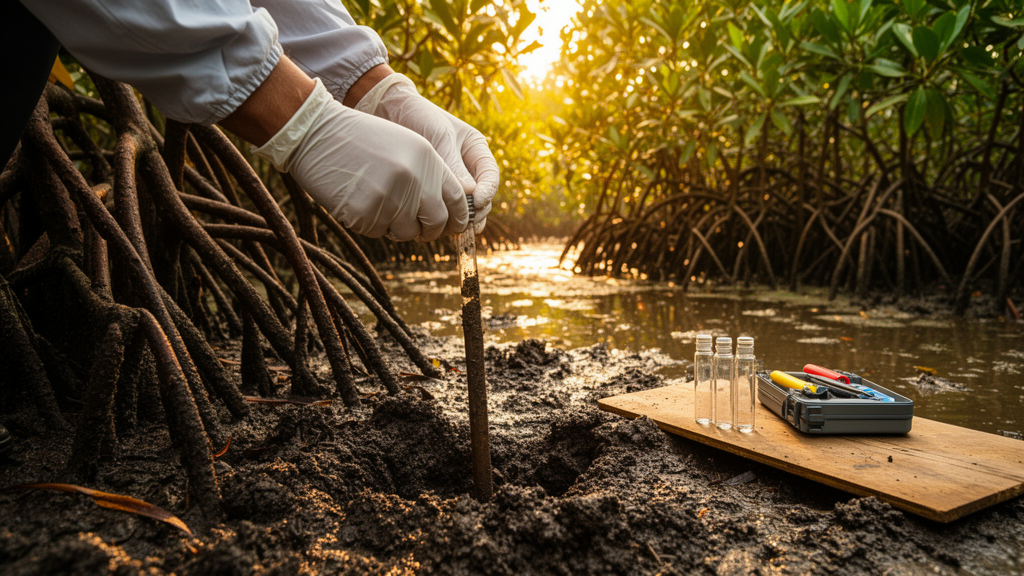
Buried in the mud of Hong Kong’s Mai Po Nature Reserve, single-celled organisms no larger than a grain of sand are quietly rewriting how scientists read the history of the ocean. Foraminifera, shelled amoeba-like protists that thrive in intertidal sediments, have long served as one of the most trusted indicators of past sea level. Because different species occupy narrow vertical bands along the tidal gradient, the identity of foraminifera preserved in a sediment core can be translated, with remarkable precision, into the elevation at which that sediment once sat relative to the sea. Now a two-year study of foraminiferal environmental DNA in subtropical mangroves and mudflats has revealed a crucial subtlety: the reliability of that translation depends heavily on where, and in which season, the modern calibration samples are collected.
The research, led by Zhaojia Liu and Nicole S. Khan of The University of Hong Kong together with colleagues in France and the United States, monitored foraminiferal eDNA communities at three stations of differing tidal elevation in the Mai Po wetlands, on the eastern fringe of the Pearl River Delta. Sampling took place semi-annually between November 2022 and May 2024, timed to capture the region’s dramatic monsoon-driven contrast between a wet season from April to September, which delivers roughly 77 percent of annual precipitation, and a dry season from October to March when monthly rainfall can fall below one millimetre. At each station, three replicate sediment cores from the top centimetre were collected within one-square-metre plots, allowing the team to separate genuine seasonal change from small-scale spatial patchiness.
The genetic workflow behind the study is a tour de force of modern molecular ecology. DNA was extracted from the sediments and the foraminiferal signal was amplified using primers targeting a short, hypervariable region of the small subunit ribosomal DNA gene, a fragment of only 135 to 190 base pairs that is short enough to survive in degraded environmental samples yet variable enough to distinguish taxa. Duplicate extractions and duplicate polymerase chain reactions for every sample helped suppress amplification bias, and the resulting libraries were sequenced on an Illumina NovaSeq platform. Bioinformatic pipelines then merged, denoised and clustered the reads into operational taxonomic units at 97 percent similarity, with taxonomy assigned against the GenBank database and a curated in-house foraminiferal reference collection.
The headline finding is a striking asymmetry between habitats. At the mid-mangrove station, community composition remained essentially stable across both years and both seasons, suggesting that the mangrove interior buffers short-term environmental fluctuations and that its eDNA pool reflects long-term gradients such as tidal elevation. The authors propose that this stability may arise because extracellular DNA accumulated from local populations across multiple generations dominates the signal, a pool that can account for more than 40 percent of total sediment eDNA. Such a signal would behave much like the dead foraminiferal tests that traditional morphology-based studies favour for calibration, integrating population flux over time rather than tracking ephemeral blooms.
By contrast, the upper mangrove and especially the mudflat-mangrove transitional zone shifted markedly with the seasons. Saccamminidae, a family of soft-shelled, single-chambered foraminifera whose delicate tests rarely fossilise and are therefore invisible to conventional microscopy, were significantly more abundant during the dry season, reaching between 4 and 60 percent of the assemblage, compared with 9 to 36 percent in the wet season. Hard-shelled Ammoniidae, meanwhile, peaked in the wet season at the mid-mangrove station, consistent with morphological surveys showing that calcareous taxa flourish in warmer months when planktonic productivity rises. These monothalamous taxa are precisely the ones that eDNA methods were expected to add to the sea-level toolkit, so their pronounced seasonality is both an opportunity and a warning.
What drives these seasonal swings? The team measured porewater salinity, pH, total organic carbon, total nitrogen and stable carbon isotopes at every station, alongside regional climate data. Salinity emerged as the primary seasonal driver, plummeting at the upper-mudflat station from values of 18.0 to 20.2 in the dry season to just 8.1 to 10.9 in the wet season as monsoon rains and river discharge freshened the system. Salinity, pH and total organic carbon all significantly shaped community composition, while tidal elevation remained the single dominant control, explaining 13 percent of the variance in assemblages, ahead of salinity at 11 percent and pH at 7 percent. Physicochemical variables collectively explained 36.2 percent of compositional variance, whereas direct climatic factors such as temperature and precipitation explained only 5.5 percent, implying that climate acts mainly indirectly, by modulating local water chemistry.
The spatial analysis delivered equally good news for the field. Within-station variability, measured as pairwise Bray-Curtis dissimilarity among replicate samples collected metres apart, was significantly lower than among-station differences, and dispersion did not differ significantly across stations. In practical terms, a single sample from a homogeneous patch of mangrove or mudflat is sufficient to characterise the local eDNA assemblage, validating the sampling designs used in modern training sets, where communities are assumed to be representative across narrow elevation intervals. This contrasts with the pronounced patchiness reported in deep-sea and temperate mudflat environments, and it means eDNA monitoring programmes need not invest in intensive spatial replication under relatively uniform conditions.
The most consequential test came when the team fed their seasonal eDNA data into a Bayesian transfer function built from a previously established modern training set of 59 surface samples spanning the full tidal range. For both mangrove stations, the elevation estimates derived from eDNA fell within the observed elevation ranges, inside 95 percent credible intervals, in both the wet and dry seasons. The mudflat station told a different story: the transfer function consistently overpredicted elevation in both seasons, with the bias most pronounced during the wet season. The likely culprit is an influx of exogenous DNA, including propagules and genetic material transported from higher-elevation mangrove environments by stronger wet-season hydrodynamics, which blurs the tight relationship between assemblage composition and local tidal height in these dynamic transitional settings.
For a world grappling with accelerating sea-level rise, the implications are far-reaching. Reconstructions of relative sea level over the late Holocene underpin estimates of how fast ice sheets respond to warming, and every improvement in proxy fidelity sharpens those projections. The study offers three concrete guidelines: prioritise stable mangrove environments when building modern training sets, avoid transitional mudflat zones where imported DNA can corrupt the elevation signal, and collect training samples during the wet season when seasonally explosive taxa such as Saccamminidae are less dominant, preventing a handful of species from masking the underlying ecological gradient. Foraminiferal eDNA, the authors conclude, remains a robust and broadly applicable sea-level proxy, but its power depends on respecting the rhythms of the living coast. In the mangroves of the Pearl River Delta, the genetic archive of the tide is legible, provided scientists know when to read it.
Subject of Research: Seasonal and spatial variability of foraminiferal environmental DNA in subtropical mangrove and mudflat sediments and its implications for reconstructing past sea levels
Article Title: Temporal and spatial variability in mudflat and mangrove foraminiferal eDNA communities in subtropical environments and their implication for sea-level reconstruction
Article References: Liu, Z., Khan, N. S., Yu, H. K. Y., Schweizer, M., Walker, J. S., & Schunter, C. (2026). Temporal and spatial variability in mudflat and mangrove foraminiferal eDNA communities in subtropical environments and their implication for sea-level reconstruction. Journal of Micropalaeontology, 45(2), 679-698. https://doi.org/10.5194/jm-45-679-2026
Image Credits: AI Generated
Keywords: foraminifera, environmental DNA, sea-level reconstruction, mangroves, mudflats, Hong Kong, Mai Po Nature Reserve, Bayesian transfer function, monothalamous foraminifera, salinity, monsoon, Pearl River Delta
Cite Scienmag News
Violet Maxwell. (October 8, 2026). Mangrove DNA Reveals a More Reliable Archive of Ancient Sea Levels. Scienmag. https://scienmag.com/mangrove-dna-reveals-a-more-reliable-archive-of-ancient-sea-levels/
Violet Maxwell. "Mangrove DNA Reveals a More Reliable Archive of Ancient Sea Levels." Scienmag, 8 October 2026, https://scienmag.com/mangrove-dna-reveals-a-more-reliable-archive-of-ancient-sea-levels/. Accessed 8 October 2026.
Violet Maxwell. "Mangrove DNA Reveals a More Reliable Archive of Ancient Sea Levels." Scienmag. October 8, 2026. https://scienmag.com/mangrove-dna-reveals-a-more-reliable-archive-of-ancient-sea-levels/


