


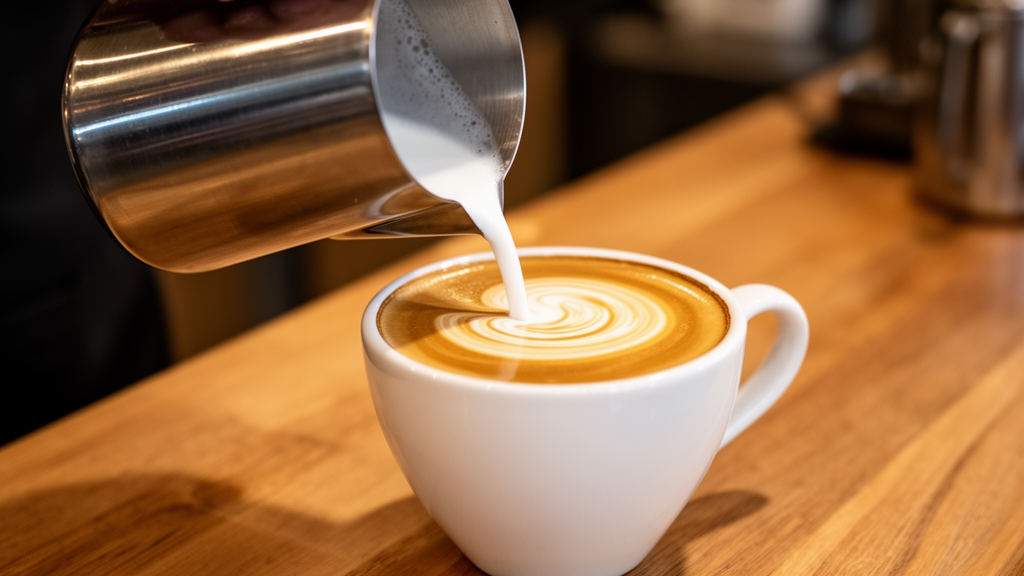
There is a moment, familiar to anyone who has ever taken the first sip of a well-made latte, when the harshness of black coffee gives way to something rounder, softer, and almost velvety. Food scientists have long credited milk fat for this transformation, but a new study suggests the story is far stranger and more elegant than a simple matter of adding creaminess. According to research published in npj Science of Food, the way milk reorganizes itself at the molecular level inside coffee determines how much friction the drink generates on your tongue, and that friction, in turn, shapes everything you perceive as texture, body, and smoothness.
The research team, led by Tong Wu and Jiashuo Huang of Beijing Technology and Business University, set out to answer a deceptively simple question: what actually happens inside a cup when coffee meets milk? To find out, they prepared four different coffee-milk systems, combining coffee with ultra-high-temperature treated and pasteurized milk, in both whole and skim varieties. This design allowed them to isolate the effects of two variables that matter enormously to the dairy industry and to consumers: how intensely the milk has been heat-treated, and how much fat it contains.
The first surprise came from just how thoroughly coffee transforms milk’s internal architecture. When milk was added to coffee, the mixture’s pH rose, its color became lighter, and its viscosity increased. The particles suspended in the liquid grew larger, and spectroscopic analysis using Fourier-transform infrared spectroscopy revealed distinct shifts in the chemical signatures of the mixture. Under the electron microscope, the researchers could see the evidence directly: aggregates had formed, clusters of milk proteins bound together with coffee components into structures that neither ingredient possessed on its own.
To understand why these aggregates form at all, the team turned to molecular docking, a computational technique more commonly associated with drug discovery than with breakfast beverages. The simulations revealed that coffee components latch onto milk proteins primarily through hydrogen bonding and pi-pi stacking interactions, the latter being a form of molecular attraction between flat, ring-shaped chemical structures. These weak but numerous bonds act like microscopic Velcro, stabilizing the complexes that form when the two liquids merge. It is a molecular handshake, repeated billions of times throughout the cup, that gives the drink its new physical identity.
Here is where the physics becomes genuinely counterintuitive. One might assume that larger, more numerous particles would make a drink feel smoother, the way cream enriches a soup. The opposite occurred. The structural reorganization triggered by coffee actually enhanced interactions between particles in the liquid, and this crowded, interactive environment reduced the lubrication at the interface between the beverage and the surfaces of the mouth. The measurable consequence was an increase in the friction coefficient, a tribological parameter that quantifies how much resistance arises when the liquid slides across a surface, in this case a simulated tongue.
Tribology, the study of friction and wear, has quietly become one of the most powerful tools in modern food science. Traditional rheology measures how a liquid flows in bulk, but it cannot capture what happens in the thin films that exist between the tongue and the roof of the mouth during swallowing. Those thin-film dynamics are where mouthfeel lives. A beverage can have identical viscosity readings yet feel dramatically different in the mouth if its particles interact differently with oral surfaces. By measuring friction coefficients across their four coffee-milk systems, the researchers could connect the invisible molecular architecture of the drink directly to the felt experience of drinking it.
The role of fat emerged as the decisive counterweight. In the systems made with whole milk, fat globules physically disrupted the aggregate structures that coffee components and milk proteins had built together. The fat essentially wedged itself into the protein-coffee networks, breaking them apart and restoring lubrication to the oral interface. The result was lower friction and, presumably, the smoother, rounder mouthfeel that whole-milk coffee drinkers know and love. To confirm that fat was genuinely the causal agent rather than a bystander, the team performed fat add-back experiments, reintroducing fat into the systems and watching the friction coefficients fall in response. The evidence was direct: fat is the friction-reducer, the natural lubricant of the coffee-milk world.
This finding carries real weight for an industry under pressure. Reduced-fat dairy products are in growing demand as consumers seek healthier options, but skim-milk coffee has never fully replicated the sensory appeal of its full-fat counterpart, and this study now explains why in physical terms. Remove the fat, and the protein-coffee aggregates remain intact, interparticle interactions intensify, lubrication drops, and friction rises, producing the thinner, sometimes astringent sensation that makes skim lattes disappointing. The researchers frame their work as a step toward optimizing the mouthfeel and sensory quality of reduced-fat coffee-milk beverages, suggesting that if manufacturers can find other ways to disrupt aggregates or restore interfacial lubrication, they might engineer low-fat drinks that feel indulgent without the fat.
The study also highlights how much sensory science has matured as a discipline. Rather than relying solely on taste panels to describe differences that panelists may struggle to articulate, researchers can now trace those differences down through multiple levels of organization: the molecular bonds between coffee polyphenols and milk proteins, the microscopic aggregates visible under electron microscopy, the bulk properties like viscosity and particle size, and finally the tribological behavior at the oral interface. Each level feeds into the next, and the sensory experience that reaches the consumer is the integrated output of this entire cascade. It is a reminder that even the most everyday pleasures rest on remarkably intricate physical foundations.
There is something almost poetic in the conclusion. Every morning, billions of people perform an unwitting experiment in soft-matter physics, pouring milk into coffee and setting off a cascade of hydrogen bonds, pi-pi stacking interactions, and aggregate formation that will register on their tongues as nothing more than a pleasant smoothness. The Beijing team’s work transforms that daily ritual into a map, showing exactly which molecular events produce which physical consequences and which sensory outcomes. For the coffee industry, it offers a blueprint for building better low-fat beverages. For everyone else, it offers a new appreciation of the hidden engineering in the cup, and of the humble fat globule, quietly dismantling protein networks one interface at a time so that your morning coffee glides instead of drags.
Subject of Research: Structural reorganization of milk matrices in coffee-milk systems and its effect on oral friction and sensory perception
Article Title: Milk matrix-driven structural reorganization modulates oral friction and sensory perception in coffee-milk systems
Article References: Wu, T., Huang, J., Hu, Y., Guo, K., Zeng, H., & Wang, Y. (2026). Milk matrix-driven structural reorganization modulates oral friction and sensory perception in coffee-milk systems. npj Science of Food. https://doi.org/10.1038/s41538-026-01173-z
Image Credits: AI Generated
DOI: 10.1038/s41538-026-01173-z
Keywords: coffee, milk, mouthfeel, tribology, food science, milk fat, molecular docking, oral friction, sensory perception, reduced-fat beverages, protein aggregates, npj Science of Food
Cite Scienmag News
Katie Riggs. (October 8, 2026). Why Your Latte Feels So Smooth: Milk Fat Rewrites the Physics of Coffee’s Mouthfeel. Scienmag. https://scienmag.com/why-your-latte-feels-so-smooth-milk-fat-rewrites-the-physics-of-coffees-mouthfeel/
Katie Riggs. "Why Your Latte Feels So Smooth: Milk Fat Rewrites the Physics of Coffee’s Mouthfeel." Scienmag, 8 October 2026, https://scienmag.com/why-your-latte-feels-so-smooth-milk-fat-rewrites-the-physics-of-coffees-mouthfeel/. Accessed 8 October 2026.
Katie Riggs. "Why Your Latte Feels So Smooth: Milk Fat Rewrites the Physics of Coffee’s Mouthfeel." Scienmag. October 8, 2026. https://scienmag.com/why-your-latte-feels-so-smooth-milk-fat-rewrites-the-physics-of-coffees-mouthfeel/


