


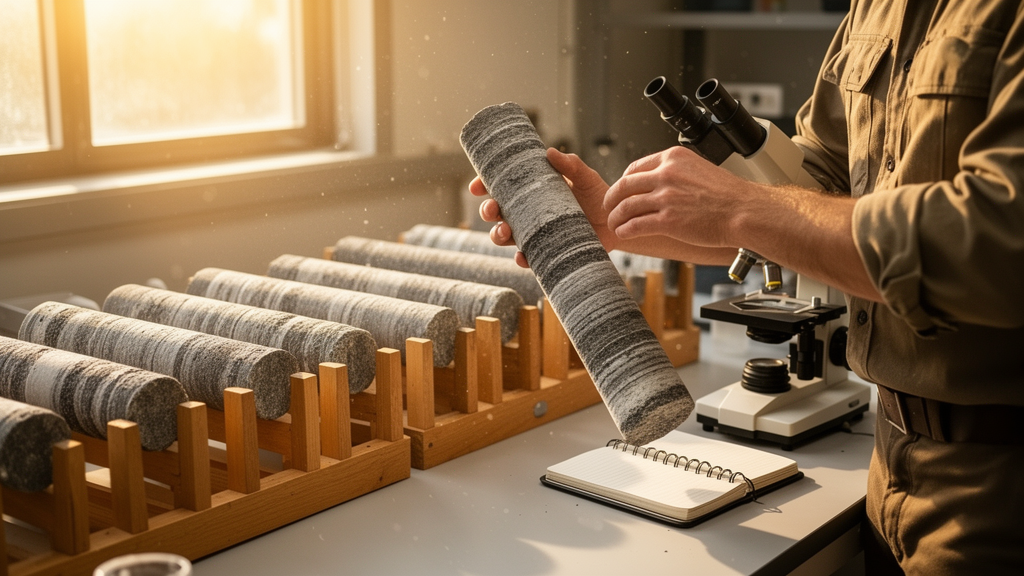
More than half a billion years ago, Earth’s oceans underwent a transformation so profound that it reshaped the history of life on our planet. In the twilight of the Ediacaran Period, between roughly 630 and 520 million years ago, the first animals appeared, diversified, and in some cases vanished, all in the geological blink of an eye before the celebrated Cambrian Explosion. Now, an ambitious international drilling campaign has recovered thousands of metres of pristine rock core from Namibia and Brazil, preserving some of the finest archives of that pivotal moment. The project, known as GRIND-ECT, short for Geological Research through Integrated Neoproterozoic Drilling, Ediacaran–Cambrian Transition, is described in a new report in the journal Scientific Drilling by Catherine V. Rose of the University of St Andrews and an international team of collaborators.
GRIND itself was born in 2014, when 44 scientists from 14 countries gathered at the British Geological Survey to design a core archive spanning the entire Neoproterozoic Era, from 1000 to 538.8 million years ago. The era witnessed extraordinary upheaval: a supercontinent broke apart and another assembled, marine oxygen climbed toward modern levels, the global carbon cycle swung through wild fluctuations, and ice sheets twice engulfed the planet during the Snowball Earth glaciations. Against that turbulent backdrop, the first animals emerged, marine planktonic algae rose to prominence, and biomineralization, the ability to build skeletons, became widespread. The International Continental Scientific Drilling Program accepted the proposal in 2018, dividing it into three phases: GRIND-TON for the Tonian, GRIND-CRY for the Cryogenian, and GRIND-ECT for the Ediacaran–Cambrian Transition. The team unanimously chose to begin with GRIND-ECT, targeting the interval that Darwin himself found so troubling that he called the sudden appearance of Cambrian fossils one of the gravest objections to his theory of evolution.
The scientific stakes are considerable. The appearance and diversification of animals between about 650 and 500 million years ago constitute one of the most profound episodes in the evolution of Earth’s ecosystems, yet the causes of the so-called long fuse leading to the Cambrian Explosion remain among science’s great unresolved challenges. GRIND-ECT is designed to answer several fundamental questions: What were the temporal and spatial patterns of marine oxygenation, and do they collectively represent a Neoproterozoic oxygenation event? What drove the large-amplitude carbon isotope excursions that mark Ediacaran and early Cambrian strata? How quickly did the Ediacaran biota appear, expand, and disappear? And is the Ediacaran–Cambrian boundary a synchronous worldwide biological event or a lengthy episode of progressive innovation? Answering these questions requires rock records with exceptional stratigraphic completeness, broad palaeogeographic distribution, and fine temporal resolution, which is precisely what the chosen drilling sites promised.
Three successions were identified as ideal targets: the Nama Group in Namibia, the Corumbá Group in Brazil, and the Yangtze Platform of South China. All preserve thick, laterally continuous sequences with minimal structural disturbance and, crucially, datable volcanic ash horizons that allow high-resolution correlation. The Namibian and Brazilian phases are now complete, while the Chinese phase, delayed by COVID-19 restrictions, began drilling in 2024. In Namibia, the contractor Günzel Drilling recovered more than 2379 metres of HQ-diameter core in six overlapping cores, achieving over 95 percent recovery while averaging 50 metres of core per day. The team used only re-circulated water as a lubricant, avoiding chemical drilling fluids that could contaminate geochemical analyses, and restored drill sites to exceptional environmental condition. In Brazil, the contractor Roquesonda drilled two cores totalling 306 metres with similarly high recovery. Boreholes were drilled perpendicular to bedding, so measured depth corresponds closely to true stratigraphic thickness.
The Namibian cores target the Kuibis and Schwarzrand sub-groups of the Nama Group, a mixed sandstone-shale-carbonate succession two to three kilometres thick deposited in a foreland basin that formed during the collision of the Congo, Rio de la Plata, and Kalahari cratons as Gondwana assembled. These strata, known since the early twentieth century, contain a rich record of Ediacaran life, including the tubular calcifying fossil Cloudina, related small shelly fossils, impressions of large soft-bodied organisms, and trace fossils ranging from simple burrows to complex networks that document the activities of some of the earliest mobile animals. The environments sampled span shorelines to deeper-marine ramps. Equally important for the project’s success was the geology itself: the strata in the Witpütz Sub-basin are flat-lying to gently dipping, with deformation limited to widely spaced sub-vertical normal faults that could be identified and avoided, and excellent surface outcrops adjacent to the drill sites allow the cores to be tied directly to mapped geological features.
The six Namibian cores form an overlapping stratigraphic ladder through the succession. Core 1G at Anib, 272.48 metres long, recovers the oldest strata, from the basal unconformity on the 1.3 to 1.0 billion-year-old Namaqua metamorphic complex up through fluvial sandstones and shallow-marine limestones bearing soft-bodied macrofossils and calcitized small shelly fauna. Core 1A at Tierkloof, at 563.78 metres the longest, samples the deeper-water shales and storm-influenced sandstones of the Nudaus Formation and Nasep Member, including pyritic black shales that may prove ideal for rhenium-osmium dating. Cores 1B, 1D, 1F, and 1H span the youngest units, the fossil-rich Huns and Spitskop members, whose limestones, microbialites, and interbedded volcanic tuffs hold the key to dating the Ediacaran–Cambrian boundary. The youngest dated tuff in the region has a uranium-lead zircon age of 538.57 million years, while the oldest known tuff in the wider basin dates to 547.36 million years, and tuffs recovered in the cores are expected to refine these age models considerably.
The carbon isotope story embedded in these carbonates is equally compelling. Late Ediacaran carbon isotope records show several globally recognized excursions, most notably the Basal Cambrian Excursion, in which the carbon isotope ratio of seawater plunges by roughly 5 to 10 per mil before recovering, coinciding with major biotic turnover just before the formally defined boundary at about 541 million years ago. Intriguingly, the lack of a clear BACE signal in the Schwarzrand Sub-group has led some researchers to suggest that the Ediacaran–Cambrian boundary may lie higher in the Nama succession than traditionally assumed. The continuous, unweathered core record now offers a means of building a finely resolved chemostratigraphy anchored by radiometric ages, testing whether these excursions are truly global signals or regional phenomena, and constraining the mass balance between organic productivity and carbon burial during a time of rising atmospheric oxygen.
In Brazil, the two cores drilled near Corumbá in Mato Grosso do Sul sample the Corumbá Group, a carbonate platform succession deposited along the southeastern margin of the Amazon Craton. The Tamengo Formation is South America’s premier Ediacaran fossil locality, hosting Cloudina lucianoi, the enigmatic Corumbella werneri, conulariids, macroalgae, and bilaterian trace fossils, while the overlying Guaicurus Formation contains vendotaenid fossils. Ash beds in the Tamengo Formation have yielded uranium-lead zircon ages of 542.37 and 541.85 million years, placing the unit firmly in the terminal Ediacaran, and its carbon isotope profile records the rising limb of the Shuram excursion. Core 3A at the Sobramil site, 183.1 metres long, captures microbialites, oncoids, and breccias of the Bocaina Formation before crossing an erosive boundary into the black shales and grainstones of the Tamengo. Core 3B at the Corcal Mine, 122.6 metres long, shows the same transition and ends in weathered siltstones of the Guaicurus Formation. Together the facies record a major change from a rimmed shelf to a distally steepened ramp, punctuated by storm-dominated deposition.
All cores were shipped to the Bundesanstalt für Geowissenschaften und Rohstoffe core archive in Berlin-Spandau, where they were split, scanned, and logged into the International Continental Scientific Drilling Program’s database. Under the GRIND agreement, split halves will eventually be returned to Namibia and Brazil for in-country training and study, with archive material also held at the Ministry of Mines in Windhoek and the Universidade de São Paulo. Three sampling parties have so far collected 2823 samples from the Namibian cores and 267 from the Brazilian ones, targeting an extraordinary analytical suite: stable isotopes of carbon, nitrogen, sulfur, strontium, uranium, calcium, boron, chromium, and other elements; organic and inorganic carbon contents; major, trace, and rare earth element geochemistry; iron and phosphorus speciation; uranium-lead and rhenium-osmium geochronology; palaeomagnetism; and micropalaeontology. The first characterization party alone involved 28 researchers and 2794 samples.
Early results are already reshaping understanding of the interval. Spectral analysis of magnetic susceptibility data from the lower Schwarzrand Sub-group has identified orbital cycles that allow sedimentation rates to be calculated, yielding an updated age-depth model that refines the timing of the earliest major radiation of bilaterian animals. Palaeomagnetic work has identified a primary magnetic component recording an unstable geomagnetic field at 540 million years ago, the youngest such evidence from the Ediacaran and the first from the Kalahari Craton. High-precision uranium-lead dating of tuffs has revealed a cryptic structural repetition in the Spitskop Member, sparking active debate about the chronostratigraphy of the terminal Ediacaran. Perhaps most significantly, current age models indicate exceptionally high sedimentation rates in the Schwarzrand Sub-group, producing an expanded Ediacaran–Cambrian succession that likely preserves a higher-resolution record of evolutionary change than is available anywhere else on Earth. As isotope geochemistry, geochronology, and facies analysis converge on these cores, GRIND-ECT is delivering the data needed to test, at last, what triggered the greatest biological revolution in Earth history, and the Berlin archive will serve as a legacy resource for decades to come.
Subject of Research: Scientific drilling of late Ediacaran rocks in Namibia and Brazil to reconstruct the environmental and biogeochemical context of early animal evolution across the Ediacaran–Cambrian transition
Article Title: GRIND-ECT: geological research through integrated Neoproterozoic drilling – Ediacaran–Cambrian transition
Article References: Rose, C. V., Kasemann, S. A., Macdonald, F. A., Mesli, M., Nduutepo, A., Trindade, R., Zhu, M., & Prave, A. R. (2026). GRIND-ECT: geological research through integrated Neoproterozoic drilling – Ediacaran–Cambrian transition. Scientific Drilling, 35(2), 171-192. https://doi.org/10.5194/sd-35-171-2026
Image Credits: AI Generated
Keywords: GRIND-ECT, Ediacaran, Cambrian Explosion, scientific drilling, Nama Group, Corumbá Group, Cloudina, Namibia, Brazil, chemostratigraphy, ICDP, early animal evolution
Cite Scienmag News
Violet Maxwell. (October 8, 2026). Deep Cores Through Namibia and Brazil Capture the Dawn of Animal Life. Scienmag. https://scienmag.com/deep-cores-through-namibia-and-brazil-capture-the-dawn-of-animal-life/
Violet Maxwell. "Deep Cores Through Namibia and Brazil Capture the Dawn of Animal Life." Scienmag, 8 October 2026, https://scienmag.com/deep-cores-through-namibia-and-brazil-capture-the-dawn-of-animal-life/. Accessed 8 October 2026.
Violet Maxwell. "Deep Cores Through Namibia and Brazil Capture the Dawn of Animal Life." Scienmag. October 8, 2026. https://scienmag.com/deep-cores-through-namibia-and-brazil-capture-the-dawn-of-animal-life/


