


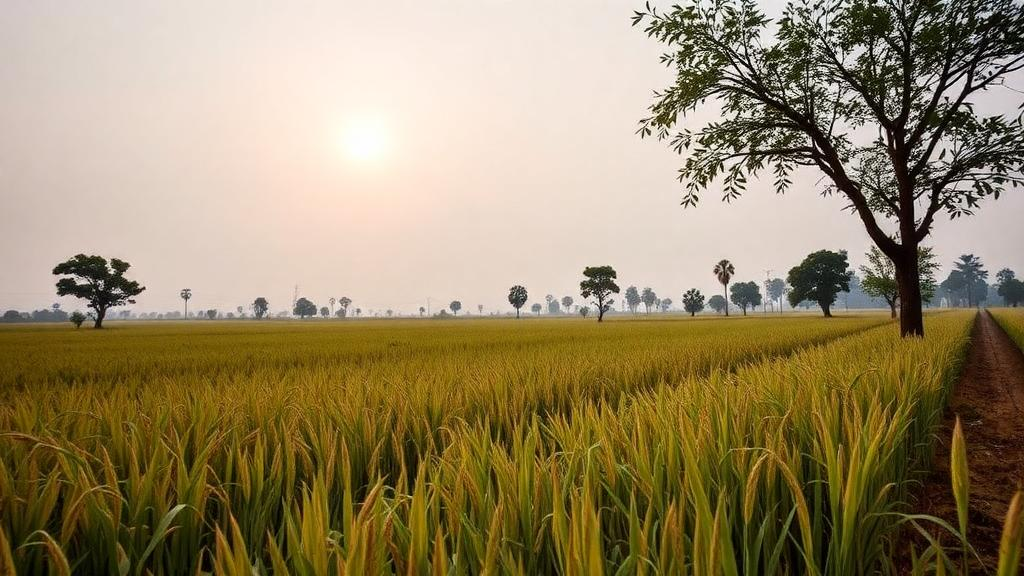
In the rice-growing heartlands of Nigeria, a single dry spell at the wrong moment can wipe out a season’s harvest. Now a team of Belgian and Nigerian researchers has shown that satellite observations of vegetation and soil moisture, when paired with the firsthand accounts of smallholder farmers, can reveal drought damage that conventional rainfall indices miss. The study, published in the journal Earth Observation, connects earth observation anomalies to farmer survey data collected across four major rice-producing states, offering a blueprint for early warning systems that speak directly to the people most exposed to climate shocks.
Nigeria’s rice sector is both vital and vulnerable. Rice has become one of the country’s leading cereals by value and a cornerstone of food security policy, yet domestic production covers only about half to sixty percent of national consumption, with the rest filled by imports. Roughly ninety percent of that production comes from smallholder farmers cultivating plots of just 0.2 to 3 hectares, most of them entirely dependent on rainfall. Rainfed lowland ecologies account for around 47 percent of the total rice area and rainfed upland systems for more than 30 percent, meaning the vast majority of the crop lives or dies by the timing of the rains. Climate projections suggest rainfall variability will only intensify, bringing more frequent and severe droughts even as total rainfall increases.
The Nigerian Meteorological Agency, NiMet, currently relies primarily on the Standardized Precipitation Index, or SPI, to flag drought conditions in its quarterly bulletins, while the Standardized Precipitation and Evapotranspiration Index, SPEI, adds a water-balance perspective by accounting for evaporation from soils and plants. These indices are useful, but they detect meteorological drought, a deficit of precipitation relative to demand. Agricultural drought, by contrast, is about what happens in the root zone, where crops actually draw their water. In the heterogeneous landscapes of West Africa, where small-scale irrigation, bunding, and varied management practices blur the signal, a rainfall deficit does not always translate into crop stress, and crop stress does not always follow rainfall deficits.
To close that gap, the research team, led by Nick Gutkin of KU Leuven and VITO together with Chiamaka I. Ehiemere of the University of Nigeria Nsukka, turned to two satellite-derived indicators. The first was the Normalized Difference Vegetation Index, NDVI, a measure of vegetation greenness calculated from red and near-infrared reflectance that signals plant stress. The second was the Soil Water Index, SWI, which estimates root-zone soil moisture from scatterometer observations aboard the Metop satellites. NDVI time series were drawn from harmonized Copernicus Land Monitoring Service products, combining the long SPOT and PROBA-V record from 1999 onward with higher-resolution Sentinel-3 OLCI data from 2020 to 2024, while the SWI layer used a latency factor of 40 days, corresponding roughly to soil water availability down to 60 centimeters, the rooting depth of common African rainfed rice varieties.
Calculating anomalies across a country as ecologically diverse as Nigeria required careful calibration. The team used a KMeans clustering algorithm to divide the country into agricultural zones based on the similarity of NDVI values, harmonic descriptions of seasonal vegetation cycles, and geographic location. Harmonic analysis, which fits sine and cosine waves to multi-year vegetation time series, allowed the algorithm to distinguish cropping systems with different growing seasons. Within each zone, pixel-level statistics were adjusted against zonal medians, and anomalies were computed against lower and upper percentile thresholds, with values scaling linearly from zero, meaning no anomaly, to 100, indicating a severe negative departure. The researchers tested zone numbers from 5 to 120 and upper thresholds from 15 to 50 percent to see how these methodological choices shaped the results.
The ground truth came from the farmers themselves. In March and April 2025, trained enumerators administered face-to-face surveys to 226 rainfed rice farmers across ten local government areas in Niger, Nasarawa, Ebonyi, and Ogun states, identifying 154 rice plots by GPS. Farmers recalled their annual harvests from 2019 to 2024, the timing of droughts they experienced, and the crop stages at which stress struck. The results were striking: 2024 stood out as the worst drought year, with more than double the number of drought-affected plots reported in July and August than in any previous year, while 2021 was the calmest. Crucially, 62 percent of farmers reported drought stress during panicle initiation, the short reproductive stage when the rice plant determines how many grains it will produce, and 58 percent attributed major yield losses to droughts striking at that exact moment.
With survey data in hand, the team built multivariate regression models predicting year-over-year yield changes from meteorological indices, satellite anomalies, and survey variables such as soil type and rice variety. The meteorological indices performed well in several years, particularly 2020, 2021, and 2024, with SPEI generally outperforming SPI thanks to its inclusion of crop water demand. But the satellite anomalies added real value precisely where the meteorological indices faltered. Soil moisture anomalies, SWIA, proved the more robust of the two, improving model performance with a maximum adjusted R-squared of 0.25 in years when rainfall indices alone explained little. Combining both anomaly types with meteorological variables produced the strongest models, most notably for 2020, when a mid-season cessation of rains hit Niger and Nasarawa states during sensitive crop stages.
The temporal dimension proved decisive. When the researchers aggregated anomalies separately over the vegetative and maturity phases of the rice cycle, splitting the season at the onset of panicle initiation, model performance improved, especially for NDVI anomalies in 2023, a year that otherwise defied prediction. The two indicators also behaved differently in time: vegetation greenness anomalies tended to peak early, during tillering, in response to rainfall dips, while soil moisture anomalies emerged later in the season, reflecting the lagged propagation of rainfall deficits through the soil profile. This lag structure, consistent with recent findings on deep soil moisture and agroecosystem water use efficiency in Africa, suggests that soil moisture monitoring captures the memory of drought in ways that rainfall indices cannot.
State-by-state analysis revealed both the promise and the limits of the approach. In Niger state, the 2024 drought unfolded exactly as the satellites and rainfall indices described, with SPI3 and SPEI3 plunging below minus 2.5 during panicle initiation and soil moisture anomalies persisting through flowering, matching farmer reports and significant yield losses. In Nasarawa, a known drought-prone region, soil moisture anomalies were persistently high and often decoupled from rainfall patterns, yet aligned closely with what farmers reported. Ebonyi state showed stable indices and near-zero anomalies in uneventful years, mirroring stable yields. Ogun state, with few surveyed plots and shifting cultivation practices, resisted clear interpretation, a reminder that sample size and land management history matter.
The study’s authors are candid about the challenges. Farmer recall of harvests dating back to 2019 introduces potential bias, the one-kilometer satellite pixels dwarf the smallholder plots they are meant to represent, and meteorological indices arrive at an even coarser resolution of roughly 28 kilometers. Collinearity among the indicators complicates the statistics, and adjusted R-squared values remain modest, a sign that many factors beyond water availability shape smallholder yields. Yet the direction is clear: nearly 99 percent of surveyed farmers already use alert systems, mostly radios and extension officers, meaning a better signal could reach them quickly. The researchers argue that integrating vegetation and soil moisture anomaly indicators, especially when timed to phenological stages, into NiMet’s existing early warning framework would sharpen drought warnings for rainfed rice farmers, and they point toward higher-resolution sensors such as Sentinel-2 and thermal indicators as the next frontier. For a crop that feeds a nation and hangs on the whims of the rainy season, every extra ounce of foresight counts.
Subject of Research: Monitoring agricultural drought impacts on rainfed rice yields in Nigeria using earth observation anomalies and farmer survey data
Article Title: Connecting earth observation anomalies to farmer surveys for monitoring impacts of agricultural drought on rainfed rice yields in Nigeria
Article References: Gutkin, N., Ehiemere, C. I., De Vos, K., Ehiemere, N., Degerickx, J., Gebruers, S., Nwafor, U., & Gobin, A. (2026). Connecting earth observation anomalies to farmer surveys for monitoring impacts of agricultural drought on rainfed rice yields in Nigeria. Earth Observation, 1(1), 77-104. https://doi.org/10.5194/eo-1-77-2026
Image Credits: AI Generated
DOI: 10.5194/eo-1-77-2026
Keywords: agricultural drought, rainfed rice, Nigeria, earth observation, soil moisture, NDVI, early warning systems, smallholder farmers, SPI, SPEI, crop yields, remote sensing
Cite Scienmag News
Alan Morgan. (October 8, 2026). Satellites and Farmers Join Forces to Track Drought’s Toll on Nigeria’s Rice Harvests. Scienmag. https://scienmag.com/satellites-and-farmers-join-forces-to-track-droughts-toll-on-nigerias-rice-harvests/
Alan Morgan. "Satellites and Farmers Join Forces to Track Drought’s Toll on Nigeria’s Rice Harvests." Scienmag, 8 October 2026, https://scienmag.com/satellites-and-farmers-join-forces-to-track-droughts-toll-on-nigerias-rice-harvests/. Accessed 8 October 2026.
Alan Morgan. "Satellites and Farmers Join Forces to Track Drought’s Toll on Nigeria’s Rice Harvests." Scienmag. October 8, 2026. https://scienmag.com/satellites-and-farmers-join-forces-to-track-droughts-toll-on-nigerias-rice-harvests/


