


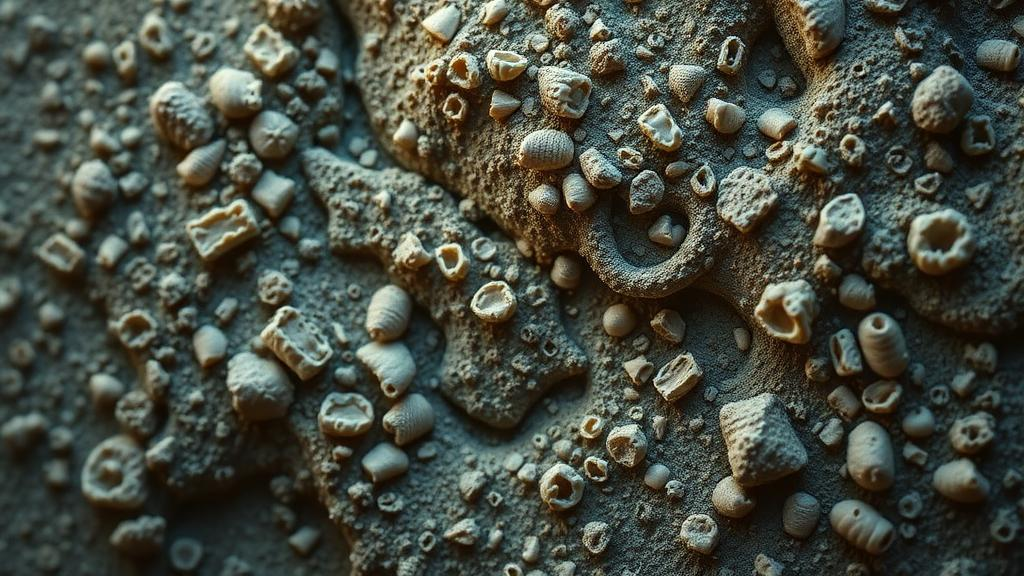
Deep beneath the surface of coastal mudflats and seagrass meadows lives a group of single-celled organisms that scientists have relied on for decades to diagnose the health of the ocean. Benthic foraminifera, tiny shelled amoebae that build ornate calcareous and agglutinated tests, respond rapidly and species-specifically to pollution, oxygen depletion, and climate-driven change. Their abundance, diversity, and community composition make them powerful bioindicators, but there has always been a catch: identifying them means sitting at a stereomicroscope for hours, picking specimens one by one and naming them with expert eyes. Now a team of French and Australian researchers has shown that artificial intelligence can do much of that work, and, remarkably, can even tell whether an individual foraminifer was alive when it was sampled.
The study, led by Tobias Walla of the IRD research institute in Nouméa, New Caledonia, together with colleagues from the University of Angers, Aix-Marseille University, Lille University, and CSIRO Data61 in Australia, was published in the Journal of Micropalaeontology. The researchers trained convolutional neural networks, or CNNs, to automatically identify living, Rose Bengal-stained benthic foraminifera at the species level, drawing on sediment samples from two strikingly different coastal environments: a low-diversity intertidal mudflat in Bourgneuf Bay on the French Atlantic coast and a high-diversity set of Mediterranean sites along the southern French coast and Corsica. It is, according to the authors, the first application of machine learning to the identification of living benthic foraminifera from coastal sediments.
The technical pipeline begins with a piece of equipment that would look at home in any hobbyist’s workshop: a modified 3D printer. Stripped of its printing function and fitted with a 5-megapixel Basler camera, a telecentric lens with 4x magnification, and a ring light for constant illumination, the printer’s moving head becomes a precision gantry that scans micropalaeontological slides in the X, Y, and Z directions. The system, nicknamed Sashimi, captures stacks of images at fixed exposure and step intervals, which are then fused into fully focused composite pictures using Helicon Focus software. A complete scan of a single slide takes roughly an hour and a half, and the entire build instructions are freely available on GitHub, making the setup a genuinely low-cost alternative to dedicated imaging rigs.
Because a single field of view can contain many specimens, the team first needed a way to isolate individual foraminifera from the background clutter of glue residues, grid lines, and other particles. They annotated images using the open-source Computer Vision Annotation Tool and trained a faster region-based convolutional neural network, built on a ResNet50 backbone pre-trained on the COCO dataset, to draw bounding boxes around every foraminifer. The detection step performed impressively. On the Atlantic slides, the model missed only one specimen out of 381, achieving an accuracy and recall of 99.74 percent and a perfect precision score. On the Mediterranean slides, it caught 129 of 131 specimens, with a recall of 98.47 percent, though it also flagged 30 false positives, mostly glue and debris that would later be filtered out during classification.
With individual specimen images extracted, the researchers labeled more than 13,000 of them using the ParticleTrieur software and trained three classification models. The first, trained on the Atlantic MUDSURV dataset of 6,375 images covering six species, distinguished species regardless of vital status and reached an accuracy of 96.0 percent, with a precision of 96.1 percent and a recall of 95.5 percent. Five of the six species were recognized with accuracies above 96 percent, and the morphologically distinctive agglutinated Ammobaculites balkwilli and the monothalamid Psammophaga were classified perfectly. The trickiest case was Elphidium selseyense, which was confused with its close relatives Ammonia confertitesta and Elphidium oceanense in a minority of cases, a reminder that even algorithms struggle with the taxonomic fine print that vexes human experts.
The second Atlantic model tackled a problem no automated foraminifera classifier had attempted before: separating living from dead specimens of the same species. Rose Bengal staining, the standard technique in biomonitoring, colours the cytoplasm of living individuals pink, but faded stains, discoloured tests, and human inconsistency in labeling made this a harder task. Nevertheless, the model distinguished ten classes, combining species and vital status, with an accuracy of 94.2 percent. Eight of the ten classes scored above 90 percent, and only dead Ammonia confertitesta and dead Elphidium fell below that mark, at 80 and 86 percent respectively. Species recognition, the authors note, remained consistently easier than vital status determination, partly because the training labels themselves carried the bias of human experts who do not always agree on how much staining counts as alive.
The Mediterranean challenge was steeper. The MEDIT dataset comprised 7,148 images spanning 63 species, many of them porcelaneous miliolids whose whitish shells nearly vanish against the white background of standard micropalaeontological slides. The resulting model achieved an overall accuracy of 82.2 percent, with 16 species recognized at better than 90 percent and seven, including Ammodiscus planus, Nonion scaphum, and Valvulineria bradyana, at a flawless 100 percent. But 12 species fell below 50 percent accuracy, and several porcelaneous taxa such as Biloculinella irregularis and Quinqueloculina spp. were never correctly predicted. When the model was applied to six independent test samples from a sewage outfall transect in Calvi Bay, Corsica, average accuracy dropped to about 69.7 percent, largely because the samples contained species the model had never seen during training.
Here is the twist that matters most for environmental managers: even with that imperfect species-level accuracy, the automated results translated into almost identical ecological verdicts. The team calculated the Tolerant Species Index, or TSI-Med, an index of ecological quality status that depends on identifying tolerant species and counting total living foraminifera. Of six test samples analyzed, only one shifted category, moving from very good to good. The tolerant species that drive the index, such as Cancris auricula and Leptohalysis scottii, happened to be among the best-identified taxa because ample training images were available. On the Atlantic side, the CNN tracked monthly abundance trends of the four dominant species closely enough to detect reproduction events, including two high-density blooms in October 2020, with the model correctly identifying them at 67 percent accuracy.
The speed gains are hard to overstate. Once the models are trained, applying them to a full dataset takes less than a minute on an ordinary laptop, compared with hours of expert picking and counting for each sample. That opens the door to the kind of high-temporal-resolution monitoring that seasonal population dynamics demand but manual workflows cannot deliver. International biomonitoring protocols such as FOBIMO recommend annual sampling with three replicates per station, yet most real studies span multiple stations sampled monthly or seasonally, generating overwhelming workloads. Automated imaging and classification could also reduce operator-dependent taxonomic bias, a documented problem in foraminiferal science, where studies have shown that even experienced identifiers disagree on planktonic species at median cross-recognition accuracies of around 79 percent.
The authors are careful about the limits. The current workflow still requires specimens to be picked and glued onto slides before scanning, though extending it to raw sieved sediment is the obvious next step. Rose Bengal staining fades over time in dried slides, so rapid scanning after picking is essential, and porcelaneous and agglutinated groups remain problematic on white backgrounds, prompting plans to test alternative slide colours. The reliability of the CNNs rests on hundreds to thousands of expertly labeled images, which underscores that taxonomists remain indispensable. Still, the demonstration that a machine can distinguish living from dead foraminifera, and do so fast enough to support large-scale monitoring programs, marks a genuine turning point for these humble shelled amoebae, which may soon be reporting on the health of coastal oceans at a pace their human interpreters could never match.
Subject of Research: Automated deep learning identification of living benthic foraminifera for coastal biomonitoring
Article Title: Identification of living (Rose Bengal)-stained benthic foraminifera using automated image recognition
Article References: Identification of living (Rose Bengal)-stained benthic foraminifera using automated image recognition. (n.d.). https://doi.org/10.5194/jm-45-623-2026
Image Credits: AI Generated
Keywords: foraminifera, deep learning, convolutional neural networks, Rose Bengal staining, biomonitoring, bioindicators, automated imaging, coastal ecosystems, micropalaeontology, ecological quality, machine learning, ocean health
Cite Scienmag News
Violet Maxwell. (October 8, 2026). AI Learns to Tell Living From Dead Microscopic Ocean Fossils. Scienmag. https://scienmag.com/ai-learns-to-tell-living-from-dead-microscopic-ocean-fossils/
Violet Maxwell. "AI Learns to Tell Living From Dead Microscopic Ocean Fossils." Scienmag, 8 October 2026, https://scienmag.com/ai-learns-to-tell-living-from-dead-microscopic-ocean-fossils/. Accessed 8 October 2026.
Violet Maxwell. "AI Learns to Tell Living From Dead Microscopic Ocean Fossils." Scienmag. October 8, 2026. https://scienmag.com/ai-learns-to-tell-living-from-dead-microscopic-ocean-fossils/


