


In much of sub-Saharan Africa, a diagnosis of psychosis can be a life sentence of exclusion. Services are scarce, often limited to urban hospitals, and frequently focused narrowly on medication rather than the broader dimensions of a person’s life: their relationships, their work, their standing in the community, and their basic economic security. Against this backdrop, an international research collaboration has spent years developing and refining a community-based rehabilitation intervention designed with, rather than for, people living with psychosis in West and Southeast Africa. The results of that effort, published in PLOS Mental Health, offer a detailed account of how the intervention known as SUCCEED — Support, Comprehensive Care and Empowerment for People with Psychosocial Disabilities — was co-produced across four countries using an iterative application of Theory of Change methodology.
The scale of the problem the programme addresses is difficult to overstate. Psychosis and other severe mental health conditions cause substantial disability and reduced functioning across multiple domains of life, from self-care and mobility to social participation and productive work. In low- and middle-income settings, the services that exist to meet this need are often weak and predominantly biomedical, meaning they concentrate on clinical treatment while leaving the social and economic consequences of illness unaddressed. Community-Based Rehabilitation, or CBR, has emerged as a promising alternative because it takes a comprehensive and person-centred approach, aligning closely with effective case management models that have proven their worth in other areas of global health.
SUCCEED set out to harness that potential. The programme’s stated ambition was to improve quality of life, mental health outcomes, and community participation for people living with psychosis in four sub-Saharan countries. But rather than importing a model designed elsewhere and testing whether it survived transplantation, the research team — led by Julian Eaton and Olubukola Omobowale, with collaborators including Rita Tamambang, Rachel Greenley, and Grace K. Ryan — began with an open question: what would a rehabilitation intervention look like if the people who would use it, and the communities who would deliver it, helped design it from the ground up?
The methodological backbone of the answer is Theory of Change, a framework widely used in international development but less commonly applied with such rigour in mental health intervention design. A Theory of Change process asks stakeholders to articulate the long-term outcome they want to achieve and then work backwards, mapping the preconditions that must be in place for that outcome to occur, the assumptions underlying each causal link, and the interventions required to make each precondition a reality. In SUCCEED’s case, this was not a one-off workshop exercise. The team conducted multiple iterations of Theory of Change, revisiting and revising the causal map as new evidence accumulated from situation analysis, formative research, and piloting.
That iterative structure is what distinguishes the work. The first Theory of Change iterations drew on a situation analysis that documented the realities on the ground: the state of formal services, the role of traditional and faith-based healers, the economic pressures on households affected by psychosis, and the stigma that isolates individuals from the communities that might otherwise support them. Formative research then probed these findings in greater depth, generating the contextual understanding needed to specify what a feasible, acceptable intervention might look like in each setting. Early versions of the intervention were piloted, and the lessons from those pilots fed back into revised Theories of Change, which in turn reshaped the intervention itself.
To make this process transparent and reproducible, the researchers structured their reporting using two established frameworks. The GUIDED framework for intervention development provided the scaffolding for presenting the multiple Theory of Change iterations as results in their own right, rather than as background context. The TIDieR framework — Template for Intervention Description and Replication — was used to describe the final intervention in sufficient detail that other teams could understand exactly what it involves, a critical step if the programme is ever to be evaluated in a trial or adapted elsewhere. This dual framing is a deliberate answer to a common criticism of complex interventions: that their development is described so loosely that outsiders cannot tell what was done, why, or whether it could be done again.
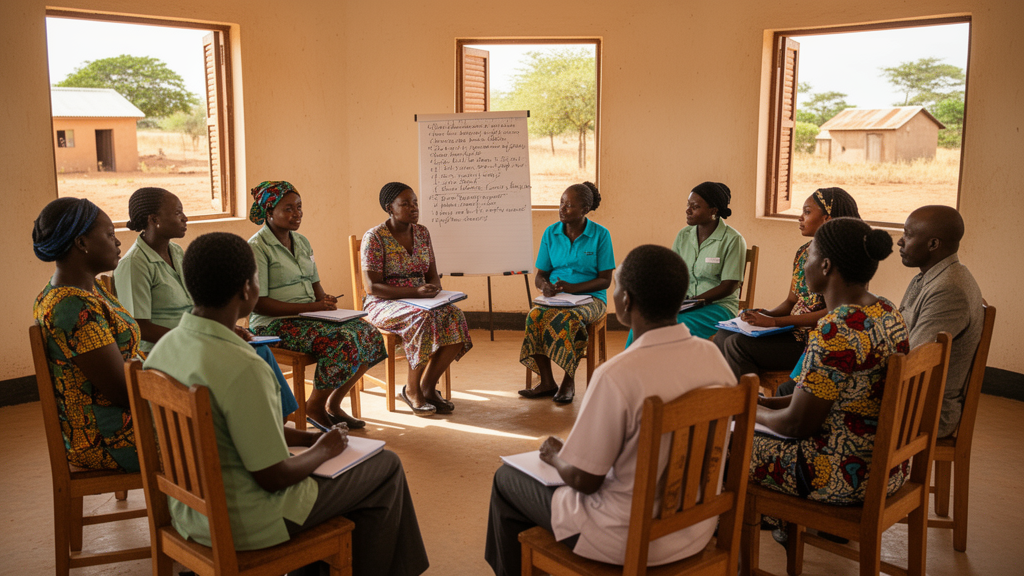
The content of the intervention reflects the priorities that emerged from the co-production process. Consistent with CBR principles, SUCCEED is built around comprehensive, person-centred support delivered close to where people live, aiming to strengthen functioning and community participation rather than treating symptoms in isolation. The co-production approach meant that people with lived experience of psychosis, along with family members, community workers, and local service providers, were not merely consulted but were active participants in deciding what the intervention should contain, how it should be delivered, and what success would look like. The Theory of Change workshops gave these diverse stakeholders a shared language and a shared map, allowing disagreements and assumptions to surface early and be examined openly.
The authors draw two conclusions from the process that carry weight well beyond this specific programme. First, they find that Theory of Change can promote participatory processes of intervention co-development: the framework’s demand for explicit causal reasoning creates a natural structure for genuine dialogue, in which stakeholders must negotiate not just what should be done but why they believe it will work. Second, they observe that the same process generates research questions. Because every arrow in a Theory of Change diagram represents an assumption that can be tested, the completed maps double as an agenda for evaluation, pointing evaluators toward the mechanisms that matter most and the links that remain most uncertain.
Perhaps the most important message, however, concerns flexibility. The team concludes that interventions must remain flexible and open to revision, even when they possess core active ingredients. In mental health research, there is a persistent tension between the standardisation needed for rigorous evaluation and the adaptation needed for real-world contexts. SUCCEED’s development model suggests a way through that tension: hold firm to the essential components that the Theory of Change identifies as causally necessary, while allowing the surrounding details of delivery to evolve as communities, evidence, and circumstances change. The multiple iterations documented in the paper are, in effect, a record of that controlled evolution.
For the wider field of global mental health, the study arrives at a moment when funders and governments are increasingly demanding evidence that interventions in low-resource settings are not only effective but also locally legitimate and sustainable. Co-production has become a watchword, yet it is often invoked without a clear account of how participation actually shaped the result. By presenting its Theory of Change iterations as findings, the SUCCEED team has provided one of the more concrete demonstrations available of what co-produced intervention development looks like in practice — from the first situation analysis through formative research and piloting to a fully specified, replicable community-based rehabilitation package for people living with psychosis in West and Southeast Africa.
Subject of Research: Co-production of a community-based rehabilitation intervention for people living with psychosis in West and Southeast Africa using Theory of Change methodology
Article Title: Co-production using Theory of Change in the development of the SUCCEED Africa community-based rehabilitation intervention for people living with psychosis in West and Southeast Africa
Article References: Co-production using Theory of Change in the development of the SUCCEED Africa community-based rehabilitation intervention for people living with psychosis in West and Southeast Africa. (n.d.). https://doi.org/10.1371/journal.pmen.0000668
Image Credits: AI Generated
DOI: 10.1371/journal.pmen.0000668
Keywords: psychosis, community-based rehabilitation, Theory of Change, co-production, global mental health, sub-Saharan Africa, intervention development, GUIDED framework, TIDieR framework, severe mental illness, low- and middle-income countries, SUCCEED programme
Cite Scienmag News
Glenn Wilkins. (October 8, 2026). Building Mental Health Care With Communities: How Theory of Change Shaped a New Psychosis Intervention in Africa. Scienmag. https://scienmag.com/building-mental-health-care-with-communities-how-theory-of-change-shaped-a-new-psychosis-intervention-in-africa/
Glenn Wilkins. "Building Mental Health Care With Communities: How Theory of Change Shaped a New Psychosis Intervention in Africa." Scienmag, 8 October 2026, https://scienmag.com/building-mental-health-care-with-communities-how-theory-of-change-shaped-a-new-psychosis-intervention-in-africa/. Accessed 8 October 2026.
Glenn Wilkins. "Building Mental Health Care With Communities: How Theory of Change Shaped a New Psychosis Intervention in Africa." Scienmag. October 8, 2026. https://scienmag.com/building-mental-health-care-with-communities-how-theory-of-change-shaped-a-new-psychosis-intervention-in-africa/


