


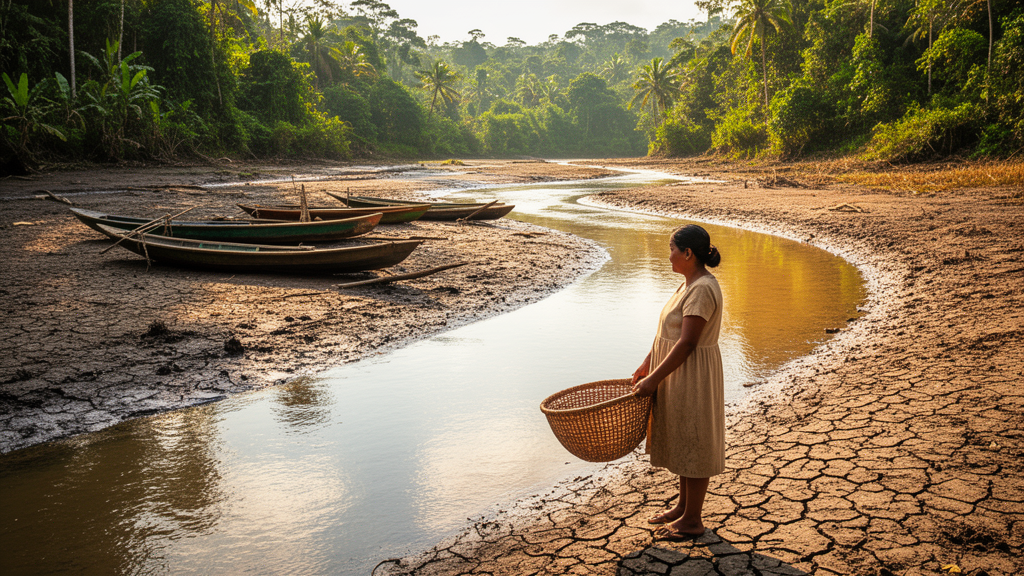
In the rainforest communities of the Awajún people of northern Peru, the distance to a clean water source can shape what a family eats for dinner. That is the central finding of a new study published in PLOS Water, which examined how water insecurity, food insecurity, and dietary diversity intertwine among Indigenous adults living in the Peruvian Amazon. The research, led by Paula Skye Tallman and Shalean M. Collins, offers a statistically rigorous portrait of how two forms of resource deprivation reinforce one another in one of the most water-abundant environments on Earth, and it suggests that the way scientists measure water insecurity may be obscuring some of its most damaging consequences.
Resource insecurity is a growing concern for Indigenous populations worldwide, many of whom depend directly on local ecosystems for food, water, and livelihoods. Climate change, deforestation, mining, and infrastructure development are altering the hydrological and ecological foundations of these livelihoods at unprecedented speed. Yet the relationship between access to water and access to food is rarely studied together, despite the obvious practical connections between the two. Drawing water, purifying it, and transporting it all consume time, energy, and health; when any of those resources are stretched thin, the ability to procure and prepare diverse foods can suffer. The new study set out to quantify precisely these linkages in an Awajún population for whom both water and food systems remain closely tied to the surrounding forest and rivers.
The researchers analyzed cross-sectional data from 212 Awajún adults, using linear and logistic regression models with robust standard errors to test associations between water insecurity, food insecurity, and dietary diversity. Water insecurity was assessed through a composite score as well as through individual indicators capturing distinct lived experiences, such as being unable to collect water because of distance, being unable to collect water due to illness or weakness, going for extended periods without drinking water, and not boiling water before use. Food insecurity was likewise measured with a validated score, while dietary diversity captured the variety of foods consumed, a widely used proxy for overall diet quality. This dual approach, combining a composite index with its component indicators, proved to be the study’s most consequential methodological decision.
The results confirmed that both food and water insecurity are prevalent among the Awajún, a finding that may surprise outsiders who imagine the Amazon as a landscape of limitless water. Abundance in the environment does not guarantee access at the household level. Rivers and streams may be contaminated, distant, or dangerous to reach, and seasonal variation can leave families dependent on sources that are unreliable for months at a time. The study’s statistical models showed that these everyday struggles with water translate directly into struggles with food, even after adjusting for other factors.
In adjusted linear regression models, higher composite water insecurity scores were significantly associated with higher food insecurity scores, with a beta coefficient of 0.24 and a 95 percent confidence interval of 0.11 to 0.36, and a p-value below 0.001. In practical terms, this means that as Awajún adults experienced more severe and more frequent water problems, their food insecurity rose in a predictable, measurable way. The association was independent of other variables in the model, strengthening the case that water insecurity is not merely a symptom of general poverty but a distinct driver of hunger. Interestingly, however, the composite water insecurity score was not significantly associated with dietary diversity, suggesting that the aggregated measure was averaging away some of the most important signals.
That is where the component-level analysis became revelatory. When the researchers disaggregated the composite score, individual indicators turned out to be more strongly associated with food insecurity and dietary diversity than the composite measure itself. Being unable to collect water due to distance was associated with a 0.61-point increase in food insecurity scores (95 percent CI: 0.19 to 1.03; p = 0.005). Being unable to collect water due to illness or weakness showed an even stronger association, with a beta of 0.68 (95 percent CI: 0.20 to 1.16; p = 0.006). Not boiling water before drinking was associated with a 0.60-point increase in food insecurity (95 percent CI: 0.15 to 1.05; p = 0.009). Each of these associations was stronger than the one observed for the composite score, indicating that specific, concrete hardships carry more statistical and practical information than a blended index.
Perhaps the most striking result concerned dehydration. Going for extended periods of time without drinking water was associated with lower dietary diversity scores, with a beta of -0.79 and a 95 percent confidence interval of -1.43 to -0.16 (p = 0.01). This inverse relationship hints at a physiological and behavioral cascade: people who cannot drink enough water may reduce their consumption of foods that are difficult to eat or digest without adequate hydration, or they may lack the energy to prepare varied meals. It may also reflect that households facing the most acute water deprivation are those whose entire subsistence system, from farming to fishing to forest gathering, is under strain. Whatever the precise mechanism, the finding links an extreme form of water deprivation to the quality of the diet itself, not just its quantity.
The authors argue that these findings carry significant implications for how governments and aid organizations monitor and address resource insecurity in vulnerable populations. Composite scores, while useful for standardization and cross-cultural comparison, can dilute the signal of specific experiences that are both more measurable in practice and more actionable in policy. A survey that records only an aggregate water insecurity number might miss the fact that distance to water, physical illness, and lack of water treatment are each distinct levers for intervention. Building a well closer to a community addresses one indicator; a mobile water delivery program for sick or elderly residents addresses another; a boiling or filtration campaign addresses a third. The study suggests that tracking these dimensions separately could sharpen the targeting and evaluation of such programs.
The research also speaks directly to the United Nations Sustainable Development Goals, particularly SDG 6 on clean water and sanitation and SDG 2 on zero hunger. Progress toward these goals is often measured and pursued separately, with water programs in one ministry and nutrition programs in another. The Awajún data demonstrate that in Indigenous Amazonian communities, the two agendas are empirically inseparable: water insecurity predicts food insecurity, and specific water deprivations shape dietary quality. Interventions that treat water access as a food security strategy, and vice versa, are likely to outperform siloed approaches. For health surveillance systems, the message is equally clear: questionnaires that capture the lived, granular experiences of water hardship, such as walking long distances, collecting water while ill, or going hours without a drink, may identify at-risk households that aggregate indices overlook.
Beyond its policy relevance, the study is a methodological caution for the growing field of water insecurity research. As instruments like composite water insecurity scales are deployed across dozens of countries, researchers have tended to report the headline score. This analysis shows that the components of such scores can behave differently, and sometimes more powerfully, than the sum of their parts. For the Awajún, whose food systems and water systems are bound together by rainforest ecology, by the labor of collection, and by the daily decisions of households, the path to both clean water and adequate food runs through the same small, hard details of ordinary life. Recognizing those details, the authors suggest, is the first step toward measuring them, and measuring them is the first step toward fixing them.
Subject of Research: Associations between water insecurity, food insecurity, and dietary diversity among Indigenous Awajún adults in the Peruvian Amazon
Article Title: Water insecurity, food insecurity, and dietary diversity among Awajún adults living in the Peruvian Amazon
Article References: Tallman, P. S., & Collins, S. M. (2026). Water insecurity, food insecurity, and dietary diversity among Awajún adults living in the Peruvian Amazon. PLOS Water, 5(9), e0000556. https://doi.org/10.1371/journal.pwat.0000556
Image Credits: AI Generated
DOI: 10.1371/journal.pwat.0000556
Keywords: water insecurity, food insecurity, dietary diversity, Awajún, Peruvian Amazon, Indigenous health, PLOS Water, Sustainable Development Goals, clean water access, nutrition surveillance, resource insecurity, Water
Cite Scienmag News
Daisy Hatcher. (October 8, 2026). When Water Runs Short, Hunger Follows: New Clues from the Peruvian Amazon. Scienmag. https://scienmag.com/when-water-runs-short-hunger-follows-new-clues-from-the-peruvian-amazon/
Daisy Hatcher. "When Water Runs Short, Hunger Follows: New Clues from the Peruvian Amazon." Scienmag, 8 October 2026, https://scienmag.com/when-water-runs-short-hunger-follows-new-clues-from-the-peruvian-amazon/. Accessed 8 October 2026.
Daisy Hatcher. "When Water Runs Short, Hunger Follows: New Clues from the Peruvian Amazon." Scienmag. October 8, 2026. https://scienmag.com/when-water-runs-short-hunger-follows-new-clues-from-the-peruvian-amazon/


