


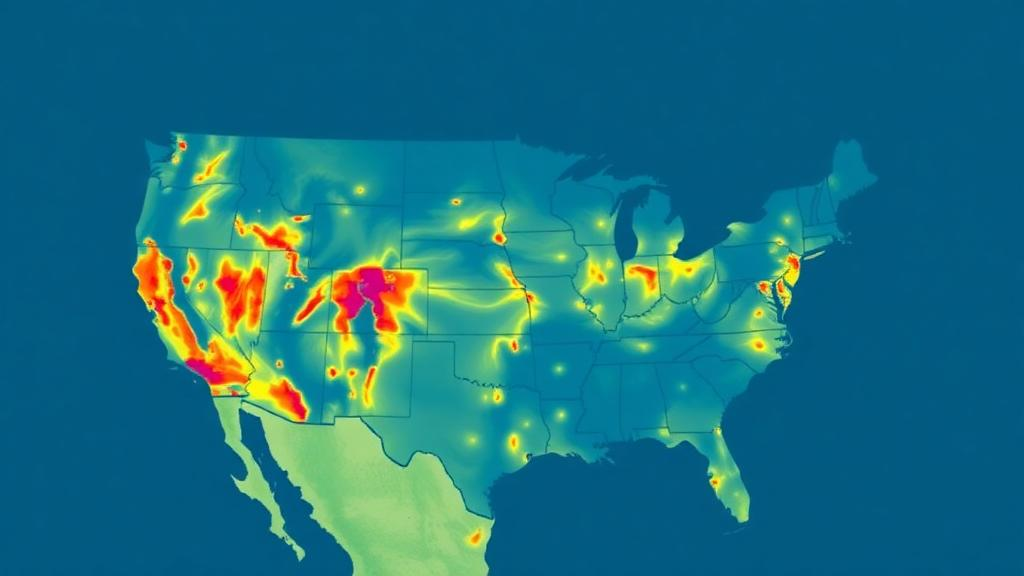
Every year, the forests, croplands, and wetlands of North America inhale and exhale billions of tonnes of carbon dioxide, and for decades scientists have struggled to measure that continental breath with confidence. Now a team of researchers has unveiled MemoryFlux, a new monthly dataset that maps net ecosystem CO2 exchange (NEE) across the continent at a fine 0.1-degree resolution from 2001 to 2021. Built with a Long Short-Term Memory (LSTM) neural network trained on more than 7,700 monthly records from 84 eddy covariance flux towers, the dataset captures not only what ecosystems are doing today but how their carbon behaviour echoes the climate of previous months. The result, published in Earth System Science Data, brings bottom-up carbon accounting closer than ever to the independent picture painted by atmospheric measurements.
The stakes of this measurement problem are enormous. Terrestrial ecosystems absorb roughly one quarter of the carbon dioxide released by human activities, a service that significantly slows the rise of atmospheric CO2 and the pace of global warming. NEE, defined as the difference between the CO2 released by ecosystem respiration and the CO2 sequestered by photosynthesis, is the quantity that tells us whether a landscape is a net carbon sink or source. Yet NEE can only be measured directly at the plot scale, using eddy covariance towers that monitor the vertical exchange of CO2 between vegetation and air. Everything beyond the tower footprint must be estimated, and that is where the disagreements begin.
Scientists have traditionally taken two routes to continental-scale carbon budgets. Top-down atmospheric inversions combine measurements of atmospheric CO2 concentrations with transport models to infer surface fluxes, offering an independent perspective but at coarse spatial resolutions limited by sparse sampling. Bottom-up approaches use process-based terrestrial biosphere models or data-driven machine learning to extrapolate tower observations across landscapes. The trouble is that bottom-up estimates have often diverged dramatically from inversions, partly because conventional machine learning treats each time step independently and fails to capture the complex, nonlinear ways ecosystems respond to disturbances and climate extremes. Ecosystems remember: a drought can suppress carbon uptake for months or years after the rains return, and most models simply do not carry that memory.
The LSTM architecture is what sets MemoryFlux apart. Developed originally to solve long-term dependency problems in sequence modelling, the network uses a six-month look-back window of historical climate and vegetation data to predict current carbon exchange, explicitly encoding the legacy effects of antecedent conditions. The team trained separate ecosystem-specific models for ten major plant functional types, from evergreen needleleaf forests to permanent wetlands, using tower-measured meteorology combined with a rich suite of satellite observations. Those predictors included the normalized difference vegetation index, leaf area index, the fraction of absorbed photosynthetically active radiation, and solar-induced chlorophyll fluorescence, a direct signal of photosynthetic activity, alongside ERA5-Land climate reanalysis variables such as temperature, radiation, precipitation, soil water content, and vapour pressure deficit.
The validation results are striking. MemoryFlux’s seasonal cycle of NEE correlated at r=0.96 with the ensemble mean of the OCO-2 v10 Model Intercomparison Project inversion and at r=0.97 with CarbonTracker2022, both top-down estimates derived from fundamentally different methodology. Perhaps more importantly, the mean annual carbon sink of −1.27 ± 0.12 petagrams of carbon per year sits far closer to the inversion range of −0.83 to −0.70 petagrams than existing machine-learning upscaling products, which have suggested sinks as large as −3.30 petagrams per year. That gap between bottom-up and top-down estimates has long been one of the most stubborn discrepancies in regional carbon cycle science, and narrowing it builds confidence in both approaches.
One of the dataset’s most celebrated achievements is its reproduction of the Midwest Corn Belt phenomenon. Atmospheric inversions have consistently shown that the croplands of the Upper Midwest pull in enormous amounts of carbon during the peak growing season in July and August, a continental-scale signal recognized as a model benchmark since the early days of the CarbonTracker project. Yet most existing global flux upscaling datasets fail to capture it, instead placing their strongest seasonal uptake in the southeastern United States. MemoryFlux correctly identifies the Corn Belt as the dominant carbon-uptake region during the peak growing season, matching the empirical evidence and the inversion picture, even though the uptake is transitory because most of the absorbed carbon ends up in harvested crops consumed by humans and livestock.
The spatial patterns across the continent also align with ecological understanding. The strongest annual carbon uptake appears in the humid southeastern United States, followed by the northern Pacific Coast and tropical regions, while major carbon sources concentrate in the tundra of northern and central Canada and the arid central United States, where warming could release soil carbon and accelerate climate change. Forests and wooded ecosystems emerge as the continent’s dominant carbon sink, contributing a mean uptake of −0.76 petagrams of carbon per year, with MemoryFlux attributing more than 85 percent of the total sink to forests, a share higher than most other products suggest.
To test whether the memory mechanism actually matters, the researchers ran a controlled experiment. They built a parallel dataset, dubbed nonMemoryFlux, using the same predictors, architecture, and validation scheme but feeding the model only contemporaneous variables, with no look-back window. The differences were substantial. At the plant functional type level, the coefficient of determination rose from 0.63 to 0.79 when historical information was included, and error metrics dropped accordingly. The memory-free version also estimated stronger carbon uptake in recent years, precisely the period when the 2015/16 El Niño and repeated droughts and heatwaves struck North America, suggesting it failed to capture the lingering legacy of those extremes. The gap between the two versions reached 186 teragrams of carbon in a single year, about 14.6 percent of the mean continental uptake.
MemoryFlux also proved its worth during climate disasters. The researchers examined six major events, including the 2011 drought in Mexico and the southern United States, the 2012 North American drought, the 2013 California drought, the 2017 flash drought across the northern plains, the 2019 Midwest floods, and the southwestern drought and wildfires of 2020 to 2021. In each case, the dataset’s spatial anomaly patterns coincided with negative soil moisture and fluorescence anomalies and with the documented extent of the events, showing anomalous carbon release where ecosystems were stressed. The memory-equipped version represented these regional anomaly patterns more clearly than its memory-free counterpart, particularly for the 2011 and 2012 droughts and the 2019 flood.
The authors are careful about limitations. Flux tower coverage remains uneven, with some ecosystem types represented by only two sites, and the dataset lacks a fully spatially explicit uncertainty framework. A mismatch between tower-scale training data and gridded reanalysis predictors introduces additional uncertainty, and the static land-cover map cannot track real transitions such as cropland expansion or fire-induced vegetation change. Differences with inversions persist in the managed Midwest croplands, hinting that human management information could further improve the models. Still, with the dataset and code openly available, MemoryFlux offers climate scientists a powerful new lens on how a continent’s ecosystems respond to a rapidly changing climate, and a template for bringing memory into the next generation of carbon cycle models worldwide.
Subject of Research: LSTM-based upscaling of net ecosystem CO2 exchange across North America from flux tower and satellite observations
Article Title: Improved estimation of net ecosystem CO2 exchange over North America using LSTM-based flux upscaling (2001–2021)
Article References: Improved estimation of net ecosystem CO2 exchange over North America using LSTM-based flux upscaling (2001–2021). (n.d.). https://doi.org/10.5194/essd-18-7367-2026
Image Credits: AI Generated
DOI: 10.5194/essd-18-7367-2026
Keywords: carbon cycle, net ecosystem exchange, LSTM, deep learning, MemoryFlux, eddy covariance, atmospheric inversion, drought, Corn Belt, remote sensing, North America, carbon sink
Cite Scienmag News
Blake Davidson. (October 8, 2026). Deep Learning Dataset Tracks North America’s Carbon Breath for Two Decades. Scienmag. https://scienmag.com/deep-learning-dataset-tracks-north-americas-carbon-breath-for-two-decades/
Blake Davidson. "Deep Learning Dataset Tracks North America’s Carbon Breath for Two Decades." Scienmag, 8 October 2026, https://scienmag.com/deep-learning-dataset-tracks-north-americas-carbon-breath-for-two-decades/. Accessed 8 October 2026.
Blake Davidson. "Deep Learning Dataset Tracks North America’s Carbon Breath for Two Decades." Scienmag. October 8, 2026. https://scienmag.com/deep-learning-dataset-tracks-north-americas-carbon-breath-for-two-decades/


