


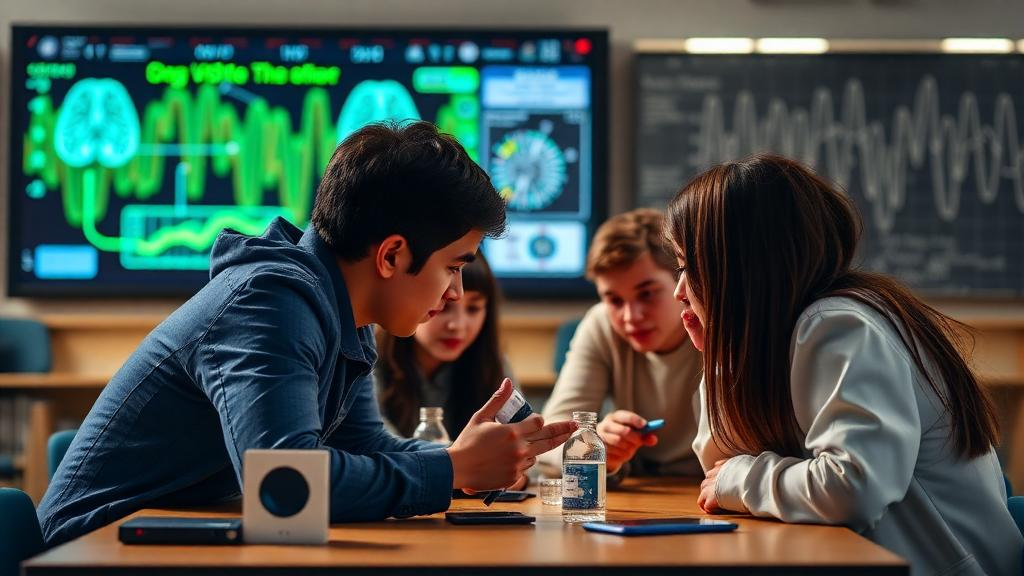
Every teacher knows the scene: a cluster of students huddled around a worksheet, ostensibly collaborating on a science task, while at least one of them stares out the window. Engagement, the holy grail of cooperative learning, is notoriously difficult to pin down. It is invisible, fluctuating, and multidimensional, shifting from moment to moment in ways that a single test score or a teacher’s impression can never capture. A new study published in npj Science of Learning takes one of the most ambitious swings yet at measuring it, combining classroom video coding, fine-grained behavioral microanalysis, and portable electroencephalography, or EEG, to track how high school students engage, disengage, and drift while working together on a science task.
The research team, led by Ido Davidesco of Boston College’s Lynch School of Education and Human Development together with Yushuang Liu, and including collaborators at New York University, Harvard University, Columbia University’s Teachers College, and Ghent University, recruited nine groups of four high school students each. The task was deceptively simple and pedagogically rich: each group had to collaboratively build a model of a cell, a classic cooperative learning exercise in biology education. What made the study unusual was the instrumentation. As the students negotiated, sketched, argued, and assembled their models, their brain activity was recorded continuously using EEG, a technique that measures the tiny electrical voltages generated by populations of neurons firing in synchrony, picked up by electrodes placed on the scalp. At the same time, the entire session was videotaped, transcribed, and later coded frame by frame by trained analysts.
The behavioral findings offer a strikingly granular picture of what group work actually looks like from second to second. When the researchers analyzed the video recordings, they found that students did not settle into long stretches of focused work punctuated by occasional distraction. Instead, they cycled rapidly between three distinct states: on-task, meaning actively engaged with the collaborative task; off-task, meaning engaged in unrelated activity or conversation; and idle, meaning apparently doing nothing in particular. On average, students switched between these states every ten to thirty seconds. That timescale is remarkable. It suggests that engagement in cooperative learning is not a stable trait of a student or even of a lesson, but a fast-fluctuating dynamic process, more like a flickering signal than a steady state.
This rapid cycling has real consequences for how engagement should be measured and interpreted. Traditional approaches, such as self-report questionnaires administered after a lesson or a teacher’s global rating of a class period, average over exactly the kind of moment-to-moment variability that the study reveals. A student who is on-task for half of a ten-minute activity and off-task for the other half may end up with the same summary score as a student who is mildly engaged throughout, yet the two patterns likely reflect very different underlying cognitive and social processes. The microanalysis approach used in the study, which involves coding behavior at fine temporal resolution, captures these dynamics directly, and the researchers argue that such methods are essential if the field wants to understand what actually happens inside collaborative groups rather than merely how those groups are remembered or judged afterward.
Crucially, the study also connected these behavioral dynamics to learning outcomes. The researchers found that the amount of time students spent in the on-task state significantly predicted their performance on a subsequent test. In other words, minutes of genuine engagement, measured objectively from video, translated into measurable learning. This is a deceptively straightforward result with substantial implications. It validates time-on-task as a meaningful construct even in the messy, social, multi-party context of group work, and it suggests that interventions aimed at extending the duration of on-task episodes, rather than eliminating distraction entirely, could be a productive target for educators. Given that students naturally alternate states every ten to thirty seconds, the goal may not be perfect attention but a higher duty cycle of engagement.
The EEG component of the study adds a neural dimension that behavioral coding alone cannot provide. The researchers focused on two well-studied frequency bands of the EEG signal. Theta activity, oscillations in the range of four to seven hertz, is often associated with cognitive effort, working memory load, and sustained attention. Alpha activity, oscillations in the range of eight to twelve hertz, is typically interpreted through the lens of cortical arousal: strong alpha power is commonly linked to relaxed or disengaged states, while reduced alpha is associated with active information processing. By examining these bands during the states identified in the video coding, the team could ask whether the brain signatures of on-task, off-task, and idle behavior actually differ in the ways one would expect.
The answer was surprising in one important respect. During on-task states, both theta and alpha activity were significantly different from the other two states, indicating that genuine engagement does leave a detectable neural fingerprint even in a noisy, social classroom setting. But the idle and off-task states were, from the perspective of both theta and alpha activity, essentially indistinguishable from each other. A student sitting quietly, apparently doing nothing, showed brain activity that looked the same as a student actively goofing off. This finding challenges a common intuition, and a common measurement assumption, that idle behavior represents a kind of neutral baseline between engagement and distraction. Instead, the neural data suggest that idle states may be closer to disengagement than to engagement, or at least that the two non-engaged states share a common neural profile that conventional EEG band analysis cannot separate.
The technical achievement underlying these results deserves emphasis. Recording usable EEG from multiple participants simultaneously in a real classroom, while they move, talk, and manipulate physical materials, is a formidable signal-processing challenge. Scalp electrodes are sensitive to muscle activity, eye movements, and electrical noise, all of which abound in active group work. Portable EEG systems and sophisticated offline processing pipelines have made such classroom neuroimaging increasingly feasible, and this study represents one of the more complete demonstrations of the approach, pairing the neural recordings with systematic behavioral coding so that each data stream can be interpreted in light of the other. The work was supported by the National Science Foundation and the European Research Council, reflecting the interdisciplinary infrastructure required to pull it off.
For the growing field of classroom neuroscience, the study delivers both a methodological template and a caution. The template is multimodality: neither the video coding nor the EEG alone would have produced the study’s key insights. The behavioral data revealed the temporal structure of engagement and its link to test performance, while the neural data revealed that the categories of disengagement, which look distinct on video, may converge in the brain. The caution is that engagement is genuinely complex, and any single measure, whether a camera, a questionnaire, or an electrode cap, will capture only part of the picture. The authors explicitly frame their findings as a call for interdisciplinary work that treats brain and behavior as complementary information sources rather than competitors.
The practical stakes extend beyond the laboratory. Cooperative learning is a staple of science education worldwide, praised for building conceptual understanding and social skills alike, yet its effectiveness depends entirely on what students actually do when placed in groups. If engagement flickers on and off every few seconds, then the design of group tasks, the composition of groups, and the timing of teacher interventions all become questions that can, in principle, be informed by fine-grained measurement. Tools derived from this line of research could eventually help educators identify the moments when collaborative work is functioning and the moments when it is quietly dissolving, long before a unit test reveals the difference. For now, the study’s most vivid contribution may be its portrait of the classroom as a place where attention is not a switch but a rhythm, oscillating ten to thirty seconds at a time, with learning accumulating in the on-task beats.
Subject of Research: Multimodal measurement of student engagement dynamics in cooperative science learning using EEG and video coding
Article Title: The dynamics of student engagement in cooperative science learning: a multimodal approach
Article References: Davidesco, I., Liu, Y., Chaloner, K., Laurent, E., Ali, G. A., Creider, S. C., Hughes, S., Noejovich, L., Valk, H., Bevilacqua, D., Poeppel, D., & Dikker, S. (2026). The dynamics of student engagement in cooperative science learning: a multimodal approach. npj Science of Learning. https://doi.org/10.1038/s41539-026-00457-z
Image Credits: AI Generated
DOI: 10.1038/s41539-026-00457-z
Keywords: student engagement, cooperative learning, EEG, classroom neuroscience, science education, theta activity, alpha activity, group work, multimodal measurement, attention, microanalysis, npj Science of Learning
Cite Scienmag News
Courtney Benton. (October 8, 2026). Brainwaves and Video Reveal How Students Really Engage in Group Science Work. Scienmag. https://scienmag.com/brainwaves-and-video-reveal-how-students-really-engage-in-group-science-work/
Courtney Benton. "Brainwaves and Video Reveal How Students Really Engage in Group Science Work." Scienmag, 8 October 2026, https://scienmag.com/brainwaves-and-video-reveal-how-students-really-engage-in-group-science-work/. Accessed 8 October 2026.
Courtney Benton. "Brainwaves and Video Reveal How Students Really Engage in Group Science Work." Scienmag. October 8, 2026. https://scienmag.com/brainwaves-and-video-reveal-how-students-really-engage-in-group-science-work/


