


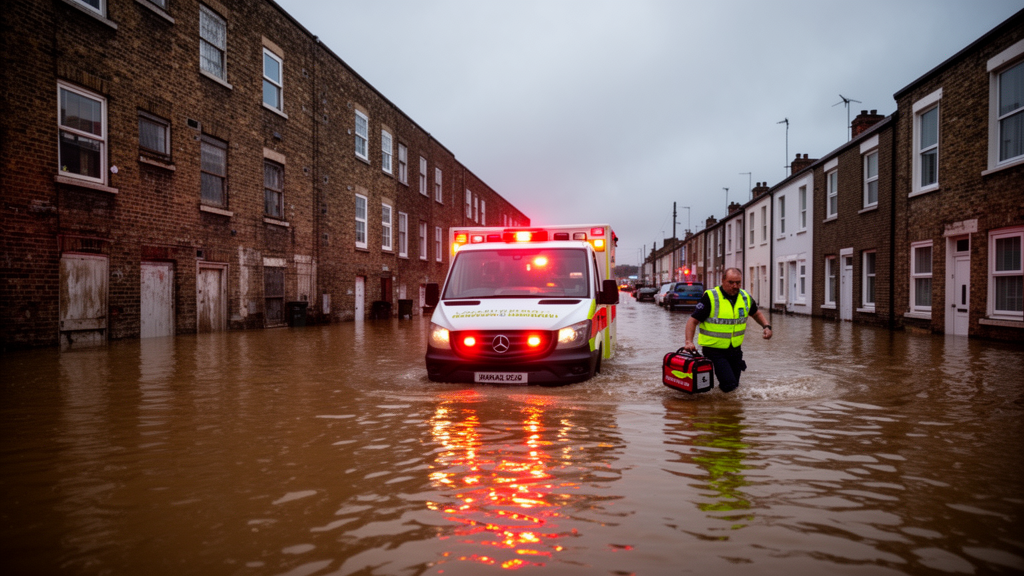
When Hurricane Matthew swept across Virginia Beach in October 2016, floodwaters did not fall evenly on the coastal city, and neither did the consequences for emergency medical care. A new study published in npj Urban Sustainability by Xiyu Pan, Neda Mohammadi, and John E. Taylor of the Georgia Institute of Technology shows that the computational models cities rely on to estimate how floods slow down ambulances systematically understate the danger for low-income communities. By comparing modeled ambulance travel times with the actual response times recorded during the hurricane, the researchers found that travel delays for low-income neighborhoods were underestimated by an average of 5.7 minutes, while delays for high-income communities were underestimated by only 1.9 minutes. That gap is not a rounding error. In emergency medicine, minutes separate survival from death, and a five-minute discrepancy in a model can mean the difference between a well-prepared city and one that abandons its most vulnerable residents on paper before the water ever rises.
The central insight of the study is deceptively simple but potentially transformative for disaster planning: the tools used to assess flood risk inequity are themselves biased. When the researchers compared their modeled estimates against observed data from the 2016 flood, they discovered that the models captured only 35.8 percent of the actual risk inequity between low-income and high-income communities. In other words, nearly two-thirds of the real disparity in emergency service disruption was invisible to the standard estimation approaches. A city planner using these models would conclude that flooding affects rich and poor neighborhoods in roughly similar ways, and would allocate resources accordingly, unaware that the true burden on disadvantaged areas was far heavier than the numbers suggested.
Why do these models fail so badly, and why do they fail disproportionately for the poor? The Georgia Tech team traced the bias to two mechanisms that existing approaches simply do not account for. The first is traffic congestion. During a flood, residents evacuate, roads clog, and vehicles cluster on the few elevated or unblocked routes that remain passable. Lower-income communities, the study found, experienced greater traffic congestion during the disaster, which slowed emergency vehicles far more than the models predicted. The second mechanism is the failure of the emergency infrastructure itself. More ambulance stations serving lower-income communities were closed or ran out of capacity during the flood, forcing vehicles to travel from farther away and adding delays that no static distance-based model could anticipate.
These findings arrive at a moment when cities around the world are investing heavily in digital twins, flood simulators, and equity dashboards intended to guide climate adaptation. The implicit promise of such tools is that if we can model the hazard precisely enough, we can protect everyone fairly. The Virginia Beach case study punctures that promise. A model can be technically accurate about water depth, road network topology, and travel distances, and still be profoundly wrong about who suffers, because it omits the dynamic, human, and infrastructural realities of a disaster as it unfolds. Congestion is a behavioral phenomenon; station closures are an operational one. Neither appears in the static network calculations that underpin most accessibility analyses.
The methodological approach of the study deserves attention because it offers a template other cities can follow. Rather than building a new simulation from scratch, the researchers performed a validation exercise: they took modeled travel time estimates for the Hurricane Matthew flood and compared them, neighborhood by neighborhood, with the actual ambulance response times recorded during the event. This comparison between modeled and observed data is the gold standard for assessing whether a risk estimation tool reflects reality, yet it is rarely done, particularly with an equity lens. By stratifying the comparison by community income level, Pan and colleagues were able to reveal not just that the models were biased, but that the bias itself was unequal, larger for the communities least able to absorb delayed medical care.
The implications for health outcomes are stark. Ambulance response time is one of the most tightly studied variables in emergency medicine, and the difference between a response within a few minutes and one delayed by five or more can determine whether a patient survives cardiac arrest, stroke, severe trauma, or childbirth complications. During a flood, when call volumes spike and normal hospital capacity is degraded, every additional minute of travel time compounds the strain on the system. If planners believe low-income areas face a two-minute underestimation when the real figure approaches six, they will size their ambulance fleets, pre-position their units, and design their evacuation protocols for a disaster that is milder than the one that actually arrives in those neighborhoods.
There is also a deeper equity dimension. The study’s authors frame their work around the question of whether socially vulnerable neighborhoods face disproportionate travel delays during urban floods, and their answer is an emphatic yes, compounded by the fact that the disproportion is systematically hidden. Risk inequity assessments are supposed to be the corrective lens that lets policymakers see and remedy these disparities. When the lens itself distorts, the harm is doubled: vulnerable communities suffer worse outcomes during the flood, and then suffer again in the planning process, because the data used to justify investments understates their need. Resources flow to where the models say the risk is, and the models say the risk is lower in the places where it is actually highest.
What would better estimation look like? The study points toward models that incorporate real-time traffic dynamics during flood events, rather than assuming free-flow conditions on the surviving road network. It points toward models that track the operational status of emergency facilities, including closures and capacity exhaustion, as part of the disruption itself rather than as an afterthought. And it points toward a culture of validation, in which cities routinely compare their modeled disaster scenarios against observed response data from past events, disaggregated by demographic characteristics, to detect and correct bias before it shapes policy. None of these requirements is conceptually exotic; the novelty of the study lies in demonstrating how much inequity goes undetected without them.
The research was supported by the Georgia Partnership for Innovation Community Research grant program and the National Science Foundation, and it arrives with an urgency amplified by climate change. Urban flooding is intensifying in frequency and severity across coastal and inland cities alike, and the populations most exposed, often lower-income residents in flood-prone districts, are precisely those with the fewest private resources to compensate for public failures. An ambulance that arrives six minutes late in a wealthy suburb with a private car in the driveway is a different catastrophe than one that arrives six minutes late in a neighborhood where that ambulance was the only realistic route to emergency care. The bias in the models, in this sense, is not merely a technical flaw but a distributional one, determining whose emergencies the system is calibrated to meet.
For the field of urban sustainability and disaster resilience, the Virginia Beach study is likely to become a canonical example of what researchers call estimation bias in risk assessment, and a reminder that equity analysis is only as good as the models on which it rests. The authors’ finding that conventional approaches captured barely a third of the true risk inequity should prompt every city that maintains a flood response plan to ask an uncomfortable question: if our models missed 64 percent of the disparity in Virginia Beach, how much are they missing here? The answer will not be found in more sophisticated water simulations or finer-grained road networks alone, but in grounding those models in the messy, observed reality of how floods actually paralyze traffic, close stations, and stretch emergency capacity, and in checking, neighborhood by neighborhood, whether the numbers we plan with match the minutes patients actually wait.
Subject of Research: Biased estimation of flood-related emergency service disruptions and ambulance response inequity in urban areas
Article Title: Exposing biased risk estimation of emergency service disruptions during urban floods
Article References: Pan, X., Mohammadi, N., & Taylor, J. E. (2026). Exposing biased risk estimation of emergency service disruptions during urban floods. npj Urban Sustainability. https://doi.org/10.1038/s42949-026-00473-3
Image Credits: AI Generated
DOI: 10.1038/s42949-026-00473-3
Keywords: urban flooding, ambulance response time, risk estimation bias, emergency services, social vulnerability, Hurricane Matthew, Virginia Beach, traffic congestion, health equity, disaster modeling, infrastructure resilience, npj Urban Sustainability
Cite Scienmag News
Violet Maxwell. (October 8, 2026). Flood Models Understate Ambulance Delays in Poor Neighborhoods. Scienmag. https://scienmag.com/flood-models-understate-ambulance-delays-in-poor-neighborhoods/
Violet Maxwell. "Flood Models Understate Ambulance Delays in Poor Neighborhoods." Scienmag, 8 October 2026, https://scienmag.com/flood-models-understate-ambulance-delays-in-poor-neighborhoods/. Accessed 8 October 2026.
Violet Maxwell. "Flood Models Understate Ambulance Delays in Poor Neighborhoods." Scienmag. October 8, 2026. https://scienmag.com/flood-models-understate-ambulance-delays-in-poor-neighborhoods/


